Davisite Banner. Left side the bicycle obelisk at 3rd and University. Right side the trellis at the entrance to the Arboretum.

Category: Uncategorized

  • Why we need to change our thinking about the pandemic: virus variants, vaccination, divisiveness

    The following comments from Tia Will are in response to an editorial from David Greenwald, which you may wish to read first for context.

    Reality Check – or why I strongly disagree with almost everything you said:

    1. “Our biggest concern is that we are going to continue to see preventable cases, hospitalizations and, sadly, deaths among the unvaccinated,” Walensky said.  It shouldn’t be. Our biggest concern should be the possibility of more variants. How do you think the Delta variant arose? It came from our unwillingness to implement and maintain the preventive measures to control the novel virus in the first place. If you look at our county’s website graphics you will see that every time we masked, distanced , chose outside activities and avoided crowds, the virus came under control, every time we didn’t, it surged. Around a year ago I wrote here that my nightmare scenario was the emergence of a variant that was highly transmissible, had high lethality and attacked the young, and was vaccine resistant. Delta was just the virus’ first stab at that. Do we honestly think if we just let the virus spread, even amongst just the unvaccinated,  the nightmare scenario cannot occur?

    2.”The good news is that if you are fully vaccinated, you are protected against severe Covid, ” Let’s look at this a little closer. The current vaccines confer a 95 percent chance that an individual who contracts the virus will not have severe COVID or die or a 5% chance you will. Viral Roulette anyone?  This focus on severe disease and death only was useful in the beginning when the biggest concern was to keep people out of the hospital in order to “flatten the curve”. This was a worthy goal when hospitals are overwhelmed but which allowed the “only the vulnerable” will be affected attitude to arise. This neglected other undesirable consequences both economic and medical – shutdowns, deaths of those under 50 ( often our first responders and medical personnel, careers and lives not taken, but ruined by long COVID, and, once again, the rise of variants.

    (more…)

  • Pacifico proposal rushed without community input

    SignA letter to City Council from Trace DeWitt

    ——–

    Dear Mayor Partida and Council –

    Like many residents of South Davis I was shocked and startled to learn on Friday morning that the Davis City Council plans, at a meeting this coming Tuesday, July 20, to “direct the Council Subcommittee and City staff to negotiate a tentative master lease agreement with Yolo County” embodying a CalWORKS proposal based on a Yolo County Health and Human Services (Yolo County HHS) presentation for the future use of the City’s Pacifico property that will only be received by the Council as part of the same agenda item at the very same meeting.  The Subcommittee and staff are then to be directed to “bring [that Pacifico  master lease agreement] back to the City Council for a final review.”   

    I understand of course that the Brown Act only requires 72 hours’ notice of city council meetings even though 48 hours of that notice period is a weekend. This letter isn’t about the legality notice.  It’s about fairness of notice to the affected community, which in the two business days allotted cannot possibly respond to even the cursory terms of the CalWorks proposal’s most terms l in a way that can provide the Council the input needed for an intelligent decision on whether the CalWorks proposal should be negotiated with the County at all.

    As all members of the Council are well aware, the historic mismanagement of the Pacifico property in South Davis as low-income housing since its default acquisition by the City a decade ago has inflicted a number of ills on the surrounding community that have yet to be satisfactorily addressed by the City, and so continue to fester to the present day.  While the City has taken some first, necessary steps to ameliorate the situation, it is far from having resolved the issues that have plagued Pacifico residents and neighboring homeowners, including drug use, alcohol abuse, theft, trespass, physical assaults, verbal violence, noise, littering, and a host of behaviors that adversely impact the lives of residents of South Davis.  The City’s inattention to these problems has been a bane on the lives of vulnerable residents of Pacifico, and of their neighbors at large. 

    Now the City proposes not merely to entertain, but to negotiate an agreement with Yolo County that will presumably double the current number of residents of the Pacifico property by the addition of single-parent families to the low-income housing mix.  This increase is of necessity presumed, since Yolo County HHS’s CalWorks proposal – its “project details” comprise all of 20 lines of text (Proposal, 06-5) — does not bother to disclose the number of new residents it will add to Pacifico’s current population (the staff report implies an increase of perhaps 56 beds (Report, 06-3).  The proposal does indicate it plans to utilize the two of four buildings that are currently vacant on the property, and “keep the dormitory style layout” (Proposal, 06-5) that has been a source of complaints from residents in the currently-occupied buildings, with “no budget to improve the habitability of each unit” (ibid.).  And  while proposing to add this new population of single parents and their children to the residents currently housed on the Pacifico property, Yolo County HHS apparently plans to do nothing to address the problems emanating from Pacifico  – only to “manage its own residents” (Report, 06-3) and “[p]rovide additional fencing for site security and control” (Proposal, 06-5) – apparently believing it will wall off its own “vulnerable population in need of safe and secure housing” (Report, 06-3) from the onsite problems that have plagued Pacifico’s existing residents and the neighboring population for the last decade.

    Three business days is simply not enough time for citizens having a genuine interest in the welfare of our vulnerable, underserved populations to bring to the Council what it needs to know of their concerns for their Pacifico neighbors and themselves in their daily lives.  The community has a right not to have its concerns dismissed with the bland assurance of the City that “Staff and the Council Subcommittee heard the questions and concerns and believe that many of them can be addressed in partnership with Yolo County” (Report, 06-2).  Citizens have a right to express their skepticism of that belief in the face of the spectacular failure of the past partnership to come to grips with Pacifico’s problems.  The City Council should defer Agenda Item 6 to the next appropriate council meeting to afford a meaningful opportunity to make their views known to their representatives.

    – Tracy 

  • Where are our fully-loaded EBT cards?

    Foodbanks


    Yesterday, the Davis Vanguard's "Food Assistance Has Tripled in Yolo County in the Past Year – Here's How We Can Continue to Meet These Critical Needs" invited some obvious praise – and perhaps some not so obvious further thoughts…

    But to start I'll say: Good going Yolo Food Bank! And Freedge, Davis Nightmarket, Tuesday Table, Buy Nothing (Facebook) and others in your efforts towards nutritional equity. It’s also vital that doubling for Calfresh (EBT/”Food stamps”) at Farmers’ Markets continues.

    I’m curious, however: The combined value – monetary, simplified – of the assistance one e.g. single-member household can get from Calfresh and related government-programs with YFB and the other programs is substantial. If one has the capacity, organization, transportation etc. it’s not difficult to receive upwards of $400 of assistance per month. That’s great, but a wealthier person – I didn’t say a “wealthy person” – can simply go  to Nugget, the Davis Food Co-Op, or the many specialty stores for all their needs (yes, one can use EBT for food items on Amazon). No travel around town (a challenge for people without easy automobile access), no waiting out the produce at Farmers’ Market which is distributed for free later in the day.

    So it seems that potential calories, proteins, phytonutrients etc. are at a considerably more equitable level than the distribution system itself. A member of a low-income household visiting a half-dozen locations at all times of day for food which the wealthier person can get in one trip is simply far from equitable.

    Is there a concept in these organizations to administratively and literally centralize all this food into a seamless operation, for example a $500+ monthly Calfresh allowance for a single-person household, and perhaps even a certain fraction that can be used at a restaurant (Calfresh currently partners with McDonald’s, 7/11 etc, seems contrary to the program’s nutrition agenda but paternalism is not welcome here, okay.)? Is this a goal, that’s stymied – at best – by government actors? What examples do we have from other places?

    Hungry for some answers….


  • Valley Clean Energy Appoints New General Counsel

    Inder Khalsa Headshot(From press release) Valley Clean Energy, Yolo County’s locally governed not-for-profit electricity provider, has appointed Inder Khalsa as its new general counsel. Khalsa is an attorney with Richards, Watson and Gershon, a law firm that specializes in providing services to local governments.

    Khalsa has advised the law firm on administrative and transactional public law matters for 16 years, with a particular focus on renewable energy, community choice programs, land use, planning, zoning, affordable housing, real estate matters and the California Environmental Quality Act (CEQA).

    She also has expertise in the creation and operations of joint powers authorities such as Valley Clean Energy. Khalsa assisted in the formation and launch of Marin’s CCA—the first to launch in the state in 2010—and has represented other CCA programs since that time. She counsels local government agencies on all aspects of municipal governance, including the interpretation, application of and compliance with the Brown Act, Public Records Act, Political Reform Act and other ethics laws.

    (more…)

  • Re-imagine Policing – The Fight for Equity

    Newrainbowflag2Comments for the City of Davis City Council on June 22, 2021

    This is about Item Number 8 – Adoption of the Budget


    My name is Todd Edelman. I’m a resident of east Davis and the son and grandson of Holocaust Survivors.

    Equity is a process, not a goal. We fight for it, forever and always.

    The fight for equity is recognizing and adopting – not only adapting – best practice from other communities.

    The fight for equity is about being honest about our history and optimistic about our future.

    In the fight for equity we support symbolic activities, but prioritize action.

    In the fight for equity we recognize that our children don’t look like other children

    In the fight for equity we recognize that our children DO look like other children.

    In the fight for equity we never lose sight of the present in favor of higher political ambitions

    In the fight for equity we listen to our Commissions, and take direction from unanimous Commission decisions. 

    In the fight for equity we recognize that citizens run the City, and that elected officials and Staff serve them in a way that optimizes every tax dollar raised, with only the best tools. 

    A City Council that is serious about its fight for equity will create a new Public Safety Department.


  • The City of Davis Housing Element Update & Developer Web

    What is fueling the push to radically rewrite Davis’s laws on development?

    by Colin Walsh

    Web
    “Pro-development activists try to trick you into thinking it helps the poor to destroy neighborhoods to make way for luxury condos.” 

    “An agenda for building up the power base of the neoliberal right is not going to get too far in liberal beachheads like San Francisco or New York using the traditional Republican platform. It needs a new story that appeals to young millennials, and it has found it in the “pro-housing” language of the YIMBYs. But in the end, it’s pushing the same underlying principles: the way to a more efficient future is to destroy belief in regulation, public investment, and democratic participation, whether the arena is charter schools or health care or housing affordability.”

    Nathan J. Robinson made these statements in a recent Current Affairs article. Let’s look at what is behind the YIMBY push in Davis.

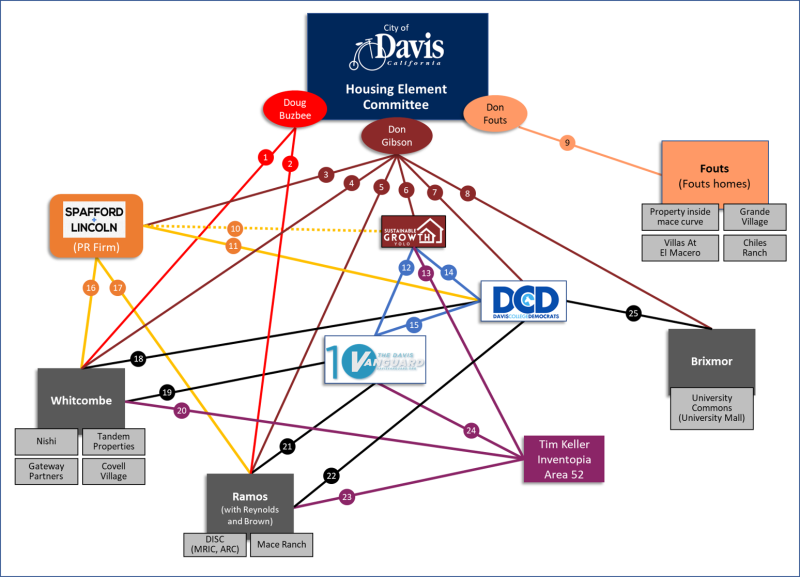
    The Davis Housing Element Update Committee (HEC) had its final meeting on May 26th where they voted to pass 10 motions that, if ultimately adopted, would radically change the development landscape in Davis. The recommendations include abolishing the 1% annual growth cap, doing away with single-family (R-1) housing zoning, removing checks, balances and public input from the approval process, and several other radical developer-friendly proposals. Neither staff nor the public were informed ahead of time of this discussion by the Committee. These radical proposals have since taken up most of the discussion at 2 planning commission meetings, and at the Davis City Council meeting on 6/15. To understand where these recommendations came from, one needs to understand the committee members and the web of developer and real estate interests surrounding the Committee. This chart helps paint that picture.


    (more…)

  • Civility, Facts and the Arroyo Park Zip Track.

    Zipline
    By Joe Krovoza

    At 7:40 pm Saturday evening (6/12) Janet went out to our backyard to pick greens for dinner. She heard a man say "…and that's where the nasty terrible people who hate the zipline and hate children live." [best possible paraphrase] Janet looked over the fence at who was saying this and there was a man standing there with his dog and children. He saw Janet and said something like, "and there's the terrible nasty woman who hates children." She said, "Excuse me? Would you like to talk?" (not threatening, certainly incredulous) but he ignored her and continued walking and talking to his children, repeating "that's the nasty terrible woman who hates children."

    She was deeply shaken. Is this okay? Can’t we respectfully agree to disagree?

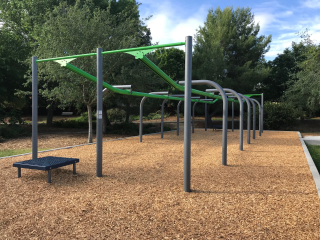
    Casual zip track users and park visitors have no way of knowing how the sound of the zip track travels through our backyard and home. It comes, uninvited, into every room of our house every single time someone is on one of the two tracks. It is not a pleasant sound. It is metallic and jarring. It is impossible to focus on ordinary tasks while it is happening. Or to sleep.

    (more…)

  • Proposal to Eliminate R-1 Single Family Zoning is a Terrible Idea

    Housing

    Dear Davis City Council, Planning Commission, and Social Services Commission Members,

    I would like to take a moment to address the idea of removing R-1 single-family zoning that is popular with developer interest groups and YIMBYs at the moment. This radical policy change would allow investors to buy single family houses in any neighborhood in the city and replace them with 4-unit or more multi-unit complexes. A good way to look at this type of proposal is as deregulation and trickle-down housing. The removal of R-1 zoning is often suggested by these pressure groups as a panacea for creating affordable housing and ending homelessness. There is mounting evidence that this is just not true, and I strongly recommend you read this article on the downfalls of trickle-down housing. https://www.housinghumanright.org/trickle-down-housing-is-a-failure-heres-what-you-need-to-know/?fbclid=IwAR2a_TkSVF0Zlb6pSMrZ7n3fL3SfLHAh354XQN3NZZuL6TNs85r5eST5iqc

    In Davis we have a large demand for rental housing. That demand coupled with an abolition of R-1 single-family housing zoning will result in investors converting single family homes to 4 units or more (per lot) of student rental housing that will be leased at top dollar. This is most likely to occur in what are currently the most affordable neighborhoods, like Davis Manor. These are also the most diverse neighborhoods. This will increase the cost of housing in these neighborhoods. This is the opposite of creating the affordable housing that deregulation advocates claim will come as a result of their trickle-down theories. Deregulation will hurt the people who need affordable housing the most.

    (more…)

  • Unequivocally Bad Solar Panel Placement at Cesar Chavez Elementary .

    This letter was sent to DJUSD on June 8.
     
    Redwood tree
    Dear Matt and Facility planning team,
     
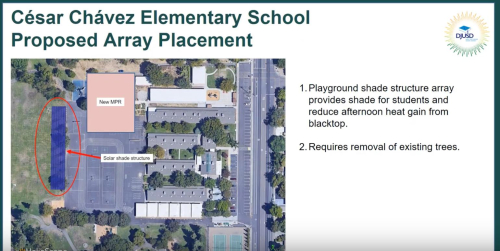
    I just saw the proposal for the placement of solar panels at CCE and it is unequivocally a bad placement.
     
    The panels will cover the existing grass at the edge of the blacktop thereby creating more of a barrier between the grass and the blacktop.   This necessitates the destruction of two massive and iconic redwood trees.    Removing trees in itself is not a problem – if the result is inescapable.  In this case, it is not an inescapable result to place the solar panels in that suggested location.
     
    The video clearly says that the benefits of this placement include  only 2 things.
     
    Benefit 1) providing a solar shade structure.    This is not necessary if there were more trees on the grass AND if those trees were maintained AND if the children were allowed to use the grass and the pathway during school hours.  Did you know that kids at CCE are not allowed to use their own school yard (the grass) during recess?  Did you know that the trees that were planted at the edge of the track are mostly dieing? 
     
    Benefit 2)  Preserving Blacktop.   Preserving blacktop is not a value of the community at large and nor is it a value of the parents of CCE, were you to poll them.  Preserving play space is important, and blacktop is important for certain kinds of play – but preserving it at the expense of creating what effectively amounts to a barrier between the children and the natural space of the field (where they should be allowed to play) is not a long term postive vision.
     
    There are at least 3 other areas where the Solar panels could be placed.
     
    1) On top of the new MPR.  Why are we building a new building that apparently cannot hold solar panels?
     
    2) Shading the portable classrooms on the south side of CCE Campus.  These roofs would benefit from the shade and the industrial structures on campus would not take anymore of the campus footprint.  In fact, one could imagine the solar array shading any number of buildings on the campus in whole or in part.
     
    3) Over the parking area.  Wouldn't the teachers appreciate a solar array over the parking area to keep their cars cool?
     
    I don't claim to speak for anyone but myself on this issue.  However, I do believe I have a good sense of the pulse of the community.   This placement will be met with massive pushback from the community and I strongly recommend reconsideration as soon as possible.
     
    Best regards
    Joseph Biello
    Parent of CCE Student and Neighbor
     
    _____
    the DJUSD video mentioned in the letter can be viewed here https://www.youtube.com/watch?v=uUn0h5tukbo
     
    CCE Solar
     
  • Commission Process, please

    AmidalaSenate

    Todd Edelman, former member of the BTSSC, undated photo – https://www.starwars.com/databank/galactic-senate


    Dear City Council, City of Davis,

    I've a few concerns, questions and proposals for you in regards to this Thursday's City Council Subcommittee on Commission Process (Special Meeting)…

    Questions and Concerns

    1) Why is there no actual content in the report prepared for the meeting?

    2) How can the public critically comment when we don't even know the actual, detailed content of the meeting until the beginning of the meeting? The immediately subsequent public comment period comes before everything else – not like typical general public comments at the beginning of the meeting – so will there be an opportunity for the public to respond to anything in the way they typically respond to a staff and/or e.g. developer report before Council or Commission discussion?

    3) Is this also intended as a meet & greet for the many Chairs who have never met each other as a way to encourage pro-active or facilitate requested collaboration – not a bad thing!

     
    PalpAmidala

    Former Commissioner Palpatine, opponent of the Brown Act; Edelman. https://www.starwars.com/databank/galactic-senate


    4) Item 4 includes "… Intent is to allow Commission Chairs to share recommendations, tips, concerns, ask questions of staff or the Council Subcommit-tee, etc" BUT when did the Chair or Vice-Chairs solicit such information from their Commissions?

    (more…)