Davisite Banner. Left side the bicycle obelisk at 3rd and University. Right side the trellis at the entrance to the Arboretum.

Category: Uncategorized

  • This Jew Says “Bring back the ‘Christmas Tree’”

    I identify as culturally Jewish. I lived in Prague for many years. Most know that Jews and Jewish culture were largely erased from what's now the Czech capital and much of central and eastern Europe from the 1930's through the 1980's.

    In Prague and all over Czechia, "Christmas" as such has various traditions, most of which are similar to those in the USA. One thing which was quite unusual was the public selling of carp in public squares or similar areas. In the days up to Xmas, many would buy them and bring them home and put them in their bathtub for a few days before killing and eating them; others – probably more – had them bludgeoned to death in the street before bringing them home.

    It was not pleasant to watch the second example; many Czechs would argue that fish had a very undeveloped nerve system and wouldn't feel much, and in any case it was not worse that simply buying meat at the market.

    I don't like cooked carp. However, if this was a Davis tradition and E St Plaza was filled with tanks of water and carp and so on, I would still not get offended, more specifically to take special offense because I am Jewish (Jews were never deported from Davis, so that element is not an issue!).

    What IS deeply offensive however, in Downtown Davis, is the "Holiday Tree". For starters, it's clear that this name for a winter pagan symbol for Christmas came about a couple decades ago because the State is not supposed to be involved in Religion. So it's thought that "Christmas Tree" is inappropriate. In schools there is education about different holidays that happen at different times of the year, though official holidays are another thing!

    The deeper problem is the second issue, which is somehow Hanukkah, the Jewish "festival of lights" is only coincidentally around Xmas, and has no connection to it, at least historically (it's more consumerist in the USA, likely because of its proximity to the western Christian holiday – Eastern Christians observe it some weeks later, they use a different calendar – so there is a bit of a relationship, fine… though for myself and some other Jews it's a more modest affair – and while about a "miracle", it's not a religious holiday.)

    The deepest problem is that the evening event traditionally connected with the Holiday Tree in Davis has almost zero Jewish anything. There's lots of Santa, songs and so on – some of which is not happening this year. Even the menorah lighting in Davis this year happened at the Cannery – in Prague, Chabad does it in one of many square in the city center. So if you're gonna call it a Holiday Tree – make it about everything happening around now – Diwali was not so long ago, tonight is the fifth night of Hanukkah, Xmas isn't for more than three weeks, then there's Gregorian New Year (like "Chinese New Year", though it's really the East Asian Lunar New Year…). There's also Winter Solstice – in the northern hemisphere -  obviously already connected with Christmas, but I think deserving distinction. One idea – to justify the felling and display of another tree in – or connected with Davis politics – is to make it truly inclusive and supporting of an inclusive event. But when there's no real connection between a holiday and another, the celebrations should be independent.

    So as a Jew I am happy to celebrate Western Christmas with my fellow Christian, Christianish or other non-Jews. After Gregorian New Year, please take down the "Holiday Tree". Permanently. Next year, please put up a "Christmas Tree" in Downtown Davis.
     

  • Call it what it is: Fireplace Terrorism

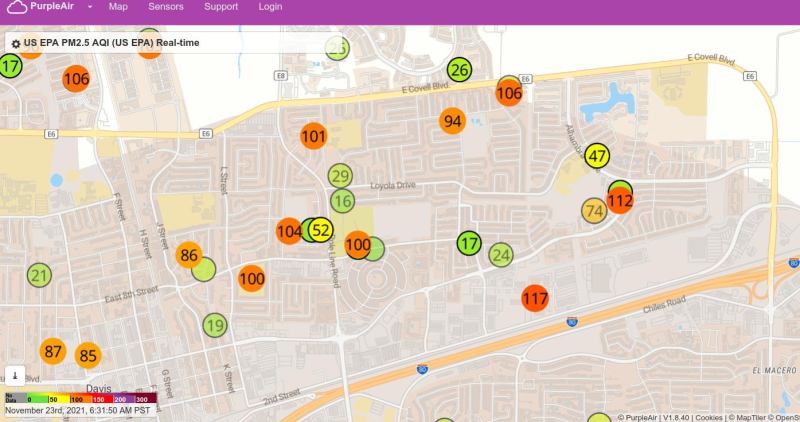
    112321paToday, DAVIS fireplace terrorists in Davis have continued success in making the air as bad as during wildfire season.
     
    As most fireplaces are used by wealthier residents, and most homes with inadequate HVAC are lower income, it's economic and racist oppression.
  • Criticism of failure to restore strong affordable housing policy draws attack from Carson

    Sterlingby Colin Walsh

    I delivered this comment to the Davis City Council on 10/19/21 and received a very unprofessional attack from Council Member Carson in return. The comment was given in relation to the "Affordable Housing Ordinance – Extension of Alternative Rental Housing Requirements and Preliminary Scope of Work for an Update of Affordable Rental Housing Requirements" agenda item in which the Council voted to extend the weak interim inclusionary affordable housing ordinance.

    —–

    On February 6 of 2018 the Davis City Council approved the 2nd attempt at the Nishi project. This project had what has proven to be an unworkable exclusionary affordable housing that forces people accepted into the affordable housing to sharing a room. What’s worse is the combined cost of the two people who share the room is higher than that of market rate single room.  Worse there are only 264 affordable beds out of 2200 beds. Beds not units. Most of the market rate is not shared.

    (more…)

  • Hiding the DISC 2022 EIR update

    DISC2022 Secret2 Comments to City Council on 9/22/2021 regarding the DISC 2020 EIR process

    ————

    Dear members of the Davis City Council,

    I would like to object to the way the City is doing business in relation to the DISC EIR.

    On the consent calendar of tonight’s agenda is a staff report detailing the actions taken by the City Manager while the council was in recess. Buried on the last page is a single line item disclosing that the City Manager approved almost $100,000 for an addendum to the EIR for the DISC project.

    Previously, approval of this type of contract was done by council and the staff report revealed important information to the public about the EIR process. Several of us objected at that time that it was not enough information, and this time around we have even less information. The City should not advance the EIR of a major project like this – in secretive ways.

    Further an addendum is not appropriate because there are significant new factors that have not been considered by the previous EIR.

    1. There are changed circumstances due to COVID and how office space is used. This must be analyzed in the new EIR.
    2. The new project has a much Higher proportion of the project dedicated to freeway adjacent retail. This is likely to have larger impacts on the downtown and must be studied. 
    3. The previous biological surveys are now outdated and need to be redone.
    4. Further revelations about the severity of climate change and how that will affect the project both in terms of adaptation and mitigation should also be considered in an update to the EIR.

    Therefore, I also call on the Council to set a public scoping meeting for the new EIR immediately.

    Please  ask that this item be pulled from the consent calendar and instruct the City Manager to immediately make the contract with Raney and outline of work be made public.

    Thank you for your Consideration,

    Colin Walsh


    ———-

    Roberta Millstein, Consent calendar, item 4 D

    Buried in this item is a line of a spreadsheet showing that the City manager approved payment to Raney Planning & Management to prepare a CEQA addendum for the new DISC 2022.

    Two years ago, this approval was its own consent item, with documentation supporting the recommendation, and it had to be pulled from consent at the request of citizens.  Two years ago, staff originally thought an addendum to the previous EIR would be sufficient.  Then they said a supplement would be required – a higher level of analysis.  Some of us objected this still wasn’t enough.  Then they ended up needed to do hundreds of pages of a more detailed Subsequent EIR. 

    It seems like the same mistakes keeping being repeated – at the last meeting, I and others highlighted the rushed process for DISC 2022 with not enough commission input, and now again with both old and new DISC we have a truncated EIR process without enough justification and transparency for the proposal to do just an addendum.

    We still haven’t been given much information about this project, yet we are being told again that an addendum to the EIR will be enough.  The pandemic makes everything uncertain, particularly traffic and office occupancy.  They will need to figure out a way to project for that.  Downtown businesses are even more financially precarious and so the impact to them needs to be reconsidered.  And of course the biological surveys need to be redone, particularly for sensitive species such as the burrowing owl and various bat species.  Finally, the impacts of drought, fire, and smoke in our area due to climate change have become evident; these must be re-evaluated as well, especially in light of the loss of potentially mitigating agricultural land and increased traffic.

    I request that this item be pulled from the consent and that the City manager be instructed to immediately make public the contract with Raney and outline of work to be performed.

    I further request a public scoping period, including a public scoping meeting, on the updated EIR.

    Thank you.

  • Sutter Tree Removal Sets Terrible Precedent

    Sutter lotA letter to the Davis City Council from Don Shor

    To the members of the Davis City Council,

    This letter is in support of the appeal by Alan Hirsch of the tree removal permit, issued for Sutter Health, for the removal of 63 trees in order to make room for the installation of solar panels in their parking lot.

    My concerns are about the process, the city’s overall policy for tree conservation, the efficacy of the mitigation proposed, failure to account for the value and many intangible benefits of trees, and the disturbing precedent of valuing solar panels over trees.

    We need a discussion of the city’s commitment to an adequate and sustained urban tree canopy, clarity about which commissions would be best for actual oversight on an advisory basis, and how the process of removing large numbers of trees should be evaluated by staff, commissions, and the council.

    Process.

    I do not fault the city staff for this. These are policy issues that have been brought to the fore by the sheer number of trees being removed via a single application. There should be some threshold at which a removal that affects the city’s urban forest to this extent is not simply done by administrative review.

    Mitigation.

    The proposed mitigation needs to be evaluated by tree professionals. The recommendation by the NRC that the mature trees be moved reflects this lack of expert input. It is unlikely to succeed and would be a misdirection of resources.

    Better planting of their entire parking area would be a better use of funds if it were done correctly. That includes new trees to shade as much asphalt as possible, with consideration given to the reduced options due to the presence of solar panels and shading issues. More open soil areas are needed to improve infiltration of natural rainfall and allow successful root development. Climate-ready landscaping should be installed wherever trees can’t be planted.

    In fact, the city’s overall tree removal mitigation strategy needs to be evaluated with a particular emphasis on parking lots, both because they are especially important for urban heat island effect and because few, if any, of the parking lots in Davis meet the city’s 50% shading requirement.

    (more…)

  • New Petition to fix Mace Mess reaches 700 Signatures

    Mace mess2

    A new petition to restore Mace Blvd south of I-80 has been circulating recently. This week it reached 700 signatures.

    You can see and sign the petition here:

    http://chng.it/Ry7fQx96


    text of the petition follows

    The petition summarizes our problems and requirements for Mace restoration.  Since this is a summary of the responses to a survey I recently sent out, it of course doesn't include each individual's favorite fix, but I hope it is close enough so that you-all would be willing to sign. 

    As two years’ experience has demonstrated, if we don't tell the City what we want, heaven only knows what they'll do.   If you are a south Davis resident and want the Davis City Council to fix Mace, please sign.     

    Thanks!

    Char  

    PETITION TEXT 

    Introduction 

    The City of Davis’ initial rationale for the Mace Project was incorrect.  This social engineering experiment on an established neighborhood to constrict the major traffic artery between north and south Davis and “force residents out of their cars” failed to recognize that all the neighborhoods affected have a high percentage of retirees and commuters who cannot lead their daily lives on bicycles even if they might wish they could, no matter how much pressure the City applies.  The result is an intrinsically flawed design. 

    South Davis residents have been living with the safety issues and problems caused by the current Mace Boulevard configuration for the last two years, and the problems, especially gridlock, are returning as people return to offices to work post COVID.  Regarding the Mace Mess, as of 5/27/21, the City’s webpage states “the County and City representatives will follow up in a few weeks to review any questions or clarifications from the County. A community meeting will follow with date and time to be announced. Further updates will be posted once the City and County representatives are able to meet again.”  

    I have advised the City that south Davis residents require adequate lead time before this meeting, that is, at least a week advance notice.  It is not reasonable to expect residents to study and understand a cryptic road diagram during a 2-hour in-person or Zoom meeting, then comment on it in two minutes.  In addition to posting on Nextdoor and the City webpage, the City should email people from the email addresses on the sign-in sheets from public meetings from the last two years.  The City must post copies of the plans to be presented on the City webpage, on Nextdoor, on Facebook, and attach them to the emails sent out to the mailing list at least a week before meetings, so people will have time to understand what is proposed.

    Survey 

    Recently south Davis residents were surveyed about what they want to see done with Mace Boulevard.  Most of the features in the current Mace configuration are designed to take up roadway in an attempt to turn Mace into a residential street. 

    The City has approximately 80 acres of infill property in central Davis on the north side of the freeway that would be perfect for the sort of residential/shopping/bicycling urban design the City has unsuccessfully attempted to force on south Davis residents.  The City needs to fix Mace and then focus on applying this design to Davis proper, where it would be more feasible and appropriate. 

    Following is a summary of the survey results. What needs to be done is really very simple.

    Summary 

    Required Design Changes in Order of Importance to Respondents (MOST IMPORTANT FIRST)

    1. Remove all bike lane curbs, the concrete maze on the west side of Mace from Cowell to Redbud, and all rock pile islands.
    2. Restore both NB and SB second vehicle lanes on Mace from Cowell to Redbud.  Remove the suicide lane and use the roadway real estate to restore the second lanes.
    3. Restore sweeping right turns at Mace and Cowell; provide adequate turn pockets at other intersections. 
    4. Elevate bike lanes (providing sloped  curbs) and merge with pedestrian walkways
    5. Design considerations:
    6. Bi-directional bike lane on West side of Mace from Redbud to Cowell; no bike lane on East side of Mace, or
    7. One-directional bike lanes on West and East sides of Mace from Redbud to Cowell; travel direction aligned with vehicle traffic. 
    8. Reduce the width of all crosswalks and move them closer to the corners so that drivers have a clear line of sight when attempting to turn.
    9.   San Marino Lights:
    10. Design considerations: 
    11. Remove massive San Marino light poles and refit San Marino lights with standard poles with RYG lights;  program them so that they do not signal when there is no cross traffic, or
    12. Retain triple pairs of lights, but fit light poles with sensors so that they only flash when there is cross traffic. 

                                     iii.    Install pedestrian/bicyclist crossing buttons. 

    1. When the second NB and SB lanes are restored to Mace, south Davis residents who are actual traffic engineers recommend that the City not plan on installing additional lights and high-tech sensors to the south until the results of the above changes are tested.  The expensive technology might not be necessary. 
    2. Taper lanes from 2 SB lanes from San Marino to Montgomery to 1 lane; increase NB Mace lanes from 1 lane at Montgomery to 2 lanes by South El Macero Dr.
    3. Add merged bike lane/sidewalk on the east side of Mace from Cowell to Chiles.  
    4. Whoever owns the oleanders on both sides of Mace should keep them trimmed up over head height or remove them. 

    RESIDENTS' COMMENTS AND QUESTIONS   

    1. Most respondents liked the County’s innovative idea of elevated/merged bike/pedestrian lanes, although there were some questions:

           o   Some (not all) bicyclists felt that bi-directional bike lanes were more likely to cause accidents than one-way bike lanes.

           o   Some residents asked whether bike traffic should be required to travel in the same direction as vehicle traffic, regardless of bike lane design. 

    1. Some residents asked if bike lanes would be necessary on both sides of Mace, especially if a bi-directional bike lane is built on the west side from Redbud through to Cowell.  
    2. All residents (and especially residents facing Mace in the El Macero/N. El Macero to Redbud area) find the bike curbs and maze in this area dangerous and dysfunctional and want them removed.  This would also restore ADA access and residents’ on-street parking, as well as provide passage for agricultural equipment. 
  • Petition on “ CANNERY TRAFFIC SAFETY MEASURES” circulates

    67417B2B-838E-48ED-8289-0539B771DC52An online petition is being circulated regarding traffic safety in the Cannery development. As of this post it has garnered 133 signatures in just a few days.

    You can view or sign the petition here.

    The petition reads as follows:

    The current traffic conditions in the Cannery are dangerous, and we need increased traffic safety measures implemented as soon as possible. We have many children and elderly residents who do not currently feel safe in their own neighborhood, and there have been recent accidents and near-misses due to the lack of adequate traffic safety measures currently in place. 


    Areas of special concern we would like to see:

    • Stop signs at Blanchard & Vine (currently a four-way intersection with no stop signs)
    • Stop signs at Spring & Kaneko (currently a four-way intersection with no stop signs)
    • Cannery Loop: Speed limit signs, stop signs, and/or speed bumps (currently no safety measures in place)
    • Pedestrian crosswalks: increased safety measures (e.g., flashing lights)
    • Engineering and traffic survey throughout the Cannery, as there are numerous other safety concerns throughout the neighborhood that the City needs to evaluate

    Thank you for your consideration and prompt attention to this matter.

  • Gary Lee Yoder Remembered

    Northern California 60s legend Gary Lee Yoder, of The Oxford Circle, Kak and Blue Cheer, passed away this weekend from numerous health complications. His friend Alec Palao remembers one of the coolest rockers around.

    It’s not easy to explain why Gary Yoder was, and is, important. As nonchalant as the man could be, he had that intangible quality that is the sign of true artistry. Gary wrote simple but effective songs and delivered them with disarming confidence and a most soulful set of pipes. A Yoder tune could wistfully ponder ‘I’ve Got Time’, vent full-on hormonal rage in ‘Foolish Woman’, or play the psychedelic nudge-and-wink in ‘Lemonaide Kid.’ His vocal personae could snarl like Burdon or Morrison, extrude vowels like Dylan, or mimic the gentle cadence of Donovan. But these were influences, not imitations: Gary Yoder had very much his own style, and he remains one of those talents whom for whatever reason never made the transition to the big time. Instead, his legacy centres around his role as founder member of two legendary and distinctly different cult acts, time spent resuscitating a San Francisco rock institution, and a subsequent career that saw four decades of solid work as a much respected solo act and bandleader in his hometown of Davis, California.

    An army brat who had spent his youngest years in Germany, Japan and various parts of the United States, Yoder ended up in Davis in 1961 when his father got a job at UC Davis. As a musician, he started with the expected folk music, but having always loved rock, he formulated a band together after graduating high school with pals Jim Keylor, Dehner Patten and Paul Whaley. This was The Hide-Aways, who soon shifted from small Davis gigs to take on the much more competitive group scene in nearby Sacramento, where surf was king. “We never did any Beach Boys or any of that kind of crap,” Gary told me. “We played Chuck Berry!” The quartet was equally fired by the British Invasion, and especially the rough soul of groups like the Animals, Yardbirds and Them. By the beginning of 1966 they had become The Oxford Circle, named for the girls’ dorm on the UC campus, and an appellation more than appropriate for the unit’s Anglophilic predilections.

    (more…)

  • A cautionary tale about commenting on the Vanguard

    DoxxingBy Ron Oertel

    I've recently learned that the “Davis Vanguard” is not a safe place in which to comment, unless you don’t mind experiencing doxing in violation of the Vanguard’s own policies, which are further discussed below.

    When I first started commenting (several years ago), “real” names were not even required.  Some suspected that more than one fake name/account was used, by some individual commenters.  I have always used my real name, and added my last name when the Vanguard changed its policy to require full names.

    However, no one “signed-up” for doxing as a result of that change in commenting requirements.  Perhaps this result is predictable on a political blog in which moderation occurs “after” posting of comments – if at all.

    In any case, the Vanguard is also a place to avoid if you don’t like having your comments labeled as racist by those intending to discredit others (which I’ve learned to laugh about).  You can see a recent example of the latter responded to herefrom the same commenter who is being defended by the Vanguard in regard to violating their own policies.  So, if the doxing doesn’t discourage you from challenging the Vanguard, perhaps having your comments labeled as “racist” will.

    Perhaps it’s not a “coincidence” that the commenter whose name-calling and doxing attempts (also) repeatedly attacks me in regard to development issues that the Vanguard supports.  But this article isn’t primarily about having comments called “racist”, and the example above occurred after I decided to write this article.  Nor is it actually about the commenter himself – it’s about how the Vanguard administers its own policies, especially when its views are challenged.

    (more…)

  • Late 1860s brick building in Davisville

    Building on 4th and G

    Photo of Building on 4th and G

    From the Hattie Weber Museum
    Submitted by museum volunteer, Aaron Wedra

    Digging through historic records, our museum staff came across a great photo of a brick building built around 1868 in what is now downtown Davis.

    The building was located at the corner of Fourth and G Streets, formerly Third and Olive (see map of Davisville below).

    Map of Davisville

    Original town plat of Davisville, 1868 (redrawn in 1968)

    The building served as the post office, bank, store and general meeting place for community members.

    It has been said that it was once owned by William Dresbach, Davisville's first postmaster in 1868. The building is said to have lost its usefulness over time, until it stood vacant and was razed from the ground, condemned as unsafe in 1926.

    Thanks to John O. and Lillian Rowe for donating a copy of this historic photo to the Davis Historical and Landmarks commission in 1973.

    Information for this post was collected from Phyllis Haig’s Portraits of the Past Collection, which contains clippings of articles written by Joann Leach Larkey and published in the Davis Enterprise from 1969-1973 as a supplement to the book Davisville ’68: the History and Heritage of the City of Davis, Yolo County, California (1968).

    Come visit the Hattie Weber Museum, open every Saturday from 10am to 4pm, located at the corner of Central Park at 445 C Street in downtown Davis.