Davisite Banner. Left side the bicycle obelisk at 3rd and University. Right side the trellis at the entrance to the Arboretum.

Category: Transportation

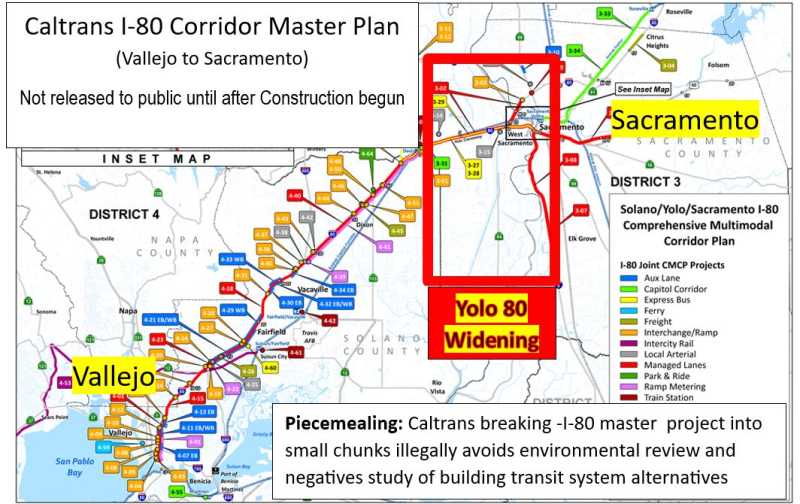
  • I-80 update: Caltrans proposes cutting mitigation for Phase I

    Image001 1525

    by Alan Hirsch

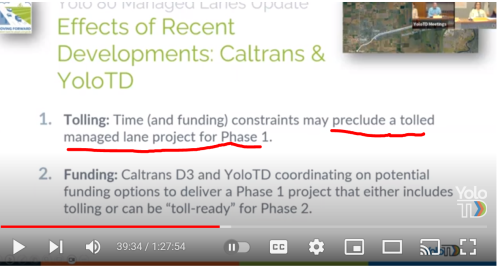
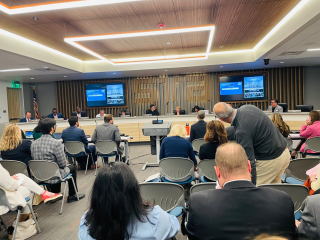
    1. At the Yolo Transportation District (YoloTD) board meeting 7/17, it was shared that Caltrans is considering a plan to save the I-80 widening project by trimming it back from $210m to the $86 mil fed funds they have so they can spend them before the funds time out: Their plan would be to widen a few miles of the freeway as HOV without adding tolling infrastructure.  i.e., no source of revenue for more transit or other mitigations. This is the core project Caltrans assumably was after anyway as they originally had Congress ear mark the $86m in grant money to only be used for an untolled  HOV lane.  Assumably full tolling and mitigation would be implemented when and if money for a now larger Phase II is found sometime in the future.
    2. YoloTD staff using Caltrans numbers have said even a complete 17mile long HOV lane would be congested day 1. Arguing now for a widening just a short section blows apart any logic that Caltrans want to fix a “bottle neck”.
    3. Three of the five YoloTD members objected to Caltrans toll-less plan for the new lane expressing concern they want money to spend locally. Board member Jesse Loren of the Winter Council was very concerned about not having toll lane revenue funds for a social equity program- assumably a program needed to mitigation of inequity of having that self-same toll lane. At risk for Davis is the Micro transit service- i.e.  93% subsidy required for $40/trip service as well as financial help the developer of the Nishe project and downtown Davis.
    4. Most Board members asked how much widening they can buy after inflation impact cutting the buying power of the money. Lucas Frerichs raise a question if a CEQA environmental lawsuit might slow or stop the project (response: likely not if EIR is certified by Caltrans but it could retroactively affect the mitigation program and tolling policy.)
    5. The board raised no question about staff’s Plan B other that cuttings scope: i.e. fund the phase I  short fall created when California Transportation Commission failed to fund on 6/26. YoloTD Staff report noted they were considering local Muni-bond or obtaining Federal FHWA Loan to be guaranteed locally. YoloTD staff said this is still being explored but the time frame is challenging.(see previous Vanguard article)
    6. Silence continues on the Climate Change Elephants in the Room: In discussions by YoloTD Board that night, the terms Climate Change,  VMT, GHG or induced demand were not used in reference to-I-80 project.  There was no acknowledgement or response to letters by Professor Stephen Wheeler, signed by 20 Davis resident on climate change asking for reopen EIR with transit alternatives or a similar letter by Professor John Johnson of CSUS.
    7. No one directly acknowledge or publicly responded to powerful letter from head of National Center for Sustainable Transportation Professor Susan Handy that said based on decades of studies the I-80 extra lane- even if tolled — won’t fix congestion but will hurt the environment. This letter was privately shared with the board but not shared with the public (see coming Vanguard article that will reprint it)
    8. YoloTD chair Tom Stallard gave a statement “for the record” He references generic “letters” which might include that from Wheeler and Handy.  Not bothering to reference any science to studies, he that the board need to be realistic and simply widen the freeway as this would fix congestion.  He used examples of his grandchildren’s need to get to piano lesson and sporting event as evidence of important needs that need be addressed. His argument is a tour de force of how common sense should overrule science out of the university. No member of board contradicted his statements as chair. Tom Stallard is one of the richest men in Yolo County having given over $50,000 to the Mondavi Center, so a managed toll lane that never congests would work well for his family to avoid congestion.
    9. Josh Chapman, the Davis Council rep failed to show.  Davis City manager/council does not seem to have appointed an alternate-to YoloTD unlike other JPB bodies the city is a party to.
    10. -I 80 Draft EIR release will again be delayed again to the end of August per Caltrans statement at YoloTD meeting. Caltrans originally scheduled the DEIR to be release in January of 2023. Caltrans has no email list to inform stakeholder of delays and does not update such information on the project’s website, so continue to read the Vanguard or Davisite to keep informed.

    The Meeting: Video of July 17, 2023 board meeting is at  https://youtu.be/O7odnLgxuF4  The I-80 agenda item begins at 33 minutes in. Tom Stallard’s statement that effectively denies university science of “induced demand” is at about 1:06


  • Letter to Yolo County Transportation District concerning adding a lane to I-80

    July 14, 2023

    Board of Directors
    Yolo County Transportation District 350 Industrial Way
    Woodland, CA 95776

    Dear YCTD Directors:

    We write to express our concern about Caltrans’ plans to add a lane to Interstate 80 between Dixon and Sacramento, referred to as the “Yolo 80 Managed Lanes Project.” Such freeway capacity expansion will raise greenhouse gas (GHG) emissions and vehicle miles travelled (VMT) in the I-80 corridor while inducing motor-vehicle-dependent suburban sprawl. It is contrary to GHG-reduction goals set by the State of California, the Sacramento region, Yolo County, and many local cities. Any congestion relief will be short-lived due to induced demand, as shown by many past freeway expansion projects.

    At your meeting on July 17, 2023, we request that you ask Caltrans to study additional options for this project that would substantially improve transit, keep freeway capacity within current limits, stabilize or reduce VMT, reduce GHGs and local air pollution, and improve equity.

    Such options might include

    (more…)

  • Breaking news: Yolo I-80 Widening Not Funded!

    Advocates who steamrolled project scramble to save it

    IMG_8626

    The June 28th California Transportation Commission meeting in Suisun gave out $3.3 billion with mantra “get it built”.  It was standing-room only, squeezing 15 commissioners on the dais, 20 staff and 60 local transportation agency officials from around the state in a room 2/3 the size of the Davis City Chambers. Activists should note that while the monthly meeting location moves from venue to venue around the state, the public can zoom call in. Photo by Alan Hirsch.

     By Alan Hirsch

    The Yolo I-80 widening project was not given the missing 54% funds ($103 million) at the California Transportation Commission meeting (CTC) on Wednesday 6/28. This means the initial $87 million earmarked federal funds for the project will be lost as it will time out before it is spent. At least this was what was represented on 6/6 to Davis City Council.

    At the June 6th meeting the Council wanted to delay the EIR to add transit options, but were told this was not possible, due to the fact the initial money would time out if EIR was completed and an alternative chosen by January 2025. What was not discussed with Council was the $87 million in earmarked Federal money could ONLY be used for widening, i.e. was a pre-wired choice from congress. So if an EIR instead choose a transit alternative that Davis want to add, it might have be a poison pill for the funding already lined up.

    Was this knowledge behind what was going on that evening when Davis Council attempted to interrogate the EIR project alternatives, and add a new one, but was discouraged?  We may never know. But it’s a new process now.

    CTC Meeting is the Major Leagues

    I was the only “civilian” public commentator speaking on this or any projects at the CTC meeting though there were many letters from public opposing Yolo I-80 project were received. It notable no one showed up in favor of project– or submitted late letters of support (note: some Yolo Cities had quietly written letter for support in winter and spring 2023).  A  number of local agencies reps and elected official from elsewhere in the state comment uniformly support on their projects, which affirm CTC staff recommendation  to fund. I note even a state Assembly member called in a comment – he was monitoring the 4-hour meeting.

    The CTC gave out $3.3 Billion, so funding the $103 million gap in the Yolo80 project was almost rounding error. The I-80 project itself got no CTC commissioner questions or discussion. Not surprising as it was one of 48 in the "Trade Corridor Enhancement" tranche – … item 17 on 18 item agendas just that afternoon. There were only funds for 25 of the 48 in that tranche so it was competitive, but rarely are CTC staff suggestions overruled.

    (more…)

  • Council bamboozled at 6/6 meeting

    I-80I-80 Widening rated last for funding by Caltrans.

    By Alan Hirsch

    Preface: Just 46 hours after Davis Council was forced into a shot gun wedding with Caltrans on the Yolo80 freeway widening, the gate keeper organization on transportation projects, the California Transportation Commission (CTC) staff made public a: “do not fund”  recommendation. The next chance for making up these state matching funds is in 18 months. It would be unusual if the staff recommendations are overturned at the June 28th CTC meeting.

    * * *

    On January 6th, ignoring 21 public comments unanimously opposing it, the Davis City Council voted 3-1 to take the first step to go along with the I-80 widening project. The majority decided to listen to YoloTD Vice Chair Josh Chapman and it’s staff. This vote supports the city partnering with Caltrans to sell out our goal of zero carbon for Davis: Caltrans will get to use our “good” GHG-reducing projects to justify the additional GHG caused by the freeway widening. Caltrans’ carrot was to offer funding (amount unknown) to help developers of both the Nishi housing development and the housing proposed in downtown Davis.

    As reported in the Enterprise article 6/10, the council voted this way even though they were uncomfortable with how the widening undercuts our local climate change plan. Among the complaints made by public were calls to remember the city’s climate emergency resolution.

    Only Councilperson Bapu Vaitla remained skeptical of what was represented to council and voted no — i.e. to protect the city’s plan to go to zero carbon.

    (more…)

  • 5 City/County Climate Commissions Are Being Sidelined

    Best way to handle inconvenient truth is to not talk of it

    Image003 323

    By Alan Hirsch

    This week the well-meaning volunteers of Yolo County’s Climate Action Committee will be hosting three open houses to collect public input.

    However, I think these volunteers, like climate committee volunteers on 4 other Yolo County cities, are being distracted from the elephant in the room.

    Image001 1516

    Is the Davis CAAP just performative if freeway widening can’t be discussed in Davis by our climate committee?

    Each of the five Yolo government’s Climate Act Plans note we need a plan to dramatically reduce auto driving if we want to address our greenhouse gases (GHG), the source of 65% of Woodland  and 69% of Davis’s GHG. For example, the city of West Sacramento plan set a goal of reducing driving 40% by 2045 by a shift to transit and active modes.

    Yet, the proposed widening of the I-80 Freeway is projected by UC Davis researchers to do the opposite: encourage more driving and longer commutes forecasting 177.9 million more miles of driving each year. This means an increase in the county’s carbon footprint by 3%- larger than the entire City of Winters.

    UC Davis research also demonstrated, like all past widening, this $380 million project one won’t fix congestion for long: the freeway is 100% certain to re-congest after a few years due to more car travel the widening it itself encourages.

    Yet not one of these five climate commissions have discussed this project and its tradeoffs or have a plan to provide input to Draft Environmental Impact Report (DEIR) in July.

    It is not the volunteers on these committee’s fault: it about city and county staff who haven’t put it on their agendas.

    This is accomplished by the freeway advocates embedded in government who claim to want public input but actually discourage it by spin:

    (more…)

  • Reject Caltrans So-Called Mitigations to I-80 Widening & Support Rail Transit Investment Instead

    I urge residents to attend the City Council meeting this evening to speak against the Davis City Council supporting the widening of I-80, and instead supporting investment in the parallel intercity rail corridor.  [The item comes up at 8:15 pm]

    An Open Letter to the Davis City Council

    2023-06-06

    Dear City Council Members:

    I am writing to you today as a citizen of Davis.

    You are being asked to approve three letters of intent with the State of California, regarding supposed 'mitigation' for the increased air pollution resulting from the widening of I-80.  I urge you not to sign these letters and instead send a strong message to the State of California opposing the widening of I-80, and instead to actively support a massive investment in intercity rail transit.

    Davis lies on the Capitol Corridor rail line between Roseville and San Jose.  Plans are being developed for a new rail crossing between the East Bay and San Francisco that would allow Capitol Corridor trains to access the Peninsula directly.  Plans are in the works for a new tunnel between Martinez and Richmond to allow the removal the curvy section of the rail line along the Bay to protect the corridor from sea-level rise and speed up that section by ten minutes.  Plans are in the works for hourly and half-hourly rail service within an 18-hour service window.  Plans are in the works for 110 m.p.h. trains using hydrogen, overhead electric, or battery-hybrid electric equipment.

    What these plans lack is funding and state commitment.  The State of California's stated policy is to fund alternative transportation and reduce VMT & GHG.  Yet actual State policy speaks through its funding allocations in expanding highways under the guise of adding 'managed lanes' which the State admits will add to air pollution in the case of the I-80 widening project.  Under what reasoning can Davis support this?

    The so-called mitigation to fund infrastructure for Davis developments is called 'support' in the documents.  That any given development will actually contribute to a reduction in pollutants is a theoretical exercise based on models that are not specific to Davis.  The true effect can only be known once such developments are occupied and the transportation choices of residents known.

    The so-called transit mitigation is to fill a need that may or may not exist.  The need for a micro-transit program in our small town, or the need for a vague 'increase' in public transit has not been studied, nor has the overall effect on pollutants.  Davis is being asked to support questionable, theoretical and insufficient mitigation for a project that the State admits will increase pollution.  This goes against Davis' values.

    Transportation is the #1 cause of air pollutants.  This is largely because of automobile dominance.  It can be difficult as City Councilmembers to turn down 'free' State money, but in this case you indeed must turn that money down.  To give support to the I-80 widening would be to support the continued mass funding of road widening and automobile supremacy.

    Instead, I urge the City Council to make a strong statement to the State of California against growing the auto-centric transportation status quo.  I urge rejecting the mitigation and 'partnership' in highway-widening and instead writing a letter to the State in support of massive investment in intercity rail transit. 

    Tell the State to leave I-80 over the Causeway as it is, retaining two shoulders on each side in each direction for safety.  Then ask the State of California to divert the billions of dollars in current and future highway funds intended for Interstate 80 expansion to instead fund the expansion and improvement of the parallel Capitol Corridor passenger rail service from Roseville to San Jose.

    I thank you for hearing me,

    Alan C. Miller

  • Will local electeds ignore UCD and buy into Caltrans’ Science Denial on VMT & GHG?

    Inconvenient truth

    Open letter to Davis BTSSC (Transportation Commission)

    To: Chair Jessica Jacobs and members, Davis BTSSC

    From: Alan ‘the Lorax’ Hirsch

    RE: Potential Endorsement of I-80 Yolo widening before Draft EIR released

    BTSSC will be asked tonight (item 6b) to endorse a letter to partner with Caltrans to endorse I-80 widening by supporting a new and untested program of mitigation that could negate local cities’ greenhouse gas reduction programs (CAAP/CAP).[i]

    You will be asked to sign before even seeing the draft Environment Study (DEIR) or the mitigation plans. This is not due out for 30 days.

    I urge caution based on the study by Professor Susan Handy’s group at UC Davis Institute of Transportation Studies. (ITS)

    The below bar chart from that UCD ITS study[ii] compares induced travel projections by Caltrans to the forecast by the National Center for Sustainable Transportation model. Caltrans’ lower forecasts in the EIRs were used to justify spending hundreds of millions of dollars on these five projects. The study shows Caltrans consistently understates the amount of travel & GHG to be mitigated. And in two projects Caltrans assumed no induced demand.

    Induced demand has been accepted science in the transportation world for over thirty years now. The science was upheld in the 1990 California case Citizens for a Better Environment vs Deukmejian, et al. [iii]  It was an inconvenient truth Caltrans has worked three decades to get around. It was not until the beginning of 2020 after the 2013 passage of Bill SB 743[iv] that EIRs had to focus on reducing Vehicle Miles Traveled (VMT).

    Caltrans has been in denial of the science on traffic, which has been confirmed by hundreds of studies out of UC Davis, UC Berkeley, and the Texas Transportation Institute, among many other places worldwide.[v]

    (more…)

  • Letter from DISC developers to Davis Automobile Association

    AutoCenter
    It took some digging but I found a key letter from the DISC developers to the City of Davis Association of Private Motor Vehicle Sellers and Suppliers:

    Dear CDAPMVSS,

    Following are what we plan on the primary characteristics of DISC in regards to your organization’s mission:

    1 – Most of the day a connection by private automobile to Downtown Davis, UC Davis and West Sacramento will be extremely convenient and fast.

    2 – A private automobile will be required to conveniently and quickly travel to Pioneer Elementary, Nugget (on Mace) and surrounding stores, and of course to the Davis Auto Mall (identifiable by its bicycle logo from I-80).

    3 – Travel by cycling and walking to Harper Junior High and Korematsu Elementary will be significant until a crossing guard is killed and two students are injured at the intersection of Alhambra and Mace. In response we plan to place small posters at bus stops in the area to direct drivers to slow down. We were going to pretend to compromise and pretend to return to our spoken-only agreement the construction of a grade-separated crossing of Mace but in the end the Council didn’t ask for it.

    4 – Travel by automobile to schools outside of east Davis will be the majority mode, especially to Davis High School, and drivers will threaten students crossing E. Covell to get to Birch Lane Elementary, crossing F and 14th to get to North Davis Elementary and the high school.

    5 – The TDM plan will determine that carshare is not interesting for nearly all residents who have opted to rent a parking place near their home.

    6 – Caltrans has confirmed that they have no interest in assisting in building a safe and dedicated bicycle and pedestrian facility across I-80 in the vicinity of Mace, similar to their same position on the I-80 Managed Lanes project.

    7 – Some residents will ride cargo bikes to Target and surrounding shops until a user is killed at the corner of Mace and 2nd.

    8 – The Chevron station at Mace and 2nd will gain business.

    9 – Mode share of the fare-free shuttle to Davis Depot and Downtown will be insignificant due to duration and inability to match fluctuating schedule of Capitol Corridor trains due to problems outside of their control, such as shipping traffic on the Carquinez Strait that requires bridge interruption.

    Thanks, the DISC development team.

  • DISC 2022 Transportation – Planning Commission falls for Developer’s Trick

    TrapBacThe trap was set likely shortly after "DISC  2020" was defeated by voters.  When the developers of this peripheral sprawl – or I'll be nice and call it West West Sacramento – were planning to re-introduce it last year for a vote this year – they realized that a key demand was a grade-separated crossing of Mace. So they removed it from the Baseline Features… fully-intending to agree to do it as a concession.

    Back story

    The City Council-approved Street Standards (2016) don't mention e-bikes at all. What this means is that the width, curvature, and proper siting of infrastructure that would optimize the use of e-bikes – in particular the Type 3 variant that has assistance up to 28 mph – is totally missing in Davis, or more immediately in concepts, plans as well as development agreements and baseline features in current and near-future projects.

    To address this, over two-and-a-half years ago when I was on the Bicycling, Transportation and Street Commission (BTSSC) I got support for adding an item to the long range calendar which would address it; this first appeared on the LRC in September 2019, with a possible date of December 2019 for the agenda. (It is abbreviated somewhat erroneously as "intersection design guidelines / standards"). It has been pushed back repeatedly since then, and the BTSSC did not support forming a sub-committee about it during 2020.

    What this means is that significant concepts and projects which could alleviate transportation problems, such as Reimagine Russell, the new-ish Class I multi-user path on the south side of Russell (chronically and clinically-referred to as a "bike path) or smaller projects all over the city are not future-proofed for the increase of modal share for cycling we desperately need to improve everything from climate impacts to conviviality to fitness to transportation crashes. Our city is simply too large now in size to have a significant modal share with "acoustic" bicycles. Not convinced? Look at the low bike modal share from peripheral areas of town in the UCD Campus Travel Survey, which shows low share even for people with campus destinations where car parking is not always convenient, and not fare-free. It's not hard to extrapolate – necessary, as the City has essentially refused to do its own counts for years – that almost no one regularly rides from Mace Ranch or some other peripheral areas to Downtown for a coffee or beer – sort of the most normal thing in the Universe in a bicycle-branded cycling city.

    SurveyCycling

    UCD Campus Travel Survey 2019-2020 (pg. 30) – By bike, DISC is just over four miles from ARC, a central point on campus when considering agricultural facilities. This distance has about a 10% modal share for cycling, and includes mostly students, many who don't have their own cars.

    However, as we can see from the example above, the faster type of e-bikes are quite expensive. I've seen nothing lower than just over $3,000. Though important – or all – major arteries in Davis – should be optimized for this type of bike – the idea is not only to optimize for them but make safe for all users, including on acoustic bikes – it cannot mean that this type of bike should be essentially required to live here and enjoy the purported high quality of life. Infrastructure optimized for fast bikes is also a significant improvement for all bikes, as it's direct, requires a minimum of stops, is not shared with motor vehicles… or pedestrians and dogs.

    To be more precise, the goal should be the 15-Minute City. This is a relatively new standard or classification of a very, very old sometimes organic strategy to make key locations in a city within 15 min from anywhere else, for all means of transportation. This seems to also serve as a kind of proof of the bicycle modal share results in the Campus Travel Survey. It's definitely something that should be part of our new General Plan, or even worked on earlier by a joint Commission process (BTSSC, Planning… perhaps Natural Resources and Social Services…). I would argue that it should also be about effort, so a 5 or perhaps 7-minute walk is the equivalent of a 15 min bike ride. I've said that if kids can't walk unaccompanied 5-minutes from where they live to buy ice cream cones, it's a failure (and that's just one example, a single ice cream place or a truck at DISC doesn't make it sustainable.)

    It's also quite important to be reminded that the City of Davis has for over four years not had a senior civil engineer with a transportation focus. Many projects have gone forward – sometimes to completion, often with significant flaws – without the benefit of this experienced and wise counsel.


    Last Night

    At the Planning Commission review of Disc 2022 last night – and early this morning – I was actually quite impressed by the comments from multiple Commissioners regarding negative transportation issues of the planned project, and even the general discussion about its unavoidable impacts and uncertainly of benefits from transportation demand management… well, at least earlier in the discussion. Commissioner Shandy was particularly right on with her criticism of planned widening of Mace – presented by the developer as a kind of unquestioned religious observance – contradicts claimed benefits for people cycling and walking. There were other positive and thoughtful comments by a majority of Commissioners.

    I knew that the grade-separated crossing of Mace was a kind of sneakily-hidden prize and tried to point out in my sort of sloppy recorded comment that that a safer crossing of Mace would not on its own make DISC 2020 excellent for cycling (this is better than "cycle-friendly"), because of distance from Downtown and places further west, and besides that, safe crossings directly to the south along Mace across 80 would cost many millions and be very complicated (and at least in my head I know that Caltrans District 3 and the Yolo County Transportation District have withdrawn the earlier plan – it was supposed to be built first! – of a new bike and ped bridge across the Bypass as part of the I-80 Managed Lanes Project.)

    Screenshot from 2022-01-13 02-14-21

    Just an aside about the bandied about "globally-known sustainability of Davis": This was the air quality last night shortly after the meeting was over (via Purple Air)


    The Trap is Sprung

    Though it was fully-intended to be a positive thing and I will give credit to Commissioner Shandy, the discussion and lead-up to a vote turned sour when she proposed that a grade-separated crossing of Mace and a Class I trail across the undeveloped land south of Harper Junior High would make her feel better about the planned Mace widening and other traffic impacts. She suggested nothing about safe cycling and walking connections to other places, such as the Nugget and popular restaurants across 80. But the problem is that, for example, the area planned for housing at DISC 2022, on the north and eastern side of the project area, is more than 15 minutes away by bike from Downtown and at leat 20 to 25 minutes away from the UC Davis campus that is the raison d'être for DISC 2022! Moreover, the route has almost no optimized cycling infrastructure the whole way (varied from local streets to arteries, no protected bike paths, lack of priority at stops, etc… there is no proposal for any of this in any proposed development agreement or baseline features). But mainly it's too far by bike… never mind walking! Most of the time people – with free or with un-bundled parking – will take I-80 between campus and DISC, even more so to many facilities etc on the west side of campus related to agriculture. I-80 is such a fantastic route much of the day that nothing can compete with it, including shuttles and express buses, which I am sure will at best have a tiny modal share.  This creates huge challenges for any development more than 15 min away from key locations, and it means simply that they should not even be considered. (Oh, wouldn't it have been great if staff were directed to work on the General Plan and told the developers that there was no capacity to work on stuff that would very likely be in violation of a progressive outcome for it?)

    So the Planning Commission has recommended the two elements mentioned above that are supposed to address problems on Mace to the City Council. My conclusion is that the developers will signal their intention to accept them – perhaps with a little drama – and the Council will praise them for doing so. But again, even with everything promised (e.g. shuttles, TDM) and not promised (e.g. e-bike-optimized infrastructure) there's still no place for DISC. Still no way to successfully do something better than I-80 via private vehicle for anything but a minority. There's really nowhere to walk to from DISC. Hopefully the voters will see through this ruse and others and reject DISC 2020.

    Galadrieltempted

    In the ALTERNATIVE timeline, Lady Galadriel was tempted by but in the end did not succumb to the Power of the Grade-Separation ring


    Denethor

    In the REAL timeline, Lord Denethor, Steward of Gondor, was consumed by the Grade Separation Ring and driven mad.


    Question

    Last night I was quite surprised when the developer said with much conviction that baseline features were not necessary to enforce the creation of certain designs and programs at DISC 2022, as these would be required by CEQA. Then why have baseline features as a solution for any of these things, in all the discussion for years up until now? If a reader could enlighten me I would truly appreciate it.

    Afterword

    I am all for more housing – for all income levels, but with a significant proportion below market and lower income – and workplace and related development in Davis. I have never said I was against these things in any local discussions, for example in the Davis Vanguard. But they have to be infill, they have to be on greyfields such as parking lots, industrial areas along 5th St – not only the PG&E yard – and in the eastern side of South Davis and other areas much closer to Downtown and especially for what DISC 2022 purports to be about much closer also to campus. With electric shuttles on fixed routes, optimized cycling infrastructure, a new connection across 80 around L St., mixed-use above (existing) parking lots and so on many if not close to all of the actual benefits of a project like DISC 2022 can be realized. It's not impossible, it's not rocket science, it simply requires conviction, creativity and less b.s. and false claims about sustainability. Hopefully Council, Commissions… local media… and organizations such as Bike Davis and Cool Davis re-direct the citizenry towards an alternative to DISC or a truly sustainable version of it… closer to and integrated with the City of Davis and the UC Davis campus.

  • History of Davis’ Train Station

    By Aaron Wedra, Marketing Coordinator for the Hattie Weber Museum

    In 1864 it was determined that the California Pacific Rail Road would extend eastward from Sacramento over the Donner Summit route to become part of the transcontinental rail line.

    The “Cal-P”, as it was familiarly known to early-day railroad builders, was incorporated in January 1865, and was principally financed with British capital. Construction began at Vallejo in December, 1866, and the first rails were laid at the same place on April 10, 1868.

    Planners for the California Pacific Rail Road Company decided to build a line from South Vallejo to Sacramento which would also connect Marysville and Woodland at a junction in Davisville. Construction and grading of the rail bed began in Vallejo in December 1866 and the first rails were laid in April 1868.

    The construction of the first Davis depot began in July 1868 and the first passenger and freight service between Vallejo and Davis Junction began on August 24th, 1868. The fare was $3.00.

    (more…)