The militarization of gardening?
A conversation about the proposed – and not – restrictions on toxic micro-particle hyper-distribution - a.k.a. “leafblowing” – by three of your favorite local activists!
(COVID is Part I)
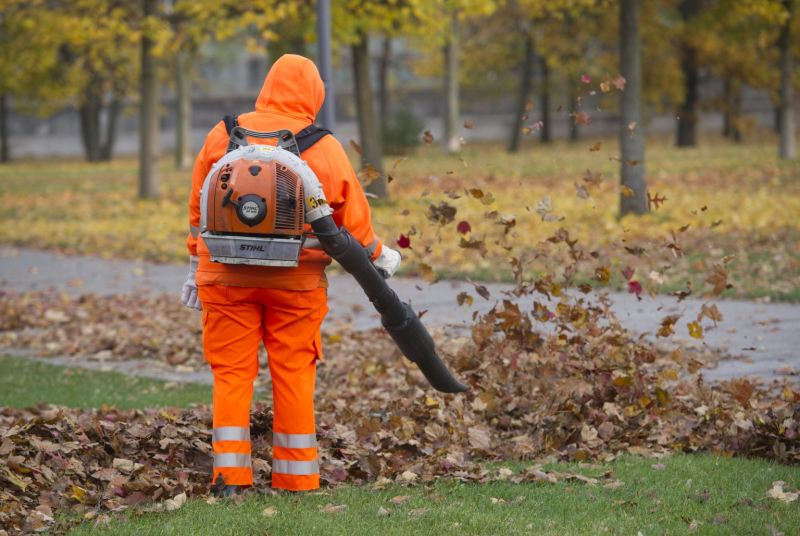
This evening the City of Davis Natural Resources Commission (NRC) will hold the first of two hearings on possibilities for leaf blowing restrictions. Here’s the memorandum – a supplement to Council’s approval of temporary leaf blowing restrictions from last October. It includes Commission and Staff proposals and results of the surveys on leaf blowing taken which were taken in June.
In summary, they are proposing a gas LB ban, time restrictions and user restrictions. Staff and Commission (sub-committee) proposals are broadly similar.
What’s very important, however, is that there is a strong likelihood that there will be a complete ban at the state level on gas-powered equipment such as lawn mowers, edgers and so on… including leaf blowers and vacuums, or combined units. This means that any equipment-related ban in Davis that only affects gas blowers will be nothing unique in just a couple of years.
The meeting is at 6:30pm
Leaf blowing prohibited on this day?…
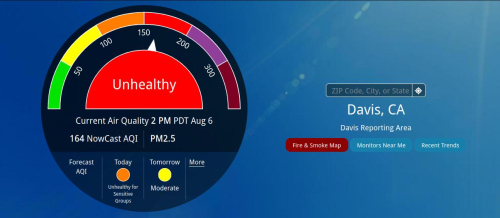
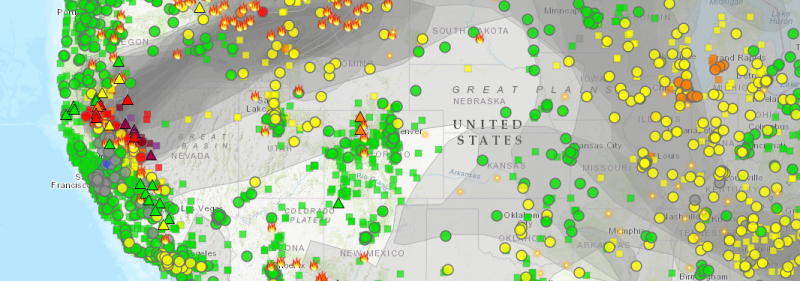
AIR QUALITY and wildfire fallout:
Todd Edelman: There is no explanation of why the air quality-based restriction due to wildfire fallout is based only on official AQI according to current City policy. For example, the very popular and relatively inexpensive Purple Air system could be used. And Purple Air isn’t only used at private residences: The UC Davis environmental engineering dept has one on its roof for experiments. Lake County Air Quality Management District (AQMD) uses them for official monitoring outside of wildfire situations. The New Jersey Transit Authority seems to also use them for official purposes. Sutter Davis Hospital has them on their roof and inside. The elementary school at Beale Air Force Base has one, as does the Yolo Solano AQMD office in south Davis – they say they use it to recognize “trends”.
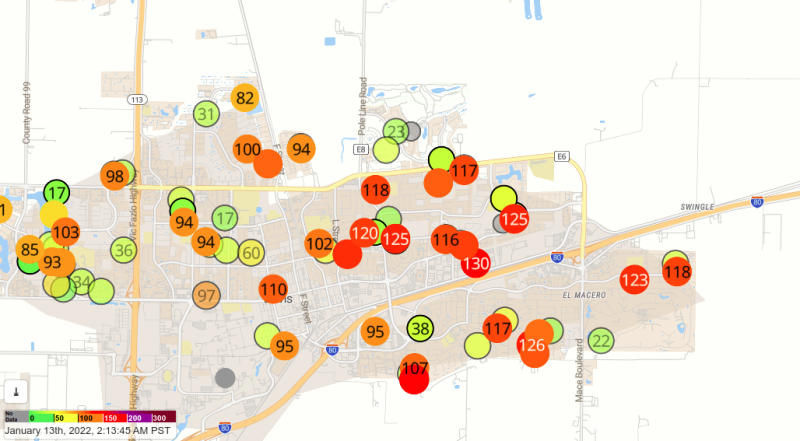
But perhaps the most important use of Purple Air is to determine local impacts of leaf blowing…
Nope… no new restrictions if the air's bad AFTER 7:30am…
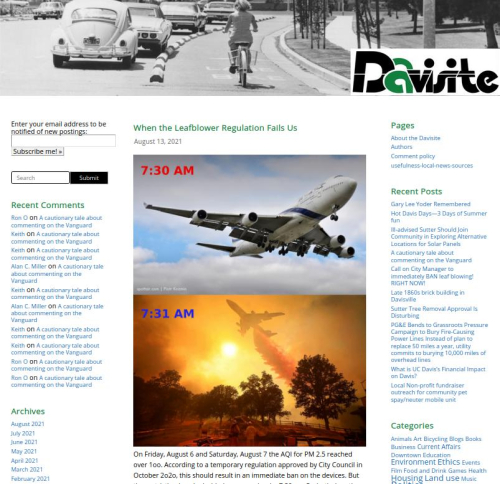
Darell Dickey: I have trouble with the concept that we can only ruin our air quality when the air is otherwise pretty good. We’re going to avoid dirtying the air when it is already bad? And then there’s my favorite part: Blowing will always create a local situation of AQI over 100, which should result in an immediate ban on blowing.
I’m thinking that a good, logical way to present this is that if we’ve all agreed that 100 AQI is “bad enough” for us to ban activities that make it worse, then we should never be allowing the use of devices that make the AQI 100+. And this circles back to local air quality vs. relying entirely on one spot of data that’s outside of town to determine what we’re breathing in our neighborhoods at any given moment.
If AQI 100+ is bad anywhere, then stop creating AQI 100+!
TE: There is nothing about how they determine how much ash is on the ground, though this is a condition of the lift of any AQI-based restriction according to current City policy. I have voiced this concern many times.
There were several times when the official AQI went over 100 during the day but not before 9AM; this was not mentioned in the memorandum, though I brought it up repeatedly in August in emails to the NRC.
LEAF-BLOWING, WILDFIRE SMOKE AND COVID-19
The proclamation from October 2020 that resulted in temporary leaf-blower restrictions mentions “COVID-19” 10 times, yet the current memorandum only mentions it once, and not directly in relation to smoke effects on those with who have COVID. Further, the October 2020 mentions no specific research at that time on wildfire smoke and COVID, but there’s new research not mentioned in the memorandum.
AIR QUALITY, general:
TE: As far as I can tell leaf vacuums distribute lots of dust, and as they pick up inorganic matter as mentioned in the memorandum, I don't see how they will be allowed. But still, do people think that these things work as HEPA interior vacuums?
DD: True. But “lots of dust” from a vacuum situation is still way better than any blowing. It all needs to be in perspective as we’ll never arrive at “perfect.” Same way that electric cars aren’t perfect, but are better than gas cars, etc.
TE: Well, I think at least all the most dangerous and invisible stuff comes out the back…
DD: “Most dangerous” is not easy to defend. If the crap being stirred up produces a violent health reaction (allergies, asthma, etc), then the acute “most dangerous” thing is probably coming out the front. At least for those people who are severely affected.
The only way to call any of this “better” is if less crap is being put into the air…. As compared to doing it another way. And IMO, a vacuum is better than a blower. And leaving stuff where it is, is better than all of it. The timing of the device usage is also important. I vacuum up deep leaves to mulch them and put them where they’ll help the yard vs. choke the plants. And I do it when the leaves are not dusty. It is a relatively benign activity.
Purple Tahoe
LABOR:
TE: There's no suggestions related to the labor issue except for what may eventually be affected by a ban on gas-powered blowers. What are their wages, by the way? This is a basic question for labor related actions or studies.
DD: I hate the question where they ask the company how much it will financially destroy them. Of course the answers are all opinion, but it is presented and answered as fact.
TE: Yes they should give figures or something. Is there possible funding from AQMD to transition out of all leaf blowing?
DD: Also, a significant percentage of landscaping businesses do not use any blowers.
TE: Why is this? How is this influenced by opinions of consumers and of workers or their managers/companies?
DD: From what I can tell, the biggest concern from the citizenry is that they may have to pay more to the poor, under-paid folks. You know… the folks that they’re really concerned about harming with…. low wages.
Asking the yard-care business owners how bad it will be if blower use is restricted is like asking El Macero drivers how bad it will be if Mace loses one of its travel lanes. It is a total guess. It is based on everything else not changing. And they simply have no idea what the result would be. Might be higher health and better hourly wages for everybody. But of course most claim that it will just be devastating to their business. I didn’t hear one response about how it would be better for the workers who might get paid more for doing healthier work.
TE: I’ve repeatedly brought up this part of the issue, not only with the NRC, but also the Social Services Commission — it needs to agree to provide feedback. Though leaf-blowing is not a job based on sustainable practices, there are many related jobs which are, and they require a higher skill-set. Tree trimming, building on-site composting facilities, triage of soil situations? No one should lose their jobs.
LABOR AND PHASE-IN:
TE; There seems to be no scientific reasons for only phasing out gas blowers in City properties except for protecting some companies. Nothing about increasing wages, etc. The proposed start date Jan 1 (2023) is after most of the "leaf season", and over two years since the temporary regulations came into effect. This seems to be about giving enough time to buy new equipment, but this seems like a tiny expense compared to labor.
Purple Nation
VIBRATION (Sound):
Roberta Millstein: You two are rightly focused on the air quality. But for a broader audience, you might also mention that these things are f*cking loud. Really f*cking loud. And that is for some a big part of why they are hated.
TE: I know that traffic noise is very bad for human health. One thing that’s worse about leaf blowing noise is that it can be unpredictable, especially if one’s neighbor is doing it — but then also who memorizes the leaf blowing schedules of their neighbors or their yard sterilization services?
While most electric leaf blowers are quieter than gas-powered ones, it’s not guaranteed. And if an electric leaf blower is less powerful than a gas one, people may use it for longer.
OTHER:
DD: And the main reason that some give for the “need” of leaf blowers? No other practical way of clearing large paved parking lots.
TE: Exactly, what are uses of LB's in terms of square footage or acres, etc?
CULTURE:
TE: Yard work is good exercise if the air is clean. It connects one to their yards – even in a rental property – that other exercise outside cannot.
Leaf blowers and vacuums didn't exist in significant numbers until what, the 1980's? What did people do before that? Die, in their yards, under piles of leaves?
EFFECT ON TREE AND SOIL HEALTH:
TE: In the Memorandum there's nothing from the Commission or Staff in the recommendations about the benefits of leaving leaves where they fall, even though it’s already recommended on sources linked from the City's Tree pages and others.
The Tree Commission will hopefully offer feedback.
EXAMPLES / Best Practice in Other Places:
TE: There is mention of the other jurisdictions which have done partial to full bans, but not by name. They clearly have this list. There is no indication how many suffer significant wildfire fallout, though as many are in California certainly some have, and there's an assumption about why most didn't respond. Two have complete bans… who are they?
EFFECT ON OTHER USERS OF ROW (street, greenbelt, or another public space):
TE: There's nothing about how use of blowers contributes to the always non-permitted piles of yard waste in bike lanes. At the October meeting of BTSSC we need to pressure them into agreeing to providing an opinion on this, especially as a related item on yard waste in bike lanes has been sitting in the long-range calendar for many months as TBD. This issue has been going on for many years.
Proposed ban during the week is only til 8AM, even though many are commuting to school or work by then, by pedal or foot. So then they will be exposed full-on as they traverse the City.



 Bac
Bac



I have aural nerve damage in one ear and so have had to, out of necessity, learn how sound affects the human body. Loud sounds can cause me splitting headaches emanating from the inside of the ear, severe ringing in the ears, internal ear pressure, disorientation, burning, aural misinterpretations, etc. Sound frequency, duration, distance, peak-volume and distortion all factor into the severity of an 'event' as I have come to know them.
Though dependent on particular circumstances, in general shorter bursts of loud sounds are more damaging than longer duration of softer sounds. That is why going with some sort of 'averaging' system would be a tragic mistake. This would ignore the very real damage done by peak sounds. My world-renowned ear doctor from Stanford Ear Clinic would back me up on this. He has coached me on how to live with my condition, which is not treatable.
My ear doctor explains that there is a 'threshold' level at which the noise becomes damaging to hearing (in my case, the threshold is much lower than those with a healthy ear). The PEAK noise is almost always the problem. Therefore, changing the city noise ordinance to consider some AVERAGE measurement as the standard is not only unwise, it is INSANE.
To give an example of how unwise this is, an example everyone can understand – consider train horns. A train horn — at 100' in front of the horn — ranges from 96 to 110 db. Even at the low end this is painfully loud, and on the high end can cause ear damage in just a few seconds. But, if you averaged the railroad noise around the tracks over a period of hours, it would show very low AVERAGE noise as over time there are few trains. The PEAK noise is when the damage is done; AVERAGING OVER TIME would FAIL to CATCH the DAMAGING peak sounds.
While I am more bothered by sound than those with healthy hearing, ear disease is rampant and hugely under-diagnosed in this country. There are many people with my condition and many other hearing diseases who are intolerant of various sound conditions. This is not just about an annoyance, it is at times debilitating.
Another thing to consider is that those close to a noise source suffer from the exposure repeatedly and over time. Those adjacent to noise sources are the people who must be considered paramount and above all else. Let's say a nightclub with sub-woofers goes in next door to someone's house. But ON AVERAGE less than 1% of the people in town even hear the noise. The standard must be on how the noise effects those adjacent, not on the fact that 99% of Davis voters never hear it. Another abominable use of 'average' exposure.
I urge the commission, the City, and the Council to retain current noise-ordinance formulas and standards, and reject any attempt to change the noise ordinance to be more allowing of harmful peak noise exposures.
Sincerely,
Alan C. Miller, District 3