[This Op-ed article was originally published in the Davis Enterprise on March 22nd in response to February 18th Davisite and Davis Vanguard articles in which Alan Pryor asserted that valid concerns related to contaminants associated with the proposed Village Farms Davis project, are “myths”. This is a slightly modified version of that article.]
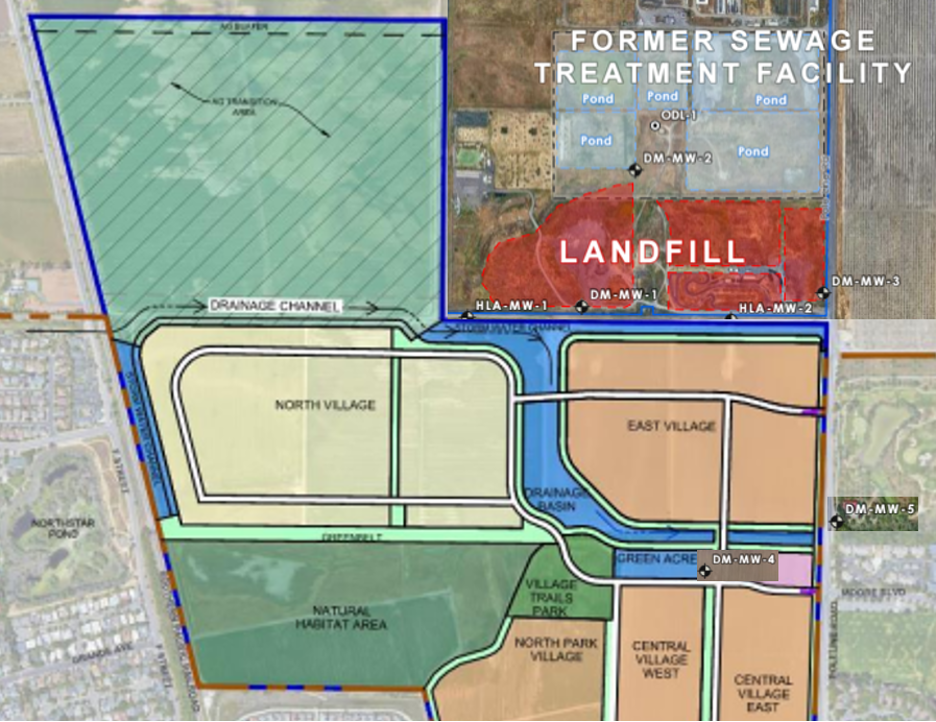
This map from the Draft Environmental Impact Report, which was not included in the Davis Enterprise Op-ed article, shows Village Farms proposed drainage and housing adjacent the Old Davis Landfill/Burn Dump and Sewage Treatment Plant and monitoring well locations. The liner discussed in the Davis Enterprise op-ed article and the Partial Draft Response to EIR Comments does not appear in the Development Agreement or Baseline Project Features.
By Steven Deverel, Marjorie Longo, and Robert Okamoto
There was a recent attempt to dismiss contaminant risks related to the proposed Village Farms project in north Davis. We herein summarize data and potential risks related to contamination from the adjacent Old Davis Landfill, Burn Area, and Wastewater Treatment Plant.
First, it was posited that contamination from the landfill has dissipated, per and poly fluoralkaline substances (PFAS) are not a health issue and that Village Farms Davis will not be built on the landfill.
There is no perfect project and there is no perfect time. But, there are good projects that come at the right time. Such a project is Village Farms. There are a few reasons I will vote YES for Village Farms.
First, Village Farms is contiguous with the City and I would label this site infill. It is surrounded by The Cannery, F Street, Covell Blvd and Poleline Road. While this land is farmland and has been planted under tomatoes, wheat, corn over the years. It is surrounded by our community on three sides and is ideal for development.
Second, the property that Village Farms sits on is in the sphere of influence created in 2008. What is the Sphere of Influence? “The legislature created the mechanism a “’sphere of influence’ (SOI) as a means for planning of probable physical boundaries and service areas within a local agency…SOIs are designed to both proactively guide and respond to the need for the extension of infrastructure and delivery of municipal services to areas of emerging growth and development.” Village Farms (formerly Covell Village) is largely within the City’s SOI. This means we as a community, former Councils as well as City Staff, have thought for decades about the areas of future growth and this is one of them.
I have been a fairly consistent opponent of most peripheral development projects in Davis over the past decade. For instance, I was the Principal Officer, Treasurer, and Chair or Co-Chair of the No on Nishi 1 (Student Housing), No on West Davis Active Adult Community (Senior Housing), and both the No on both DISC 1 and DISC 2 campaigns (primarily Commercial).
All of those peripheral annexation measures failed except West Davis Active Adult Community. But none of these projects provided for family housing for modest income buyers. I think Davis desperately needs that type of family housing and I believe the Village Farms Davis project provides it so I support the Project.
As a result, I recently both publicly endorsed the Yes on Measure V campaign and was a co-signer of the Rebuttal to the Argument Against Measure V that will appear on the June ballot.
Many folks that I had previously worked with opposing other projects have accused me of abandoning my slow-growth and/or environmental principles after hearing of my endorsement of Village Farms Davis or reading some of the articles I have published about various environmental aspects of the project. Some are saying it is inexplicable to them why I would make this seemingly sudden change in my views toward peripheral development and endorse this Project.
Well, the reasons are actually pretty simple. I opposed past peripheral development projects because I did not feel any met all of the 3 primary criteria that I look at when considering supporting or opposing a project. And the reason I can now support Village Farms Davis is because I can now check-off each of the boxes for the same 3 criteria – 1) the Features of the Project itself, 2) the Location of the Project, and 3) the Quality of the Developers of the Project.
With the for and against ballot arguments for Village Farms and their rebuttals posted to the County’s website (as Measure V), and the campaigns starting to ramp up, I thought it was important to highlight what are technically known as the projects Baseline Features. These are available as part of the “Full Text of Measure V” on the County’s website, and I encourage Davisites to take a close look at them, but I wanted to point out a couple of things first.
Most important to note is what it means to be a Baseline Feature. As the text of the Measure itself clarifies:
Beyond the Baseline Project Features there are other additional requirements for the Project, including but not limited to, the mitigation measures set forth in the Village Farms EIR, and the Development Agreement that, while important to the Project, are not Baseline Project Features and may be modified with the approval of the City after the appropriate public process (emphasis added).
Another way of saying this is to point out that only the Baseline Features are guaranteed parts of the project. Anything else can be changed with a vote of the City Council — and here one should keep in mind that membership of that future City Council could be somewhat or even substantially different from today’s City Council. Thus, anything that is not a Baseline Feature is not a guaranteed part of the project.
And even then, it’s important to read the Baseline Features carefully, as some of us learned when Bretton Woods was able to jettison its promised memory care facility. Let me give an example that is tied to one touted feature of the project that is of great interest to many voters: Affordable Housing.
The rebuttal to the argument against Measure V states that the project will have “360 units serving very low to moderate income households.” But is this true?
In an earlier article, I posted the for and against arguments for the Village Farms project. The rebuttals to each of these arguments are now available on the County’s website, and I have pasted them below. Village Farms is subject to a Measure J/R/D vote of all Davis citizens and has been assigned as Measure V.
Here is the rebuttal to the argument in favor of Village Farms that will appear on our ballots in June (the rebuttal to the argument against follows after that):
This post is to just let people know that the arguments for and against the Village Farms project are up on the County’s website. The rebuttals to the for and against arguments are due by March 3; I will post them at some point afterward. Village Farms is subject to a Measure J/R/D vote of all Davis citizens and has been assigned as Measure V.
Here is the argument in favor of Village Farms, i.e., in favor of Measure V, that will appear on our ballots in June (the argument against follows after that):
The City’s handling of the proposed noise ordinance was good in some respects and quite bad in others.
First, the good: At Tuesday night’s meeting, led by Mayor Donna Neville, the council agreed that the noise items weren’t an ordinance clean-up item and that they deserved a true staff report and separate consideration. The noise ordinance (Chapter 24) items were pulled from the Consent Calendar and Item 4B’s noise ordinance “clean-up” will come to the council at a later date.
I am grateful to the Council for hearing the Davis citizens who emailed and gave public comment concerning the noise ordinance. (Previous Davisite articles about the proposed changes can be found here and here).
Now for the bad: This should have never been on the Consent Calendar in the first place, which is for noncontroversial items that do not need discussion. I’m not quite sure how or why it was put there, or why the Council passed it unanimously at its “first reading” (Tuesday was the “second reading”), but to me it’s a continuation of a “trust staff implicitly” mentality. I hope that this is a sign that the Davis City Council recognizes that it (the Council), not staff, is the responsible party who we voted for and that oversight is needed.
Another concern is the way that comments emailed to Councilmembers were handled. I received a reply from Barbara Archer, the City’s “Public Information Officer,” asserting (in essence) that the concerns I raised were not valid. There are several problems with this:
Opponents of Village Farms Davis have made numerous misleading and/or outright false claims about the Project and its supposed adverse environmental impacts on Davis and its residents. Their allegations are made without almost no quantitative supporting data from independent, verifiable 3rd-party sources to support their claims. Unfortunately, these naysayers instead rely on speculation and innuendo to attempt to disparage and denigrate the proposed Project.
This article is the first in a series that will present detailed information that factually refutes each of these untrue “myths” and false allegations made by project opponents . This first article summarizes the false claims and provides a brief summary response followed by a more in-depth discussion refuting some of the allegations that require additional information to refute them. Subsequent articles in the coming weeks will further address some of these false claims in much greater detail.
On Tuesday, February 3, 2026, the city council approved eliminating all noise decibel limits for every city park, all school grounds, barking dogs, non-commercial power tool use and vehicle repair in neighborhoods. The council did this under the guise of a Consent Calendar “clean-up” item buried among changes to nine different ordinance chapters. The subheading was “Remove outdated and unenforceable provisions–noise limitation.”
Consent Calendar items are reserved for items deemed “routine and non-controversial” that “require no discussion.” This is not where one would expect a major overhaul of the Davis municipal code’s noise ordinance. During public comment at the February 3 meeting, we alerted the council to the magnitude of what staff had placed on the Consent Calendar and asked the council to pull the item for discussion. They did not. Agenda Item 4D passed unanimously with no public input on the noise section (other than ours), and no staff presentation.
Ordinance amendments require two “readings.” The first reading is to receive input, the second reading is for the staff to present revisions if legitimate issues arise during the first reading. Staff have placed the second reading on the Consent Calendar for the upcoming February 17th meeting as item 4B. The meeting starts at 6:30 pm. No staff presentation is planned, no public input is invited – though comment must be accepted, as always, at the start of the meeting under General Public Comment.
The changes have not been reviewed by any city commission. They should go to the Planning Commission, at a minimum. It’s unclear who the staff are that did the work on this. No experts or analysis is cited in the vague 168 word explanation for this radical new approach to city noise management. The short explanation of changes makes references to ambient noise making accurate readings difficult, ambient noise creating prosecution issues for the Yolo Superior Court, and the need for consistent application. These make no sense in the context of what’s being approved.
The city’s stated reasoning for these alterations is that because the city “has grown larger and traffic has increased locally and on highways” it is now “more difficult to take accurate noise readings.” Really? Says who? We are very familiar with the various noise studies and exchanges with the city’s consulting sound engineers since 2019, and are deeply aware of the literature. Not once have we heard a consultant posit that ambient noise levels were making it difficult to take accurate measurements. This is a complete canard, invented by unidentified staff to deflect argument and justify the gutting of huge swaths of the ordinance.
The subheading also indicates the amendment addresses “unenforceable provisions.” There’s nothing unenforceable when something exceeds a limit. Try telling a traffic officer this the next time you are pulled over for speeding. If anything, abandoning decibel limits for subjective police officer or city determinations makes enforcement more, not less, challenging. What’s easier and more defensible than enforcing an explicit limit?
[The following was sent to the Davisite for posting]
February 2, 2026 To: Mayor Donna Neville and Council Members Fr: David J. Thompson, Affordable Housing Advocate Re: My Suggested Changes to Exhibit E Affordable Housing PIP Report
Could you please address these questions and concerns before tonight’s final City Council vote on the second reading regarding Village Farms?
Due to a number of issues I have located I have made the following suggestions by section number on the “Affordable Housing” agreement:
1) Section 2. General Clarification, All 360 units are to be “deed restricted permanently affordable”. However, in Section 5. Which provides specific detail, the term ‘deed restricted permanently affordable’ is missing and should be included in Section 5.
2) Section 4.1. Do not understand why requirement of 18+ acres has been reduced to 16 acres?
3) Section 4.1. I have previously stated to the Council that the closer to transportation and shopping center the sites wins extra points in the funding competitions. Not knowing where these parcels will be should have been set by now to ensure the sites gets highest extra points for location. Why will the siting be unknown when the citywide vote occurs?
4) Section 5. ’80 ownership units for moderate income households…’. I have previously provided you with an analysis why this is not likely possible with a Limited Equity Housing Cooperative. The only other option is to do a condo which I think is equally difficult for much the same reasons. How does the city plan to get the ownership units built?
5) Section 5. I would suggest you allow for these 80 units to be also done as rentals which are a more feasible, of value and a likely option. They could be delivered much earlier. The likelihood of acquiring funding for moderate income ownership housing is a long shot at best.
6) So the City may well be left with NO affordable housing and land use dedication which will not be developed in the near future, or perhaps ever.
7) Section 6.C. Given the trend in financing low-income housing $2 million may not be enough at $20,000 per unit to complete the subsidy funding of the initial 100 units. What are the additional dollars per unit Mercy Housing is asking for per unit at Bretton Woods?
8) Section 7.2. For me and perhaps for others, the section below definitely confuses me.


 Davisite