The 30% Design (excerpt)
Necessary ADA improvements at Davis Train Station are complicated by toxic over-promise of shared infrastructure.
Facilities essential to support modern train-bike multi-modal travel a vague promise.
City Council plans to sign an MOU with Amtrak at their meeting today; a update of the “30% design” for station modifications will also be presented.
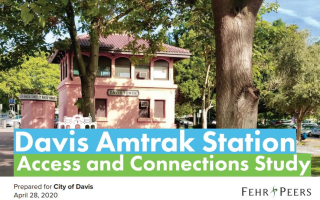
Starting in around 2012 the City of Davis – in cooperation or partnership with Amtrak and Capitol Corridor – began to attempt improvements for multi-modal access to the Southern Pacific Railway Depot, aka. Davis Depot, Davis Amtrak etc. In 2018-2020 this continued with an outreach program to determine desires and consider possibilities. (There are some bad links there, here is the Final Study). In subsequent years and through the present day Amtrak and Union Pacific made the City aware of a national program to ensure that Amtrak stations are ADA-compliant.
I fully support the Americans with Disabilities Act (ADA) and related ideas in mobility equity, and have actively done so for a long time. I applied the general principles to a train station optimization concept I worked on when I lived in Prague nearly 20 years ago, and – back in the USA in the past ten years for a water shuttle in the Estuary between Alameda and Oakland, and in Davis in regards to continued lack of a sidewalk from Old East Davis east of L and more acutely as an overgrown lot forced people to walk on 2nd Street.
Unfortunately, however, the absolutely late and totally necessary ADA improvements also planned for Davis Depot, while ostensibly improving the lot for people with mobility challenges will likely create not continual yet repeating complications for these users and people who use bikes or walk.
And it’s all completely unnecessary.
While safe infrastructure for everyone moving not by private vehicle is a necessary entitlement, there’s only a Federal law for people with mobility challenges, not – yet – for people riding bikes. So while I will focus on what I now am coining as TOPoS – toxic over-promise of shared infrastructure – I will also highlight the lowlights of barely vaguely planned bicycle facilities at the train station.
TOPoS
One doesn’t have to spend a long time on NextDoor forums focused on Davis to see a most often justified call for people to “slow down on Greenbelts” when riding bikes, and especially e-bikes and e-scooters. It’s anti-social when people do this, but what do we expect? Enforcement will never solve this, and technology fixes such as used on parts of UCD campus for shared micromobility devices don’t work with private micromobility devices, and may not for a very long time. The Greenbelt paths are in many parts of town the only active transportation (and dog walking etc.) corridors free from motor vehicles. While it’s an advantage that some go above or below arterial streets, I believe the actual physical and sound distance from motor vehicles that’s the biggest plus. Bike lanes do not provide this, slip lanes (free right turns) are especially good at encouraging people to take Greenbelt paths… to the detriment of other users.
I formally considered that the Greenbelt paths are underbuilt – i.e. too narrow, in too many cases with unnecessary bollards at egress points to the street grid and some bad sightlines, too – but increasing width where possible may only serve to increase the velocity of users.
Please note that many are called “bike paths” when – technically-speaking – they are multi-use paths. More on that in a moment….
Our current Class II bike lanes on most arteries are often not enough for side-by-side riding, an insult and more when many arteries have two lanes in the same direction.
What’s necessary is protected bike lanes – cycleways – on major arterial streets, optimized for the two general cruising speeds of their users – slower bikes and some e-scooters & faster bikes and e-bikes and some e-scooters… approximately 13 mph and 20-23 mph. They need to be wide enough to permit someone a faster device to pass two riding side-by-side going slower. That’s a necessary way to get more people to cycle in Davis and do it safety. This won’t happen if we ask people on e-bikes that travel at 20 mph without much effort to be nice, etc, or some “bike lanes for everyone” campaign.
So, how does TOPoS relate to ADA-compliance at Davis Depot?
Well, we’re not at the train station just yet….
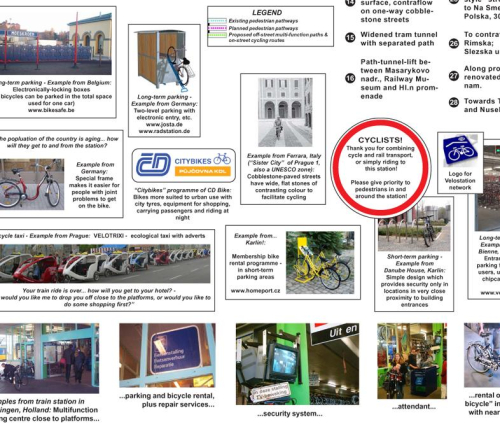
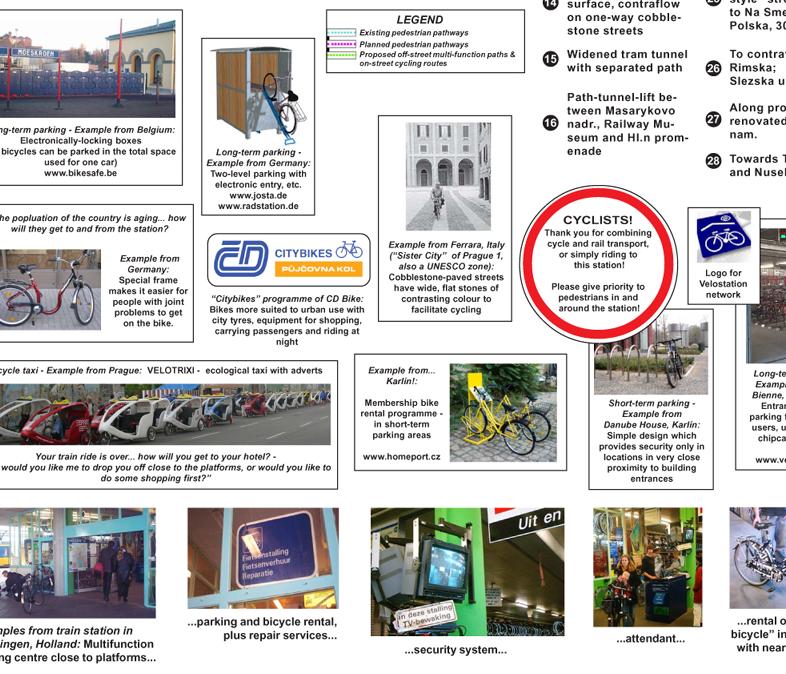
From my 2007 Concept for Prague's Main Train Station
The Davis Wall
While developers etc name many things (proposed) in Davis somewhat to fully-fictionally – e.g. “Village Farms” – not village and ex-farms, Oaktree Plaza – removed oak trees – “Village Homes” – sorry to go anti-sacred cow but where’s the cobbler?, “Palomino Place” – lack of horses, you know, like Wildhorse, ‘North Davis Creek” – like it as a wild feature but not as a development, whose creators seem to have created that name… what about the huge barrier to cycling and mobility device use running east-west across the lower third of Davis?
Every existing grade-separated crossing of I-80 and/or the railroad tracks has approximately an 6.5% to 8%. The exception is the section of the Putah Creek Parkway multi-user path going under the train tracks and up to the Arboretum.. The section going up from under I-80 to Research Park Drive is steep too, but fortunately short.
The new section of the multi-user path that’s part of the 80-Richards interchange project and which goes under its new ramps will have a 4.2% gradient. This is a standard design practice for multi-use paths, though some go to 5%. To be ADA-compliant everything above 5% needs railings and repeating short sections of max 2% gradient. Thus, the existing over-crossings on Pole Line and even the Dave Pelz bridge are not compliant. The new over-crossing of SR-113 in Woodland is 5% or less
The planned campus side of the Promenade over-crossing will be 4.2%, but the project side – the City side – will be 8%.
Why 8%? Because there’s apparently no space for a longer route on the project side. Why 8%? Because the full City Council brought what was then generally known as “Nishi 2.0” forward to a citywide vote without an agreement with Union Pacific that there would be an undercrossing (that would be under 5%). Why 8%? Because pro-Nishi 2.0 materials showed a visual of an undercrossing, whereas the actual text of the development agreement said “grade-separated crossing”. It was a con-job, and so sloppy and apparently embarrassing that it was not officially-revealed by the City until May 2023 that Union Pacific officially-rejected the undercrossing proposal that the developer and partners made in the fall of 2018, a few months after the Nishi 2.0 vote. The gradient is so unusable that City staff agreed months ago that likely nearly everyone traveling by foot, mobility device or bike from Promenade towards campus (and Downtown) will use the existing under-crossing mentioned above on the Putah Creek Parkway. (A proposed mitigation of the I-80 “Improvement Project” is a widening of the multi-user path along the Downtown side of the Arboretum, but the undercrossing (tunnel) will not be widened, so it will remain a pinch point.)
The 'Davis Wall" is nor necessarily above-grade. It's a barrier caused by both infrastructure and institutions. Minor walls in Davis could also include the H St "Bike Tunnel" towards F St, or a lack of active transportation crossings of SR-113 – even though they are at-grade and level – or even the noise produced by all road infrastructure
Are we almost at the train station?
Going back around ten years, the City performed an audit and outreach process related to walking and cycling access to schools in the City. Amongst other things, it correctly and wisely revealed that children living on East Olive Drive had a huge barrier to get to Montgomery Elementary, closest as the bird flies (and to other schools such as Peregrine or in East Davis, etc).
The solution was a ramp from the east end of Olive Drive to Pole Line, thus forming an aggregate multi-path towards Montgomery heading down and under Pole Line, under Cowell Blvd, past Playfields Park, etc.
The ramp had to get up to Pole Line BUT also leave room for the Olive Drive off-ramp from WB I-80 to remain open. To be clear, the latter was not stated at the time, not when it was finally decided by Caltrans to close the exit – though it’s not yet structurally-closed: This may be an innocent contingency in case there’s a complication in construction of 80-Richards, or Caltrans may decide to change its mind.
The resulting ramp is ADA-compliant, no more than 8%. As mentioned above, everything else in the region and beyond – I scoured recent, relevant recipient designs from the Active Transportation Program, a Federally-funded program administered by the State of California and provider of most of the funding for the Olive-Pole Line connector – is 5% or less.
From my unfortunately non-conclusive research on the issue, I provisionally-conclude that it was never, ever the intention of ADA to result in 8% ramps that are about 400 long and shared with people on bikes. The gradient and length creates multiple issues:
- It’s difficult to control speed whilst heading down on a bike, and above 12 mph or so the ADA-required undulations cause a bike and its human to nearly jump.
- The relative lack of width combined with mentioned speed doing down makes collisions between users going in opposite directions a possibility.
- The gradient makes it difficult for people on non-e-bikes to travel up; this is made worse by the undulations which make it hard to get any kind of rhythm IF one can muster the strength and stamina.
It’s not really good for anyone except for people on e-bikes, and more or less impossible for e.g. parents taking children to school with non-electric cargo bikes. This is the epitome of non-equitable infrastructure, especially in a “family”, “bike” etc etc. Davis.
(Why did this happen? I will take part of the blame, as I was on the Bicycling, Transportation and Street Safety Commission at the time. But I am not a licensed etc. traffic engineer. The licensed etc. traffic engineering firm that designed it didn’t say a thing… the licensed etc traffic engineer for the City of Davis… didn’t exist at the time. There was no senior-level traffic engineer in Davis from 2017 until 2022. I also think that the funder should have noticed these technical issues, and returned the grant application for revisions.)
Please think about these issues when you observe people using the Connector – How many people get off their bikes to go up? How many are actually using it at all?
Station Access from Olive
It’s worth noting that the approval for what was then called Lincoln40 and is now Ryder Apartments included both a below-Street Standards width for the newly-built sidewalk on the project side of Olive as well as a hard “no” to bring the bike lane up to the Street Standards minimum, and the same for the bike lane on the south side of the street. This would have resulted in less land for the Apartments.
(As part of the promised closure of the on-ramp, there’s been some vague promise of a shared street concept for Olive. It’s also worth noting that the bike lane-ish space on most of the EB side, east of In & Out has cars parked in it. Staff has refused to change it and the police have not enforced a thing).
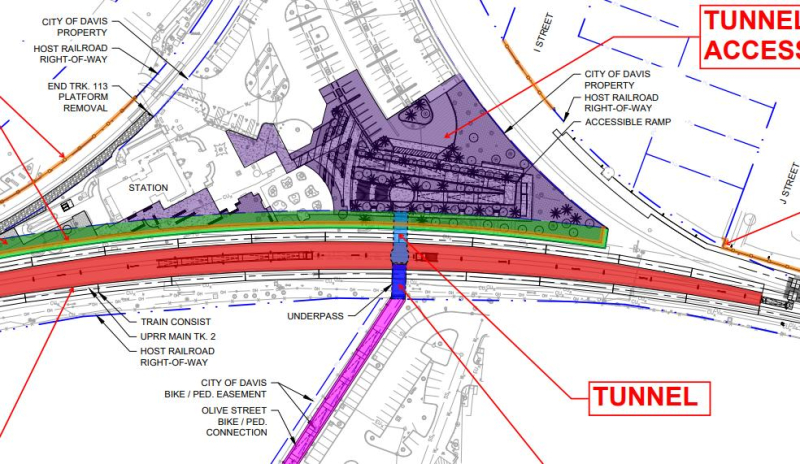
The easement on the west end of Ryder – is it too short to allow for a 5% grade from the sidewalk at Olive Dr to the underpassage? It’s not clear: The 30% seems to show a path that’s two-thirds 8% grade closer to the station and then level in its remaining third to Olive. The original concept back during the Lincoln40 approval process had some kind of corkscrew-based overcrossing. A better approach – well, from Pole Line – would have been a long ramp with a mild gradient situated in what’s now the back of the Ryder property, circling to the undercrossing. Sigh. I think a good traffic engineer could have identified it as a partial solution.
OK, we’re finally at the train station!
Lack of Specific Design Experience?
WSP – designing the station improvement for Amtrak - is a huge, multinational engineering firm with a massive portfolio even just in the train station/mobility hub sub-sector, with many prominent examples that will facilitate the expansion of sustainable mobility across the country and beyond. That’s not up for debate.
Based on a short discussion with its engineers present at the outreach event earlier this year, they’ve worked with Amtrak on many ADA-improvement projects. That’s great.
What I don’t see on their website is a lot of… bikes. Cycling is just one part of a robust sustainable mobility program, but I just don’t see any highlighted examples for cycling infrastructure nor for ADA infrastructure for train station access combined with cycling infrastructure not necessarily focused on train station access. I am happy if I am in error about this… but the bottom line perhaps is that I don’t see any evidence of an earlier or under-construction WSP project relevant to our specific needs in Davis.
I’ve not had time to research it in detail, but I don’t think Amtrak has a coherent, strategic plan for bicycle and rail multi-modality. (Again, prove me wrong!). If there’s not much there, then it’s fair to assume that WSP didn’t have a lot of direction on the matter.
If no one cycled in Davis, and everyone arrived at Davis Depot by car or bus and walked or went by mobility device etc to the platforms, things would be okay. (As the entire station is not being rebuilt – this could include a large plaza with a very, very gradual gradient leading to bicycle parking and above that the platforms accessed by escalator or elevator – things would be amazing. This is basically the template for new or rebuilt train stations in the Netherlands. )
But okay is good. Great would be a 100% elevator path option for people in mobility devices from both sides of the station; the current plan only has an elevator between the underpassage and the new center platform. The “okay” is ADA-compliant, and for this and other reasons if I was only walking to the train I would not mind that it takes more time than in the current design (rail services will have shorter delays while approaching the station that might make up for that).
But not everyone who is arriving at Davis Depot is coming by car or bus and foot and mobility device etc, and many people traveling this way in both directions – from Downtown or Olive Dr, South Davis, Promenade – are not going to or from the trains at all.
Their 30% Davis Depot design, however and sadly, builds upon the TOPoS qualities of the Olive to Pole Line Connector. It contains:
- An undulating ramp on both sides of the station.
- A bicycle wheel gutter on the wide, expressive stairs. (This solution should only be used to retrofit existing stairs, not in new builds. The best underground bike parking facilities have very long ramps which are sometimes cycleable; platforms are accessed as mentioned above in the Dutch example.)
- In addition, the overall design contains:
- No hint of bicycle parking on the Olive Dr side of the station
- Only some kind of vague mention of bike parking on the Downtown side, and nothing for large, cargo bikes, or the more expensive e-cargo bikes. (Imagine if SUV’s couldn’t be parked at the station).
- No provision for eventually connecting toward J St (this would enable people walking or cycling from the east to avoid any freight train blockages and in aggregate with the crossing to Olive Dr would make illegal encroachment of the track areas less likely)
No provision for eventually connecting under H St, and even to a below-grade entrance of the new apartment building in the old Ace home furnishings space).
- Too much regret at “losing” car parking in a City that is supposed to prioritize active transportation. We’re not yet called Not the Car Parking Capital of the USA for nothing.
Here are some scenarios to illustrate the issues, with approaches from all directions and origins:
A family from South Davis heads toward the train: an adult with two kids in a fancy e-cargo bike – manages the climb up Pole Line but struggles on the way down the Connector, fortunately mostly without any other traffic. After heading down Olive they make a more than hard right onto the ramp which has a similar gradient to the Connector. They share the ramp – train departure is approaching - with a few people walking at one speed, a single person in a motorized mobility device going a bit faster and some people on bikes originating in Downtown headed towards Olive Dr from the opposite direction. They reach the Downtown side. The kids get out of the bike and the adult pushes the heavy bike up the long steep ramp. They walk to the short-term design bike parking (Varsity racks etc which are currently used), lock their bike, walking down the stairs, walk up the ramp to the platform. When they return to Davis Depot at the end of the day the bike is, quite obviously, not there. (Option is that what’s not there is a fancy adaptive bike).
An individual who uses a manual mobility device comes from South Davis by car via Richards Blvd. They are slowed by congestion in the Richards Tunnel, park in an ADA space and then take the ramp to the underpassage and attempt to take the elevator to the platform. The elevator is not working, so they have to take the ramp. They barely make the train.
Two UCD students who live in South Davis travel by bike from Downtown. They’ve had a beer each, are only a bit tipsy, below the legal limit. They head down the undulating ramp, perhaps a bit too fast, but it’s steep. They don’t notice that the train has just arrived. At the hairpin turn, one loses traction but recovers a bit just before nearly slamming into someone with a guide dog who lives on Olive Drive, headed Downtown. The other stops at the bottom just as people from the arriving trains start arriving at the bottom of the ramp.
A Ryder resident who uses a motorized mobility device exits their building via the west entrance, and has to immediately head to the left, using the sidewalk, turning right onto the sidewalk on Olive and then over to the ramp. Not direct and a waste of time.
These are all worst-case scenarios, and certainly more likely when there’s a concurrence of uses: People going to or from trains, people headed to or from Olive Dr with no train objective… and multiple user types: walking, mobility device, slow bike, fast bike, heavy bike etc.). It won’t be like this all day; it might be like this at peaks. It cannot be made un-toxic with enforcement, signage or slogans. It makes the Depot more dangerous than it should be.
Language, language: Note that the 30% design shows a “bike/ped easement” and a “bike-ped connection” for what’s formally a multi-use path that’s optimized for people using mobility devices, ideally without the presence of people moving faster than them.
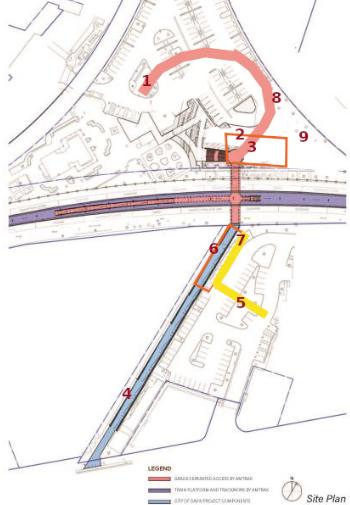
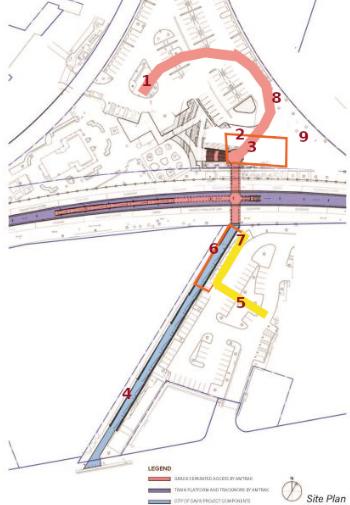
From my Concept for Davis Depot
Solutions?
I sent in comments and a design concept to the BTSSC in advance of their April 13, 2023 meeting that’s referenced in the Staff Report for tonight’s meeting. That meeting was not recorded. I saw no reference to my design or comments in the minutes and Commissioner comments apparently focused only on the underpass or overpass options, nothing about gradients, shared use, bike parking etc.
Following the outreach events earlier this year – which were quite informal and according to tonight’s Staff Report again focused only on over- or under- I drew up a more detailed concept for modifications, and discussed this in person with City of Davis Staff in March of this year. I’ve developed a bit further, so here goes nuthin’….
The main strategic elements are:
- Separate users on the most problematic sections of the project area.
- Create a more direct path for target users using mobility devices covered by ADA.
- Reduce unnecessary transits through the station whilst maintaining a desire to use active transportation through and to/from the station.
- Reduce unnecessary visits to the platform by people meeting arriving passengers.
- Reduce unnecessary transits by motor vehicle through the Richards tunnel
- Plan for likely significant demand from residents of Promenade, only one intersection and a short, mostly level ride away.
- Amend formal agreements as necessary related to provision of private vehicle parking at Davis Depot, and negotiate use of part of the parking at Ryder.
The main implementation elements are:
- Creating a continuous elevator choice for people with mobility devices covered by ADA. This will mean two more elevators: One on the plaza side and on the Olive Dr side.
- Implement a 4.2% (ideal) or max. 5% grade max path on the Downtown (plaza) side prioritized for people on bikes, but as backup in case the plaza-to-underpassage elevator is out of service. It should include markings etc to maintain safety within the parking lot.
- Implement a 5% grade max path on the Olive Dr side, prioritized for people on bikes. (If the space is too short within the current easement, either extend the easement into Olive Dr or add length within (below the parking lot grade), or add a second back up elevator)
- Create an ADA-compliant path directly from the west egress of Ryder Apartments to the Olive Dr side elevator.
- Create an inviting seating area oriented towards the elevator and stairs on the plaza side, so that arriving passengers – not heading to their cars – will know exactly where to meet. Include cover for shade and inclement weather, and space for e.g. a small food cart or two.
- Implement ADA-only parking on the existing Ryder lot (so people don’t have to drive through the Richards tunnel.)
- Design under passages on plaza side to facilitate further phase under passages towards J St and G St.
Bicycle parking:
Strategy: Create an equal level of bicycle parking security for all train passengers, whether for all-day or overnight,
Implementation:
- A small amount of short-term parking, e.g. for people doing station business or waiting for arrivals.
- Group-room based parking based on technology and structures used by BikeLink (operator of the current bike lockers) at BART stations such as Ashby and Embarcadero. Include space for bikes of all reasonable sizes. These parking rooms will be expandable: They will have a fixed portal area but can be extended by addition of glass and metal as demand warrants:
- The plaza side group room will be located close to the elevator.
- The Olive Dr side group room will be built over the under-passage, with access from the Ryder parking lot (note that many private properties in Davis allow transit between the local street grid and e.g. Greenbelt paths). Build close to the elevator: People who use the bike parking, Ryder residents and mobility device users will be encouraged to use the elevator.
- Relocate short term parking racks to Downtown or other needed areas.
- Relocate/sell e-lockers to local or regional Park(Bike)& Ride facilities.
Note on passive and other communication about likely under passage congestion: Users transiting the under passage will learn that if there’s no train on the platform or approaching it, there’s less likely to be users just getting off the train. While signage as a solution will not likely not be effective, it might be useful to consider some kind of active sign, e.g. a pictogram of a train etc, that is lit up during the a specific period of time, e.g. 5 minutes before every train departs and 3 to 5 min after it leaves. This may help normally better behaving people be more aware of possible issues.
Staff told me that the ideas for bike parking on the Olive Dr side of the station were appreciated and they promised to ask some questions about gradients on the Olive side. They said they would look into a design that would allow for further undercrossings towards J St and under H St.
In early April I corresponded about the issue with staff from Capitol Corridor. It was made clear to me that ADA-access was Amtrak’s priority, not cycling, and that funding could not be used for improving cycling, at least not as a priority of the project, but that further cooperation was possible between all the partner
My response at this juncture – which I hope I have made clear by now – is that if the station and approaches do not respect the true and equitable limits of shared space, barrier will remain for the user of mobility devices, and for ADA compliance. A lack of optimization in this area will also improve bike & rail multi-modality less than it could, and will improve conditions for cycling and walking in Davis less than it could.