Davisite Banner. Left side the bicycle obelisk at 3rd and University. Right side the trellis at the entrance to the Arboretum.

Category: Agriculture

  • What are the guaranteed parts of the Village Farms project?

    Looking at Affordable Housing in particular

    By Roberta Millstein

    With the for and against ballot arguments for Village Farms and their rebuttals posted to the County’s website (as Measure V), and the campaigns starting to ramp up, I thought it was important to highlight what are technically known as the projects Baseline Features. These are available as part of the “Full Text of Measure V” on the County’s website, and I encourage Davisites to take a close look at them, but I wanted to point out a couple of things first.

    Most important to note is what it means to be a Baseline Feature. As the text of the Measure itself clarifies:

    Beyond the Baseline Project Features there are other additional requirements for the Project, including but not limited to, the mitigation measures set forth in the Village Farms EIR, and the Development Agreement that, while important to the Project, are not Baseline Project Features and may be modified with the approval of the City after the appropriate public process (emphasis added).

    Another way of saying this is to point out that only the Baseline Features are guaranteed parts of the project. Anything else can be changed with a vote of the City Council — and here one should keep in mind that membership of that future City Council could be somewhat or even substantially different from today’s City Council. Thus, anything that is not a Baseline Feature is not a guaranteed part of the project.

    And even then, it’s important to read the Baseline Features carefully, as some of us learned when Bretton Woods was able to jettison its promised memory care facility. Let me give an example that is tied to one touted feature of the project that is of great interest to many voters: Affordable Housing.

    The rebuttal to the argument against Measure V states that the project will have “360 units serving very low to moderate income households.” But is this true?
    (more…)
  • Rebuttals to for-and-against ballot arguments are now available

    Roberta Millstein

    In an earlier article, I posted the for and against arguments for the Village Farms project. The rebuttals to each of these arguments are now available on the County’s website, and I have pasted them below. Village Farms is subject to a Measure J/R/D vote of all Davis citizens and has been assigned as Measure V.

    Here is the rebuttal to the argument in favor of Village Farms that will appear on our ballots in June (the rebuttal to the argument against follows after that):

    (more…)
  • Ballot arguments for and against Village Farms now available

    By Roberta Millstein

    This post is to just let people know that the arguments for and against the Village Farms project are up on the County’s website. The rebuttals to the for and against arguments are due by March 3; I will post them at some point afterward. Village Farms is subject to a Measure J/R/D vote of all Davis citizens and has been assigned as Measure V.

    Here is the argument in favor of Village Farms, i.e., in favor of Measure V, that will appear on our ballots in June (the argument against follows after that):

    (more…)
  • Setting the Record Straight – Part 1

    Myths vs. Facts about Village Farms Davis

    by Alan Pryor

    I. INTRODUCTION

    Opponents of Village Farms Davis have made numerous misleading and/or outright false claims about the Project and its supposed adverse environmental impacts on Davis and its residents. Their allegations are made without almost no quantitative supporting data from independent, verifiable 3rd-party sources to support their claims. Unfortunately, these naysayers instead rely on speculation and innuendo to attempt to disparage and denigrate the proposed Project.

    This article is the first in a series that will present detailed information that factually refutes each of these untrue “myths” and false allegations made by project opponents . This first article summarizes the false claims and provides a brief summary response followed by a more in-depth discussion refuting some of the allegations that require additional information to refute them. Subsequent articles in the coming weeks will further address some of these false claims in much greater detail.

    (more…)
  • Suggested changes to Ordinances for the Village Farms Project

    [The following was sent to the Davisite for posting]

    February 2, 2026
    To: Mayor Donna Neville and Council Members
    Fr: David J. Thompson, Affordable Housing Advocate
    Re: My Suggested Changes to Exhibit E Affordable Housing PIP Report

    Could you please address these questions and concerns before tonight’s final City Council vote on the second reading regarding Village Farms?

     Due to a number of issues I have located I have made the following suggestions by section number on the “Affordable Housing” agreement:

     1)    Section 2. General Clarification, All 360 units are to be “deed restricted permanently affordable”. However, in Section 5. Which provides specific detail, the term ‘deed restricted permanently affordable’ is missing and should be included in Section 5.

     2)    Section 4.1. Do not understand why requirement of 18+ acres has been reduced to 16 acres?

     3)    Section 4.1. I have previously stated to the Council that the closer to transportation and shopping center the sites wins extra points in the funding competitions. Not knowing where these parcels will be should have been set by now to ensure the sites gets highest extra points for location. Why will the siting be unknown when the citywide vote occurs?

     4)    Section 5. ’80 ownership units for moderate income households…’.  I have previously provided you with an analysis why this is not likely possible with a Limited Equity Housing Cooperative. The only other option is to do a condo which I think is equally difficult for much the same reasons. How does the city plan to get the ownership units built?

     5)    Section 5. I would suggest you allow for these 80 units to be also done as rentals which are a more feasible, of value and a likely option. They could be delivered much earlier. The likelihood of acquiring funding for moderate income ownership housing is a long shot at best.

     6)    So the City may well be left with NO affordable housing and land use dedication which will not be developed in the near future, or perhaps ever.

     7)    Section 6.C. Given the trend in financing low-income housing $2 million may not be enough at $20,000 per unit to complete the subsidy funding of the initial 100 units. What are the additional dollars per unit Mercy Housing is asking for per unit at Bretton Woods?

     8)    Section 7.2. For me and perhaps for others, the section below definitely confuses me.

    (more…)
  • Rebuttal to Village Farms Flood Control Claims

    By Rena Nayyar

    This is a response to a recent article by one of the Village Farms partners regarding the project’s proposed flood control. The article makes the claim that Village Farms will be “better protected from flooding than most of Davis.” That claim is just marketing. The Village Farms EIR does not support this claim. Links to city documents are at https://www.cityofdavis.org/city-hall/community-development/development-projects/village-farms-davis

    The article didn’t cite any sources showing a track record for their “sound, proven engineering design principles” that would be employed to reduce flood risk.  The “hundreds of pages of engineering analysis related to the impact of extreme storm events to the project…demonstrate that Village Farms Davis will be better protected against flooding” is exaggerated as these involve modeling based on assumptions and not actual plans for how this will be implemented. In fact, the flood and stormwater strategy is still being assembled piecemeal, after the circulation of the Draft EIR.  It is meaningless for them to praise the merits of a plan in flux. Village Farms is not a simple “raise the pads” project. It relies on a complex coordinated stormwater and grading strategy across a huge site in a flat floodplain basin with known downstream flooding problems. In that kind of environment, there are lots of failure scenarios. This problem requires completed project level planning that has not yet been done. 

    In the Final EIR response to comments on page 2-10,  liners are being proposed for Channel A to try to prevent the contaminated groundwater including PFAS “forever chemicals”  from mixing with the Channel A runoff water. When the City starts talking about Channel A “liners” and isolation measures to prevent stormwater from interacting with groundwater– those are major changes. This is a sign that the system is being engineered around problems that were not resolved when the public reviewed the Draft EIR. 

    Since the flood plan is so incomplete and not yet approved, the project’s flood story may require future changes, for example in maps (Final EIR page 3-12).  On page 4-83 the Final EIR says that because the drainage patterns of the area will change, “a design-level drainage report shall be submitted to the City …for review and approval” when the first tentative subdivision map is submitted.  Similarly, the response to Comment 217-54, page 2-996 says
    “the preparation of a final Stormwater Control Plan, …cannot be prepared at this time ” and “the appropriate time for a Stormwater Control Plan will be when a tentative subdivision map has been prepared”. 

    (more…)
  • No Certification of the Village Farms EIR  

    By Eileen M. Samitz

    The City Council will soon be making a decision with serious consequences of whether to certify the Village Farms EIR. It is critical that they deny certification. This EIR is seriously inadequate and flawed, and certifying it would expose the City to liability while surrendering the City’s leverage to correct course on this disastrous project.

    Background

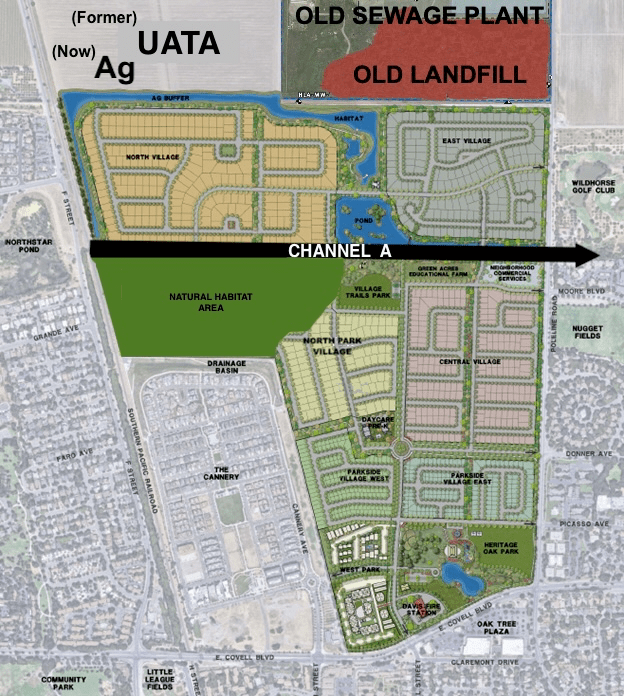
    A similar version of Village Farms, Covell Village, was rejected by Davis voters 60:40 in 2005 for many of the same reasons this project and its EIR must be rejected now. The developer, John Whitcombe (Tandem Properties partner) bought the 386-acre parcel in bankruptcy due to the many obstacles making it impractical to develop (originally costing $11 million) for a mere $3.2 million. The site has long been handicapped by an enormous floodplain, unmitigable traffic, access issues, extraordinary infrastructure costs, and toxics from the adjacent unlined Old City Landfill and Sewage Treatment Plant.

    Aberrant, Chaotic, Rushed Process

    The Village Farms “process” has been aberrant. The developer demanded that the City push his project ahead of other projects being processed. The City caved and has been accommodating him ever since, to the detriment of the community. The apparent objective has been to rush this “legacy” project onto the ballot, but the EIR and key documents still contain a plethora of “to be determined,” and “if feasible” language.

    Public meetings were rushed through the holidays, when many residents were unavailable to comment. In backwards order, the City Council held a workshop the day before the Planning Commission was asked to recommend certification of a Final EIR that did not yet exist. Never in Davis’s history has the Planning Commission been asked to recommend certification of an EIR before it was complete, yet staff pressured for that recommendation anyway. That’s not transparency, it’s corner‑cutting. The City has prioritized a June 2026 ballot timeline over the community’s right to a fair, thorough CEQA process.

    Village Farms: Serious Impacts, Costs, and EIR Inadequacies

    Massive traffic

    Village Farms would add at least 15,415 car trips PER DAY, from 1,800 housing units on the 498‑acre site, the largest residential project ever proposed in Davis. This is likely an underestimation because it assumes substantial public transit use. Covell Boulevard and Pole Line Road, already heavily impacted, would be gridlock, degrading streets to Level of Service “F”. Cut-through traffic would impact many neighborhoods of cars trying to avoid this congestion.

    (more…)
  • Village Farms will actually be better protected against future flooding than much of Davis

    By Doug Buzbee

    In a recent Op-Ed in the Enterprise (“Commentary: Why a planning commissioner voted no on Village Farms, Jan 2, 2026” [or see longer version on the Davisite here]), Greg Rowe stated he opposed the Village Farms Davis project claiming the site had excessive flood risks.

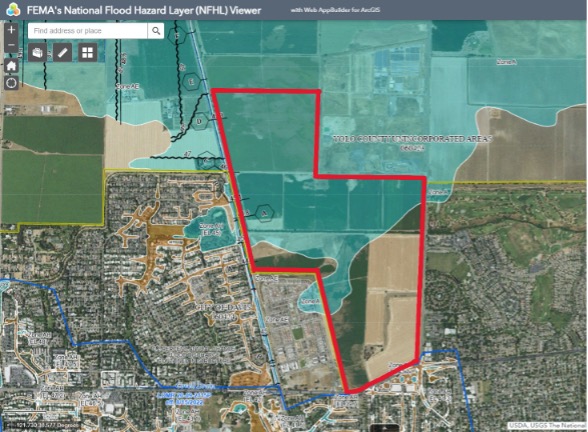
    He stated that because part of the proposed project site is currently in a 100-year Flood Zone as mapped by the Federal Emergency Management Agency (FEMA) and because climate change will bring more extreme weather events in the future, we simply should not build anything at all in that part of the project.

    While flood risks are real and climate concerns are valid, Mr. Rowe’s comments ignore the fact that proven engineering solutions will be implemented at Village Farms Davis to remove it from the mapped 100-year flood zone, and furthermore, provide protection against a more severe 200-year flood event.

    Village Farms Davis is actually designed to meet higher flood protection standards than significant portions of the rest of Davis, including many older neighborhoods developed before modern flood-protection standards, and over 400 acres within the city limits that still remain within the 100-year flood plain – including swaths of residential West and Central Davis.

    Let me explain.

    (more…)
  • The most recent Village Farms Affordable Housing Plan

    [The following letter to the Davis City Council was shared with the Davisite for posting]

    January 12th, 2025
    To. Mayor Neville and Council Members
    Fr. David J Thompson
    Re. The most recent Village Farms Affordable Housing Plan

    The latest iteration of the Affordable Housing Plan for Village Farms is still missing critical elements. Therefore, it should not be accepted by the City Council.

    * I Have placed the Regional Housing Needs Allocation (RHNA) numbers in a table at the end of this article. Clearly, Davis is most deficient in creating Very Low Income (VLI) and Low Income (LI) units

    As an interested observer, it has been difficult to keep up with the numerous changed affordable housing plans for VF brought forward at the very last minute.

    • I encourage the City Council to require the VLI and LI affordable housing plan to be specifically set in VF as close as possible to Covell Blvd. Please switch the MOD site to the most northerly of the three parcels. All the major competitive sources of funding for affordable housing are based upon a points system. Usually, each applicant scores 100 points and the winning applicants are those applicants which gain more in tie breakers. High points are for example given for categories with a quantified proximity to existing bus routes and to shopping centers with a supermarket. These points are critical specifically to the projects set aside for the categories of Very Low Income (VLI) and Low Income (LI). These projects will have a far better chance of being funded when set adjacent to Covell Blvd.
    • Another point to make is that the specific sites to be designated for VLI and LI should be large enough (min 4 acres) to be built in two phases. The second phase will score higher when added to an existing phase because of increased scale and reductions in management, administrative, legal, architectural fees and in building costs. A community building and offices built in phase one will not be needed for phase two. This also frees up land in phase two to be used for income earning additional housing units rather than the additional non-earning expenses of a community building. Otherwise, each smaller site will have to have a community building and separate staffing and duplicate costs for the expense categories listed above. Every saved penny per unit wins additional award points in the competitions.
    • If I am correct there will be no for sale single family units affordable to 80%-120% income category. This is a measureable weakness in the range of affordable housing products in the present application.
    (more…)
  • How City Council Upended the Village Farms EIR Alternatives Analysis

    By Greg Rowe

    The California Environmental Quality Act (CEQA) requires an Environmental Impact Report (EIR) to examine the potential impacts of a range of reasonable alternatives to the proposed project and evaluate the comparative merits of the alternatives. Under CEQA, the purpose of studying alternatives is to allow meaningful analysis and comparison of alternatives that could reduce significant environmental impacts as compared to the proposed project.

    The alternatives must be feasible, meet most or all of the project objectives, and avoid or substantially lessen one or more of the project’s significant impacts. Alternatives are generally evaluated in a qualitative manner rather than to the same degree of exactitude as the proposed project. A “no project” alternative is always included. The “no project” alternative for a project that would develop vacant land would in most cases be the “Environmentally Superior Alternative (ESA),” but not building the project would fail to achieve any of the project objectives.

    As a result, the alternative that best avoids or mitigates the most impacts is typically identified as the ESA, but the lead agency (the City of Davis in this case) is not obligated to substitute this alternative for the proposed project. In fact, because alternatives are generally analyzed qualitatively, a lead agency could not approve an alternative consistent with CEQA unless that alternative was also analyzed at the project-specific (i.e. detailed) level, such as the Biological Resources Preservation Alternative (BRPA) for the Village Farms project.

    Alternatives are selected after the project’s impact analysis has been completed and the project’s potential impacts to the environment are known.  This is a logical sequence because it is impossible to know if an alternative would produce fewer impacts if the potential project’s impacts are not yet  revealed, just as a doctor cannot consider alternative treatments for a patient before the ailment and its source are known.

    In my experience working with EIRs since 1984, once the impact analysis has been completed, there typically will be a meeting among the EIR consultant, the client (in this case, the City of Davis) and potentially the project proponent (in this case, the developer).  For a project such as Village Farms, the EIR consultant and city planning staff would use their professional experience and knowledge of the area and CEQA to devise a range of reasonable alternatives, with which the project proponent may or may not concur. In other words, the selection of alternatives is an objective process based on impartial judgment and professional experience. It should not influenced by political or financial considerations.

    A knowledgeable but now retired land use consultant once told me that in his long experience, impacts to biological resources, traffic, and air quality tend to be the primary factors that influence the identification of alternatives. Typical alternatives might include any or all of the following:

    • The same footprint or area but with fewer units (meaning lower density).
    • A smaller physical footprint but with the same number of units, which would typically avoid impacts on sensitive biological resources on the property.
    • A reduced project area footprint that includes the same number of housing units, but with a different mix of housing types.   
    • A lower number of housing units on a smaller footprint.   
    • Developing the project at an entirely different location, if acquiring such land for an alternative is feasible.
    (more…)