Davisite Banner. Left side the bicycle obelisk at 3rd and University. Right side the trellis at the entrance to the Arboretum.

Author: Roberta Millstein

  • Proposed changes to noise ordinance need to be sent back to the drawing board

    [The following email was sent to CityCouncilMembers@cityofdavis.org]

    Dear City Councilmembers,

    I am writing concerning Item 4B for tonight’s City Council meeting — specifically the changes to Davis’s noise ordinance. The changes would eliminate the concrete, objective measurement of too much noise — a decibel level — and replace it with the subjective determination of which sounds are “ordinary and reasonable.”  Left unclear is who is to make this determination, when such people would be available, and on what basis they would decide.

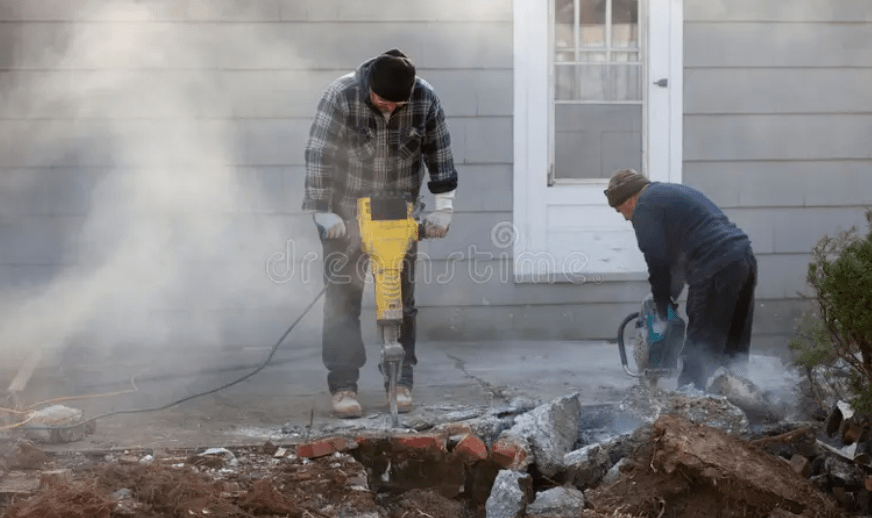
    As I understand it, the objective standard of a decibel level is being removed not just from public playgrounds, parks, and schools, but also from the regulations concerning sounds from animals, power tools, and vehicle repairs.  Thus, these proposed changes will affect every citizen in Davis.

    And let’s be clear.  This is a quality of life issue, yes, but it is more than that. Loud sounds have demonstrated physical and psychological harms on people and animals.  This is a public health issue.  Speaking personally, I find loud noises extremely debilitating. I can’t think properly, much less get any work done.

    Also, these changes will have people keeping their windows closed and using their A/Cs, unnecessarily wasting energy — and then still not really preventing exposure to the worst sounds.

    Yet despite the potential for serious harm, these considerable changes are poised to be passed without a staff presentation, without input from commissions, and without discussion of concerns raised by Davis’s citizens.

    I urge you to send this proposal back to the drawing board.

    Thank you.

    Sincerely,

    Roberta Millstein
    Davis citizen

  • Trump administration drops its attack on the University of California

    By Roberta Millstein

    This is a quick followup to two earlier articles.

    In “Trump’s Attacks on the University of California (and higher education more generally)” I explained how the administration’s “Demand” letter sought a $1.2 Billion “settlement” from UCLA for allegations of civil rights violations related to antisemitism and affirmative action. 

    Then, in “Coalition of faculty unions prevails against Trump’s attacks on the UC,” I explained that the U.S. District Court in the Northern District of California granted the Plaintiffs in AAUP v. Trump, including the Davis Faculty Association, a preliminary injunction — that by temporary court order, the federal government is prohibited from holding federal funds hostage in an effort to coerce the University of California into imposing policies that would violate our First Amendment rights.

    That temporary court order is now permanent in the wake of the Department of Justice dropping its appeal of the federal court order.

    As Brian Lynch explains, the order:

    …doesn’t just unwind what the government already did to UCLA — it sets the rules for what the government can’t do going forward to any part of the UC system.

    He continues:

    The modified order, filed February 13, 2026, does two remarkable things. First, it forces the government to follow the law before it cuts university funding. Second — and this is the real teeth — it means that if the government freezes or restricts UC funding without completing every required procedural step, the university can go straight to court and seek enforcement of the injunction. The government would be in violation of a federal court order, and the remedy is immediate. Universities don’t have to start from scratch with a new lawsuit; the injunction is already in place.

    Note the word “universities” — not just UCLA, not just the UC, but universities. Thus, Lynch points out “this injunction is a roadmap for every university currently facing the same playbook.”

    This strikes a major blow against Trump’s attempts to illegally control the free speech and operation of universities in the U.S. Are you listening, University of California? Thanks to your faculty, students, and staff who risked speaking out, you don’t have to capitulate to Trump’s demands anymore. I — and many others — urge you to stop.

    This is a BFD. And it shows that fighting back can work.

  • What happens when you build primarily high-end housing?

    By Roberta Millstein

    Two recent articles about Vacaville, our neighbor to the south, caught my eye. Both have to do with what has happened to Vacaville in the wake of building more high-end (i.e., expensive) housing.

    The first article was in the SF Chronicle, “This Bay Area exurb is full of McMansions — and may be the ‘next frontier’ of the housing crisis.” Here is an excerpt:

    Unlike Vallejo, which has yet to fully recover from its 2008 bankruptcy filing, Vacaville has signs of a suburb on the rise: a burgeoning biotech presence, a median household income in the low six figures, several new higher-end subdivisions. But the more people flock to this bedroom community for cheaper housing, the more its rental prices veer toward San Francisco levels. Over the past half-decade, Vacaville’s share of cost-burdened renters has swelled more than any other Bay Area community. 

    “If you’re a renter in Vacaville, there’s so many different market forces working against you,” said Robert Eyler, an economics professor at Sonoma State University. “Until you’re actively looking for a rental there, it’s hard to understand just how bad it is.”

    Some priced-out renters have been surprised to learn that Vacaville has no problem greenlighting construction. It’s the type of projects that’s the issue. 

    According to Vacaville’s official housing reports, it completed around 2,900 residential units between 2015 and the end of 2021, more than double what it had targeted. That was enough to put Vacaville among the top 10 Bay Area cities in overall housing production. 

    But the bulk of the building has been for large single-family homes. Along Vacaville’s southern edge, construction crews are working on a 2,400-acre development called Lagoon Valley, which will include more than 1,000 houses spanning 14 distinct neighborhoods, retail and office space, a golf course and a community event center. 

    Meanwhile, Vacaville has long ranked toward the bottom of Bay Area communities in producing multifamily homes. Housing projects such as townhomes, duplexes and triplexes, often called the “missing middle,” make up less than a 10th of the city’s housing stock. 

    Then an article in The Reporter, “Vacaville Council rejects DIF recommendations,” caught my eye. In the context of rejecting recommendations from a 2025 Developmental Impact Fees Nexus Study, Lisa Vorderbrueggen of the BIA Bay Area stated, “Vacaville has added housing yet student enrollment is declining, a clear sign that middle-income families are being priced out.”

    I leave the relevance for the upcoming discussions about Village Farms as an exercise for the reader.

  • Comments on the Village Farms recirculated draft EIR

    By Roberta Millstein

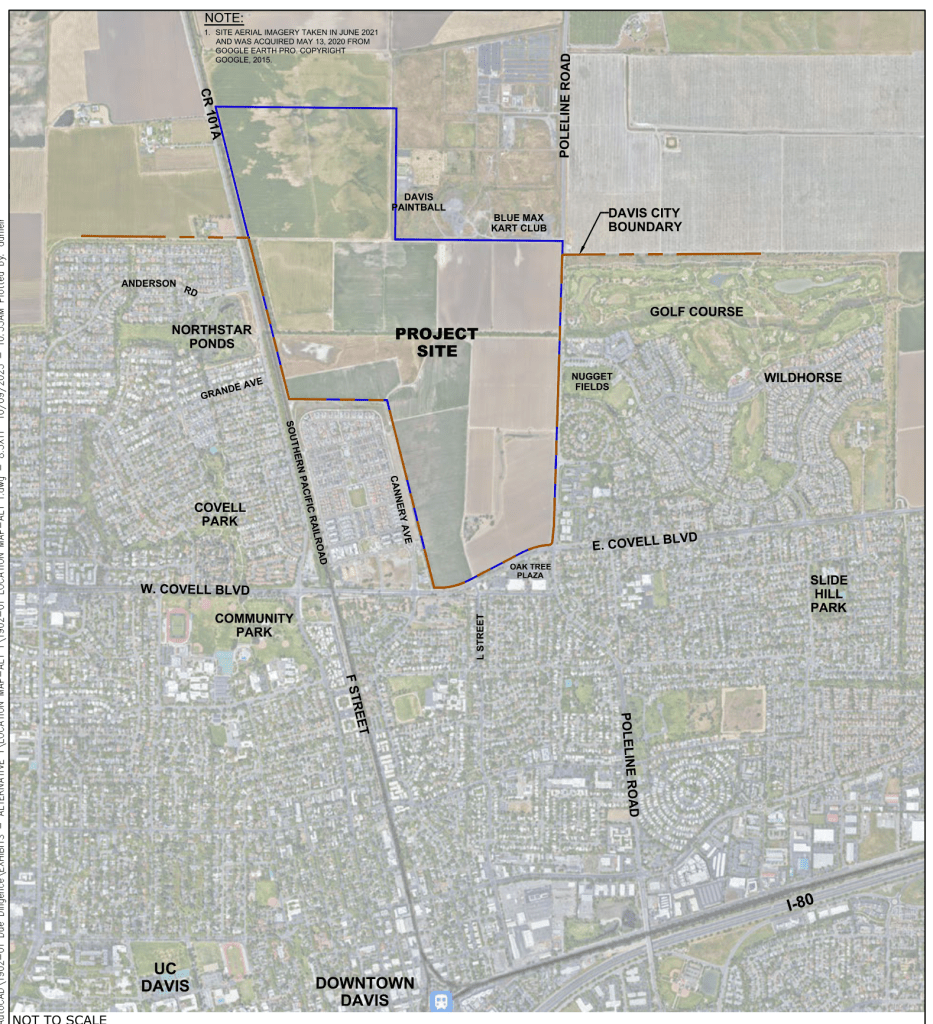
    In an earlier article, I mentioned that there was a recirculated (and partial) Draft Environmental Impact Report (DEIR) for the Village Farms proposal, necessitated by “new information” related to the City’s overall Wastewater Treatment Plant (WWTP) capacity.” I also noted that the City was taking public comment on the recirculated (partial) DEIR, with comments due by 5 PM, January 2. As that day is very soon upon us, I thought I would share my own comments here.

    Anyone thinking of submitting their own comments should note the following:

    “Pursuant to CEQA Guidelines Section 15088.5(f)(2), the City of Davis directs that public comments must be restricted to the newly circulated information contained in this document related to wastewater treatment capacity. The City is not obligated to respond to any new comments that are directed to the portions of the Draft EIR that were not revised and are not being recirculated in this document.”

    Comments must be directed to:

    Dara Dungworth, Principal Planner
    City of Davis Department of Community Development
    23 Russell Boulevard, Suite 2
    Davis, CA 95616
    ddungworth@cityofdavis.org

    My public comments (submitted earlier today) are as follows:

    (more…)
  • Give your feedback to the city on the Village Farms project proposal

    By Roberta Millstein

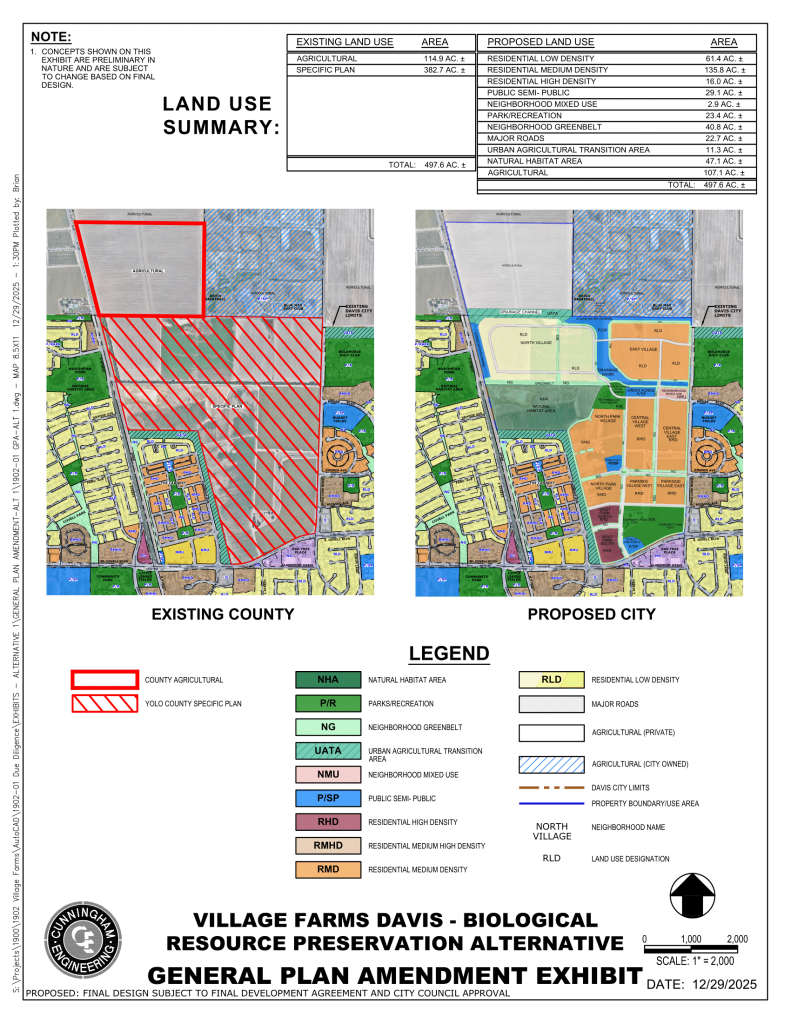
    Heads up for Davis City Council “workshop“ on Village Farms, Tues, Dec 16, approx 7:20 PM. This is an opportunity for you to let the city know your views on the project.

    Item 6: Staff recommends the City Council conduct a public workshop on the Village Farms Davis project (VF) applications, as follows:
    a. Receive Staff presentations on the proposed project;
    b. Receive Applicant presentations on the proposed project;
    c. Take public comment; and
    d. Consider the following project applications and documents and provide feedback:


    i. Pre-General Plan Amendment, including provisions for Baseline Project Features as required by Chapter 41 of the Davis Municipal Code; and
    ii. Pre-Zoning and Preliminary Planned Development; and
    iii. Development Agreement.

    Details here: https://documents.cityofdavis.org/Media/Default/Documents/PDF/CityCouncil/CouncilMeetings/Agendas/2025/2025-12-16/06-Village-Farms-Workshop.pdf

    IN PERSON PUBLIC COMMENTS:
    Speakers will be asked to line up at the podium and state their name for the record. Comments are limited to no more than 2 minutes per speaker.

    WRITTEN AND VOICEMAIL PUBLIC COMMENTS:

    1. Submit written public comments to CityCouncilMembers@cityofdavis.org. Emails are distributed to City Council and staff. To ensure the City Council has the opportunity to review information prior to the meeting, send emails by 3:00 p.m. on the meeting date.
       
    2. Submit comments by voicemail prior to the meeting: Call the city’s dedicated phone line 530-757-5693 to leave a voicemail message for public comment. Staff will play comments during the appropriate agenda item. Comments will be accepted from 12:00 noon until 4:00 p.m. on the day of the meeting. Voicemail public comments will not be accepted after 4:00 p.m. Speakers will be limited to no more than two minutes.
       
      Note: You must leave a separate voicemail for each item you wish to comment on. Please indicate your name and which item you are speaking about.
  • Planning Commission declines to even discuss Village Farms evaluation process

    By Roberta Millstein

    At last night’s Planning Commission meeting, I was the only (!) oral commenter, via the call-in option. I raised a series of concerns about the process and timeline for evaluating the Village Farms proposal, which I will paste in below. Yet neither staff nor any member of the Planning Commission chose to acknowledge the existence of my concerns, much less respond to them. I will let the reader decide whether I am making a mountain out of a molehill (possibly) or whether the Planning Commission shirked its duty by not even discussing the concerns.

    As background, the sole point of the meeting was to decide whether to “continue” the Dec 2 meeting until Dec 17, to “to allow for the final negotiations of the project’s draft development agreement to be completed such that the Planning Commission can take action before the draft is forwarded to the City Council for consideration.”

    Here is the slightly longer version of my comments that I emailed to members of the Planning Commission prior to the meeting, differing primarily in the second paragraph which I had to cut for time in my oral comments.

    (more…)
  • Yet another update on Village Farms proposal — is this proper process?

    By Roberta Millstein

    A few days ago, I wrote about two updates from the City concerning the Village Farms proposal, one of which let citizens know that the Draft Environmental Impact Report (DEIR) would be recirculated in light of new information about impacts to the City’s wastewater treatment plant and the other which announced that the City was releasing a not-quite-final-Final-EIR — a draft Final EIR, if you will — to which information about impacts to the wastewater treatment plant would be added later. 

    I wondered then how that would impact the City’s timeline for evaluating the Village Farms proposal — when would the Planning Commission weigh in on it?  When would the City Council weigh in on it?  (There is some discussion of this in the comments on the earlier post).  The issue there is that the City has been aiming to have the project up for a Measure J/R/D vote in June 2026, but (it seemed to me) the delays from this new wastewater treatment plant would make that extremely difficult, if not impossible.

    Well, we have our answer now.  As I read the City’s new update (posted to the City’s website yesterday, November 25), it means that the City isn’t changing its timeline much, if at all.  In other words, the Planning Commission will weigh in on (recommend or not recommend) the project without having a completed Final EIR.  And then, the City will likewise weigh in on the project with the hot-off-the-presses Final EIR, using the (partial? conditional?) recommendation from the Planning Commission. 

    I’m neither a lawyer nor am an expert on land use policy.  But I have been following things pretty closely in Davis for the last decade or so.  And I have never heard of anything like this. 

    It seems highly irregular to me.  And it seems as though the City is shortchanging its analysis of the impacts to the wastewater treatment plant.  If the impacts legally triggered changes to the EIR, doesn’t that mean that they should be important enough for the Planning Commission to consider?

    Here is the new update, with information about when the above-mentioned meetings will occur:

    (more…)
  • Two updates on the Village Farms project

    By Roberta Millstein

    This is just to call people’s attention to two updates on the Village Farms project. We had been expecting to see a Final Environmental Impact Report (FEIR), responding to comments on the Draft EIR, when on November 17, the City announced:

    New information has recently come to the attention of the City of Davis Department of Public Works Utilities and Operations related to the City’s overall Wastewater Treatment Plant (WWTP) capacity. Preliminary results from an ongoing study – which is still underway – revealed that the wastewater treatment system is approaching capacity sooner than anticipated, in large part due to the City’s successful water conservation efforts. Simply put, reduced water flow causes a higher concentration of waste. Though the system is performing efficiently, changes to the composition of the wastewater and new assumptions about treatment necessitate modifications to the WWTP to ensure continued reliable service for years to come. Once the study is complete in early 2026, staff will facilitate a discussion with the City Council and community about next steps.

    Thus:

    … the City of Davis is recirculating the portions of the Village Farms DEIR that require revisions to reflect this new information. Until January 2, 2026, the public may submit comments on the recirculated portions. The City will prepare a revised “response to comments” document that includes comments on these revised sections of the DEIR, and intends to make the full Final EIR available to the public at least 10 days prior to City Council action to certify the EIR. Comments submitted during the initial circulation in early 2025, and the City’s responses to those comments, will be made available in draft form for public review prior to the Planning Commission consideration of the project.

    But then on November 21, the City made an additional announcement:

    A partial draft response to comments on the previously circulated Draft Environmental Impact Report (DEIR) is provided at the link below. This document is a draft to provide the public and decision makers with an early preview of the partial responses to comments on the previously circulated DEIR for the project. This document is being released to the public prior to the Final Environmental Impact Report (FEIR) for the project and is not required by CEQA regulations but is being provided for maximum public transparency. Minor revisions to this draft document may be required to fully respond to public comment received on the partially recirculated DEIR during its 45-day comment period (November 17, 2025 through January 2, 2026).

    “The link below” that is referred to in the quote is here: https://documents.cityofdavis.org/Media/CommunityDevelopment/Documents/PDF/CDD/Planning/Project-Applications/Village%20Farms%20Davis/VFD%20Partial%20Draft%20RTCs%20DEIR_Optx.pdf

    For those of us that have been waiting to see the FEIR and have been wondering what was going on (e.g., me), this gives us probably a close-to-final version of what the FEIR will be — as I understand these announcements. (It’s a Draft Final EIR responding to the Draft EIR — got it??)

    For more information on the Village Farms proposal, and for the text of the two announcements copy-pasted above, go here: https://www.cityofdavis.org/city-hall/community-development/development-projects/village-farms-davis

  • Coalition of faculty unions prevails against Trump’s attacks on the UC

    UC administration is still laying low and not joining the fight

    By Roberta Millstein

    This is just meant to be a quick follow up to my earlier article, “Trump’s Attacks on the University of California (and higher education more generally).” On Friday, the U.S. District Court in the Northern District of California granted the Plaintiffs in AAUP v. Trump, including the Davis Faculty Association, a preliminary injunction. By temporary court orderthe federal government is prohibited from holding federal funds hostage in an effort to coerce the University of California into imposing policies that would violate our First Amendment rights.

    The judge’s decision is a rebuke of the “Demand letter” I wrote about in the earlier article (and I believe its arguments would likewise apply to the “Compact” that has been presented to other U.S. universities).  Judge Rita Lin writes:

    Plaintiffs have submitted overwhelming evidence. Across 74 declarations and more than 700 pages of supporting documents, Plaintiffs show that the Administration and its executive agencies are engaged in a concerted campaign to purge “woke,” “left,” and “socialist” viewpoints from our country’s leading universities. Agency officials, as well as the President and Vice President, have repeatedly and publicly announced a playbook of initiating civil rights investigations of preeminent universities to justify cutting off federal funding, with the goal of bringing universities to their knees and forcing them to change their ideological tune. Universities are then presented with agreements to restore federal funding under which they must change what they teach, restrict student anonymity in protests, and endorse the Administration’s view of gender, among other things. Defendants submit nothing to refute this.

    In her article on the decision, Davis Enterprise journalist Monica Stark helpfully explains that the order will stay in place until all of the required procedures under Title VI and Title IX are followed — in other words, the procedures that the Trump administration should have followed instead of simply declaring guilt and trying to impose an outrageous $1.2B fine with illegal conditions.  (See Stark’s article or the judge’s order for the list of required procedures).  The Trump administration’s conditions included, the judge states, “conditions on continued federal funding that impermissibly burden their First Amendment rights” (p. 74).

    Judge Lin offered examples of conditions on the granting or continuance of federal funding that would violate the First Amendment rights of Plaintiffs’ members (meaning that the Trump administration is prohibited from doing the following):

    (more…)
  • DEIR for Willowgrove project released

    The Willowgrove Draft Environmental Impact Report has been released and is available for public review for a minimum 45-day comment period.

    The Draft EIR public comment period begins on Nov. 10 and ends Jan. 2 at 5 p.m. Members of the public may submit written comments before the end of the comment period. Written comments can be emailed to the Project Planner Eric Lee at: elee@cityofdavis.org.

    The Planning Commission is scheduled to conduct a public comment meeting on the Draft EIR on Wednesday, Dec. 10, at 7 p.m. in the city of Davis Community Chambers (23 Russell Blvd). Members of the public or public agencies may provide comments at the meeting.

    To view the DEIR, visit https://documents.cityofdavis.org/Media/Default/Documents/PDF/CDD/Planning/Special-Projects/Willowgrove/EIR-Draft/Willowgrove-Draft-EIR-Nov-2025-Combined.pdf

    To learn more about the proposed Willowgrove project, visit https://www.cityofdavis.org/city-hall/community-development/development-projects/willowgrove