Davisite Banner. Left side the bicycle obelisk at 3rd and University. Right side the trellis at the entrance to the Arboretum.

Author: davisite2

  • Will There be No Place in Davis for Low Income Seniors

    By Bill Powell and David Thompson

    “Each day I get five calls from low income seniors looking to find housing in Davis” says Susan at Shasta Point Retirement Community. “And each day at least one senior arrives at Shasta Point anxious to get housing and hoping by turning up they may have a better chance than just calling.” They don’t.

    Every day there are five to 10 emails or phone calls from low-income seniors to the two staff members at Eleanor Roosevelt Circle. At ERC about three seniors per day walk through the door hoping to get a place. They can’t.

    In 2018, there is a waiting list of 441 seniors for the four largest Davis affordable senior communities; Davisville (70), Shasta Point (67), Eleanor Roosevelt Circle (59) and Walnut Terrace (30). In 2017 there were a total of 14 turnovers. Only 14 of the 441 waiting in line got in. At that rate it would be 31 years before the last of those seniors get housed. The actual wait for an extremely low-income senior can be from three to five years.

    (more…)

  • Planned West Davis Adult Community, if Approved, Would Perpetuate Racial Imbalance in the City of Davis

    Complaintimage(Press release) The proposed restrictive West Davis Active Adult Community on the City of Davis’ November 6 ballot which advertises its purpose as a planned community “Taking Care of Our Own,” is being challenged in federal court because it will perpetuate racial imbalance and discriminate against minorities by restricting sales to residents of Davis

    In a federal complaint filed Monday, September 24, by Sacramento civil rights attorney Mark E. Merin, plaintiff Samuel Ignacio, a Filipino/Hispanic senior on behalf and all other minorities outside of Davis, seeks to stop the project because it excludes those living outside of Davis from buying most of the 410 planned for-sale units.

    Davis, a city whose senior population is disproportionately “white” as a result of historic racially restrictive covenants, red-lining practices, and previous University of California hiring practices, approved the project with 90% of its units restricted to “purchasers with a preexisting connection to the City of Davis.” The result of this “local resident” restriction, as alleged in the civil rights complaint, is the continuation of a racially imbalanced community and the exclusion of minority would-be purchasers in violation of the Federal Fair Housing Act.

    (more…)

  • How White Is Davis Anyway? A Comparative Demographic Analysis

    Part Two in a series, this article examines historic racial/ethnic demographics in Davis compared to surrounding areas and California as a whole in order to determine what sort of effect historic patterns of discrimination may have had.

    "The Past Isn't Dead. It Isn't Even Past"

    By Rik Keller

    The first installment of this series, “Why Is So Davis So White? A Brief History of Discrimination”, provided an overview of mortgage loan redlining, restrictive covenants, and other discriminatory housing practices in the U.S., with examples from Davis showing the extent of overt discrimination in housing practices that led to excluding non-white populations from specific areas.

    The article concluded with a brief summary that described how In Davis—as in many areas of the U.S.—redlining, restrictive covenants, and other discriminatory practices effectively locked out minorities from being able to participate in one of the greatest mass opportunities for wealth accumulation in U.S. history: the post-WWII housing boom. And even as overtly discriminatory practices started to be curtailed, post-WWII municipal zoning practices in the 1950s— especially in fast-growing suburban areas—emphasized large-lot single-family homes as a way to exclude more affordable housing types and to continue patterns of racial/ethnic/income segregation. One common misconception when discussing housing is that discrimination in the U.S. ended some time in the 1960s. Davis is an example of how the wealth disparities that were accentuated by these policies and practices persist today with residential patterns and housing opportunities distributed along particular racial/ethnic lines, along with ongoing discrimination.

    (more…)

  • New online questionnaire for the future of downtown Davis

    NewonlinesurveyThe City of Davis is planing for the future of Downtown! The project team is currently drafting the Downtown Davis Plan Specific Plan and would like additional clarity on some topics. The Downtown Davis Plan Online Questionnaire just opened today and will stay open through Tues, October 2.

    The website address: www.CityofDavis.org/DowntownPlan

  • The Spirit of the Davis Based Buyer Program for the West Davis Active Adult Community (WDAAC)

    By Jason Taormino

    The spirit of the Davis Based Buyer program for the West Davis Active adult community is a focus on our community's needs. Nearly six hundred Davis families have joined our interest list for the for sale homes and there are more than four hundred additional individuals on waiting lists for affordable senior apartments. During our lengthy community outreach including more than seventeen city commission and council meetings we were asked for some methodology to ensure that we focused on this home grown demand rather than advertising in the Bay Area.

    On dozens of occasions while dropping off or picking up my kids at Cesar Chavez elementary school I was approached by parents who were eager to move their aging parent(s) to Davis. From my perspective there are two clear segments of demand that our proposed neighborhood can serve from a market rate perspective – seniors in Davis who want to downsize and those who want their aging parents to come to Davis. Additionally, the affordable apartments and a memory care facility serve important needs. Without the senior restriction on 80% of the homes it is highly unlikely that seniors in Davis or bringing a parent to Davis would occur as a significant percentage of the total housing.

    (more…)

  • Sierra Club Endorses No on Measure L – No on West Davis Active Adult Community

    Sierraclub(Press release) Citing grounds of unplanned sprawling development, the Sierra Club announced its opposition to Measure L in Davis CA on the November 2018 municipal ballot. Measure L is a vote to allow the annexation of a 75 acre parcel of farmland on the northwest periphery of the City and the subsequent development of a senior housing project including 410 single-family, single-story detached homes and a 150 units of low-income senior housing. 

    The endorsement of the opposition to this ballot measure follows an extensive evaluation process by the local Sierra Club Yolano Group, the Sierra Club Mother Lode Chapter Political and Executive Committees, and the Sierra Club California Local Measure Review Committee.

    The Sierra Club has long-standing official policies designed to minimize urban housing sprawl and maximize intensive infill development. These include planning policies which stimulate conservation of open space and preservation of natural areas and agricultural lands, The Sierra Club opposes sprawl as a pattern of increasingly inefficient and wasteful land use that is devastating environmental and social conditions.

    (more…)

  • Erroneous Assumptions and Hyperbole are Used by the Davis Vanguard to Justify WDAAC’s Illegal Affordable Housing Program

    By Alan Pryor

    INTRODUCTION

    In yesterday’s column entitled “My View: Unintended Consequences – Will Anyone Go above the Affordable Housing Requirements Again?, David Greenwald made a number of unsubstantiated and erroneous claims about whether the City’s current affordable housing requirements were met by the West Davis Active Adult Community project.

    Mr Greenwald claims these City’s minimum affordable housing requirements were more than met by the developer and chastised opponents of the project for making a number of “misleading” or “inaccurate” statements.

    As reported by Mr. Greenwald in yesterday’s column,

    What we see at WDAAC is that the developer would have been required to build around 84 units in order to reach the 15 percent threshold.  The developer could have avoided much of this kerfuffle by simply donating 1.25 acres of the land, the minimum required and then pumping additional money just like Sterling did to help them build the housing.

    The result is that the developers would have met the minimum 15 percent affordable housing requirements.  They would have had a cash contribution in there to assist with building the project.  And this attack by the opposition would not have occurred.

    ….

    “Instead of 1.25 acres, they’ve donated around 4.25 – which means by their calculation, they have made about a $2.7 million contribution over and above what they were required to do.

    In addition, there will be an additional 66 or so affordable units (there were some differences in what number that was originally required, but we will use 74 for the purpose of this argument).”

    The problem with David’s analysis is that it is just blanket statements of numbers presented as facts. There is no quantitative calculations to justify these claims nor references to the Affordable Housing Ordinance or the Development Agreement to substantiate these claims.

    (more…)

  • Why Won’t David Taormino Participate in Forums or Debates on Measure L – What is He Afraid of or Hiding?

    AfraidEmojiBy Alan Pryor

    There is a long history of community forums and debates in Davis on important ballot measures that were hosted by various community groups. Indeed, every major ballot measure for the past 10 years has seen at least two or more such forums or public debates occur leading up to election day.

    I myself have participated in a number of these debates on behalf of the City including two supporting passage of Measure D (the Parks Tax Renewal in 2012), six supporting passage of Measure I (the Water Project in 2013), and two supporting passage of Measure O (the Sales Tax Measure in 2014). I also represented the No on Nishi 1.0 campaign in 2016 in five forums or debates.

    The campaign committee “No on Measure L – No on West Davis Active Adult Community” has offered to participate in any and all such public forums and debates on Measure L during this election cycle and we were rearranging our work and vacation schedules to make sure we were available to attend such events.

    We thought we had a minimum of 2 forum/debates scheduled and were actively working to arrange to participate in others until late last week. Then we were informed that the two planned events sponsored by CivEnergy and Rancho Yolo were abruptly cancelled and simultaneously the phone lines went dead with prospective sponsors of other potential forums/debates.

    (more…)

  • Why Is Davis So White? A Brief History of Housing Discrimination

    Part one in a series on discrimination and housing in Davis, this article provides an overview of mortgage loan redlining, restrictive covenants, and other discriminatory housing practices in the U.S., with examples from Davis showing the extent of discrimination in housing practices that excluded non-white populations from specific areas. 

    Sierra Vista Oaks (Miller Drive)-1950-detail

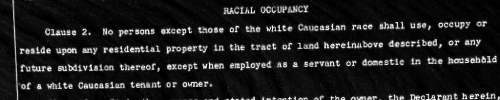
    Image: detail of the deed restrictions for the Sierra Vista Oaks subdivision in Davis (Miller Drive & Ovejas Avenue north of 8th Street) from 1950. [source: Yolo County Clerk-Recorder archives, retrieved by the author]

    By Rik Keller

    Background

    In 1917, the Supreme Court in Buchanan v. Warley ruled municipal racial zoning unconstitutional. In response, private agreements—including restrictive covenants—started to be put in place to continue residential segregation practices: “Racially restrictive covenants refer to contractual agreements that prohibit the purchase, lease, or occupation of a piece of property by a particular group of people.”[1] These were legally-enforceable contracts put onto the deed of the property. They were enforced with the help of neighborhood associations, real estate boards, and other organizations. For example, the National Association of Real Estate Boards (NAREB), started in 1908, promoted the use of racial covenants in new developments.

    Typical language in these racially-restrictive covenants included statements such as “…hereafter no part of said property or any portion thereof shall be…occupied by any person not of the Caucasian race…”[2] These covenants became so commonplace that “by 1940, 80% of property in Chicago and Los Angeles carried restrictive covenants barring black families.”[3]

    (more…)

  • WDAAC Is a Sprawling Urban Planning Disaster

    Westdavisby Alan Pryor and Pam Nieberg

    Forward –

    The Davis City Council has approved a sprawling senior housing development project located in West Davis along Covell. Voters will have a chance to approve or reject the project in this year’s November election. The project is called West Davis Active Adult Community (WDAAC).

    On Tuesday, 8/28, an article by the author was published in the Davisite that discussed the massive reductions in Development Fees given away by the City to the Developer.

    On Thursday, 8/30 another article was published that discussed the erroneous financial assumptions used by the City to project a positive annual financial benefit to the City. That article also discussed how the Development Agreement and Baseline Features for the project are so vague so as to make them functionally  unenforceable

    This current article focuses on the gross deficiencies in general land use and planning for the project and how it fails to meet objective City guidelines for senior housing nor regional sustainable urban planning standards.

    1. The Far Edge of Town is Exactly the Wrong Location for a Senior Development and This Project has Exceedingly Poor Connectivity for Seniors.

    (more…)