Davisite Banner. Left side the bicycle obelisk at 3rd and University. Right side the trellis at the entrance to the Arboretum.

Month: December 2025

  • Why is a Portion of the Village Farms DEIR being Recirculated and has the Proper Process been Followed in Doing So?

    by Alan Pryor

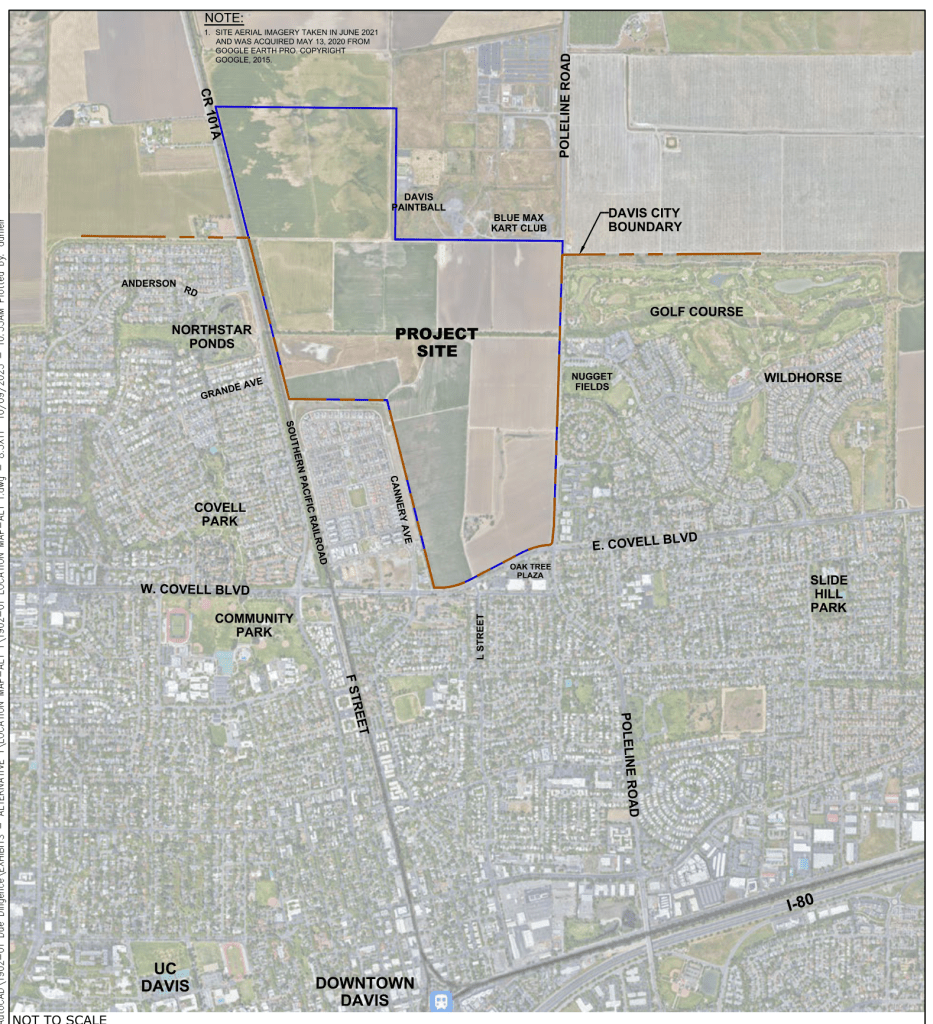
    A portion of the Village Farms DEIR (contained in the Utilities and Services chapter) is being recirculated because the City, as the “lead agency” in the EIR process, has received a last-minute report from Brown and Caldwell dated November 7. This report indicates that the City’s existing Wastewater Treatment Plant (“WWTP”) is perilously close to exceeding its maximum flow capacity and needs to be upgraded to meet the City’s wastewater treatment permit issued by the Regional Water Quality Control Board. This information was not known by the City when they prepared and circulated the current Village Farms DEIR for comment.

    However, since the new information impacts the analysis of the Village Farms project’s impact on the City’s WWTP, the City determined that the portion of the Village Farms DEIR addressing Utilities and Services needs to be recirculated with the updated information for public comment prior to consideration of the revised FEIR for certification by the City.

    Unfortunately, the City has done a poor job explaining this need to the public when they recirculated the portion of the DEIR needing additional comment. Two questions immediately come to mind that should have been answered by the City in more detail and explained better when the DEIR was recirculated.

    1) What Information Came to Light that Necessitated the Recirculation of the Portion of the Village Farms Davis DEIR?, and

    2) Is this Process Proper and Legally Compliant with CEQA and State Regulations Regarding Public Noticing and Subsequent Consideration by the Planning Commission and the City Council?

    The following discussion addresses these questions.

    (more…)
  • Planning Commission declines to even discuss Village Farms evaluation process

    By Roberta Millstein

    At last night’s Planning Commission meeting, I was the only (!) oral commenter, via the call-in option. I raised a series of concerns about the process and timeline for evaluating the Village Farms proposal, which I will paste in below. Yet neither staff nor any member of the Planning Commission chose to acknowledge the existence of my concerns, much less respond to them. I will let the reader decide whether I am making a mountain out of a molehill (possibly) or whether the Planning Commission shirked its duty by not even discussing the concerns.

    As background, the sole point of the meeting was to decide whether to “continue” the Dec 2 meeting until Dec 17, to “to allow for the final negotiations of the project’s draft development agreement to be completed such that the Planning Commission can take action before the draft is forwarded to the City Council for consideration.”

    Here is the slightly longer version of my comments that I emailed to members of the Planning Commission prior to the meeting, differing primarily in the second paragraph which I had to cut for time in my oral comments.

    (more…)
  • Take action today for Cache Creek habitat

    By Catherine Portman

    Urge the Yolo County Board of Supervisors to postpone the Dec 9th vote on Cemex’s application to extend the Granite Capay Mining and Reclamation permit another 10 years. Send your comments to clerkoftheboard@yolocounty.org and Lucas.Frerichs@yolocounty.gov

    Almost 30 years ago, I participated in the Cache Creek “gravel wars”. We believed the aggregate industry could mine gravel and reclaim mined areas. The County adopted the Cache Creek Area Plan (CCAP) which included reclamation requirements prioritizing reclamation of farmland, then secondarily habitat.

    Well, after all these years the reclamation hasn’t worked out too good. Turns out it is very difficult to meet the “healthy soil” requirements of the Surface Mining Reclamation Ordinance. It takes a long time to accumulate enough soil to put back to recreate an ag field. And when the soil is stored so long it loses its mojo according to a soil assessment by consultants House & House.  The assessment identified one reclaimed ag field produced only wheat but before it was mined it produced sunflower, corn, tomatoes and peppers.

    Habitat reclamation is sad too. Deep pit mining was supposed to result in recreational lakes in a proposed Cache Creek Parkway. Turns out the stagnant water in the pits has high levels of methyl mercury that precludes recreational use—also not too good for fish and water fowl. The Cemex application adds two more, larger (204 acres) deep pits. Some of the pits are into the water table so ground water goes into the pits and evaporates from the surface further depleting ground water. Lakes were not the natural ecosystem of the Creek—riparian floodplain was.

    (more…)