Davisite Banner. Left side the bicycle obelisk at 3rd and University. Right side the trellis at the entrance to the Arboretum.

The Permanent, Compounding Measure N Parcel Tax Is Out of Sync with Declining DJUSD Enrollment

Kindergarten

(Chart from Mr. Best’s presentation)

The School Board has completely ignored the massive student enrollment decline while they ask all of us to pay ever increasing taxes, indefinitely!

The only way to stop this disconnect is to vote NO now while you have the chance.

 By Michael J. Harrington, a downtown neighbor and Davis voter for 29 years:


On March 7, 2023, only months before Measure N was finalized and placed on the ballot, DJUSD Superintendent Matt Best testified to the Davis City Council that:

There are fewer students of school age in our region. Not only being born but in the 5–19-year age group. This is information from the census.”

In my courtroom work, we lawyers call the testimony and slides in this video a “party admission.” It is considered the highest caliber of evidence because the best possible evidence comes from the other party’s mouth.

Mr. Best further states

 “ … the number of resident students has declined by more than eleven hundred over the past seventeen years. This decline has been masked primarily due to a large extent by the increasing number of nonresident students joining our district and it wasn’t until the pandemic that the number of nonresident students stopped keeping up with the decline of resident students … that is why we are seeing the overall decline in the district’s enrollment during the last couple of years.” 

This shocking set of admissions was hidden in plain sight, on the City Council web site last year.

Even the DJUSD Officials – long before they placed Measure N on the ballot – testified to the Davis City Council that the declining enrollment is a big problem, the supply of non-Davis transfer students is drying up, and without changes, the Davis school system is facing a major enrollment decline. This testimony was backed up with detailed professional slides filled with demographic data provided by a third-party demographics company, and clearly demonstrate DJUSD enrollment is declining and will drop further in coming years.

The video from the March 7, 2023, presentation to the City Council is so shocking that I decided to try and get it out even at this late hour so voters can see for themselves that the district is asking for an ever-increasing permanent tax even while the district enrollment shrinks. Voters deserve to know about this disconnect and you certainly won’t see any mention of it in the Yes on N campaign literature. The video included here is a collection of outtakes from the council meeting (the full meeting video is available on the City of Davis website).

04-DJUSD-Demographics-Update-Presentation_Page_11

(Slide from Mr. Best’s presentation)

Considering this plummeting enrollment data, that the Measure N tax will never expire because it lacks a sunset clause, and that the tax increases every year without end, voters will see that the only responsible course is to vote NO on Measure N.

Because it lacks a sunset clause it is all but certain that today, March 5th is your only chance to vote NO. Future repeal will be almost impossible.
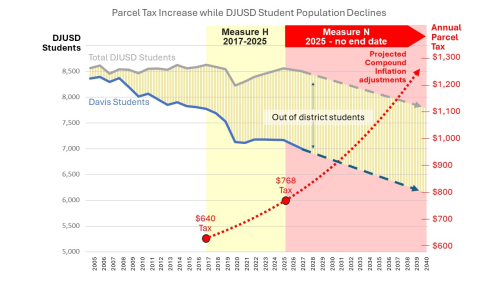
Slide1

The enrollment data through 2027on this chart is taken directly from the DJUSD projections. The projections past that are based on CA department of Finance projections.

I have voted for every previous school funding measure, but Measure N’s indefinite increases when the student population is declining is outrageous, so I must vote NO.

The Board has long known about the declining enrollment and did not apply it to the Measure N tax amounts and removed the sunset clause so it would be almost impossible for the public to undue the tax in the future. Now, if voters slap their hands and vote this tax down, the Board has 15 months to fix this problem and several opportunities to bring a new measure to voters before the current tax expires in June 2025. 

Despite the fearmongering Yes on N claims, there is no emergency to approve this!

Vote NO and make them bring back a more reasonable proposal with a sunset clause so we can be sure the district properly addresses the demographic crisis in enrollment.

Davisite logo

Did you enjoy reading this article? Then subscribe to the Davisite for free and never miss a post again.

Comments

17 responses to “The Permanent, Compounding Measure N Parcel Tax Is Out of Sync with Declining DJUSD Enrollment”

  1. Jay

    Thanks Michael for posting this. I appreciate your bravery in speaking up because anyone who opposes Davis’ school parcel taxes is vilified on social media. Sometimes it feels like almost everyone in Davis blindly votes for school parcel taxes. Hopefully your efforts here will open some eyes and start a movement to force the school board and teacher’s union to start the difficult conversation of how to right-size the district for the projected 5-10 year population of Davis-resident students, then seek an appropriate level of funding for that duration.
    BTW another topic I haven’t heard discussed with relation to out-of-district transfers is absenteeism rate. Per the CA Dept of Education website absenteeism in Davis is high at 16.7%! How many of these are transfer students whose parents work in Davis but don’t make the effort to bring their kids to school on days they are off work? This is problematic since school funding is based on attendance.

  2. Ron O

    Thanks Michael for posting this. I appreciate your bravery in speaking up because anyone who opposes Davis’ school parcel taxes is vilified on social media. Sometimes it feels like almost everyone in Davis blindly votes for school parcel taxes.
    Interesting that you mention this, since my account on Facebook was blocked (twice, now) when commenting in support of Beth Bourne’s similar posting on Facebook. Beth does not know the reason for it.
    My comments were VERY mild on there, and largely avoided the trans issue. I stuck with the type of issues raised by Mike Harrington, though I’ve been raising the same points for years.
    I did not try to ask about or protest the blockage, as I don’t post on Facebook very often in the first place.
    The first time it happened, I was responding to someone who is apparently a teacher/staff member at DJUSD. But there’s no indication that (she?) was responsible for it.

  3. Don Shor

    “How many of these are transfer students whose parents work in Davis but don’t make the effort to bring their kids to school on days they are off work? ”
    I was an interdistrict parent for the entirety of my kids’ schooling in Davis. It never even occurred to me to hold my kids out of school on days I was off work. As a parent, I understood it was my job to get them to school.

  4. Colin Walsh

    I completely agree with Don.
    If anything the days I have “off” are easier days to get kids to school. What is more challenging is half days, or days the kids are late etc. but frankly that is true if I lived in Davis or Woodland. I supposes the further away you live the harder it harder it is to deal with all the unexpected whatevers that come up.
    It is notable that the absentee rates higher in Davis though and definitely deserves looking into, but with actual data not just speculation.

  5. Ron O

    Don: You are somewhat unique, in that you (as a property owner) pay the parcel tax, despite not living in Davis.
    Though one might argue that enrolling your kids in Davis schools resulted in an unnecessary commute, on your days off.

  6. Colin Walsh

    As far as paying taxes, anyone who’s employer is based in Davis is presumably paying taxes into the city and contributing to the parcel tax directly or indirectly. Unless of course it’s a non profit like UCD that pays nothing into the District at all and is the largest employer in the region.

  7. Ron O

    Colin: Someone who is an employee (for example, a worker at a plant nursery) is not paying those taxes. The owner is, just like they do with all other expenses. The owner does not “deduct” their employees’ salaries to account for it.
    Another alternative is for them to raise their prices, to the point at which the market will support it.
    But ultimately, owners may decide that their expenses no longer justify staying in business at a given locale, at the salary that they need to provide to remain competitive. (Or, are mandated to do so by the state’s minimum wage laws.)
    It’s unfortunate that the city did not negotiate a contribution from UCD, when they had a chance (e.g., in regard to the housing agreement).
    It’s also unfortunate that apartment complexes are charged the same amount as single-family dwellings or businesses.
    Truth be told, it’s PARENTS who should be paying for their kids education – regardless of where they live. Rather than assigning the costs to properties. (But that’s a whole different can of worms.)

  8. George Galamba

    I voted for the measure because I moved to Davis for the schools, and feel that there is no more important function of government than to prepare the next generation to take over. It doesn’t bother me that the tax is ongoing–what tax isn’t? However, having said that, I also agree with Mr. Harrington that the city needs to adjust to the new reality and act accordingly. It’s much easier to add faculty and staff than it is to reduce them, but maybe it’s time to consider closing one of the junior high schools at least.
    On a different note, why is the city building so many new buildings if enrollment is declining?

  9. Ron O

    George: One no longer has to move to Davis, to attend Davis schools. 🙂
    In fact, one can attend Davis schools without having to pay the parcel tax at all (directly, OR indirectly).

  10. Ron O

    From today’s Vanguard:
    “Declining enrollment threatens to reduce ADA money coming into the school district and while the district can attempt to shed spending, our previous analysis showed that in general the district could only shed 60 cents on the dollar.”
    So again, I see David repeating this claim – which appears to be from the district itself. (I don’t recall David himself performing any analysis, but he is also biased regardless.)
    And yet, one of the first rules of financial analysis is to not rely upon calculations or conclusions put forth by an organization that has a stake in the outcome.
    Even using the district’s own figures, each and every student enrolled at DJUSD costs more that it receives from the state.

    And yet, DJUSD is pursuing students whose families don’t even contribute to the parcel tax at all. How does this make sense to Davis voters, let alone those who actually have kids in that system?
    Again, the only way to analyze cost reduction measures (e.g., closure of a school) is to have an outside (non-interested) qualified party perform the analysis, or at least audit the results. And again, that hasn’t happened.
    David should be smart-enough to know this.

  11. Ron O

    And then there’s this follow-up comment from Dave Hart – who can always be counted on to say something like this:
    It seems to me that you are unnecessarily charitable when you state Michael Harrington does not understand some of the issues. It appears to me that he and his anti-tax friends understand all they need to know: the parcel tax would be levied against every parcel they own. A parcel tax eats away at the final return on their real estate investments. What more do they need to know?
    Let me get this straight. On the one hand, those associated with the school district claim that the parcel tax INCREASES the value of properties (for sale, or rent). On the other hand, Dave Hart claims that it “eats away” at their investment.
    So which is it? It can’t be “both” on a net basis.
    And Mike Harrington is going to spend ($8,000?) of his own money (in hopes of convincing an entire city) to save some smaller amount on his total tax bill? And yet, voted for every other school parcel tax, previously?
    Dave Hart’s claims make about as much sense as David’s. It’s unfortunate that those like him (who tend to be self-labeled “progressives”) put forth claims like this.
    People aren’t always motivated by their own self-interest. Though many of those associated with the school district appear to be.
    Again, look at what Mike Harrington actually said: The school district is TOO LARGE in relation to the actual needs of Davis, among other issues. Fix that, and THEN seek a parcel tax.

  12. Keith

    Ron, I thought the arguments that Harrington put forward were very logical and sane. The vote was very close, so close that next time the school district puts a parcel tax forward they might have to think about adding exemptions to some other class of people in order to make sure it passes.

  13. South of Davis

    Keith wrote:

    they might have to think about adding exemptions to some other
    class of people in order to make sure it passes.
    Or they can just get more suitcases of ballots to put them over the top in the final hour of “counting”…
    Can anyone remember a single parcel tax in CA that barely lost? In the last 30 years I’m aware of quite a few that barely “won” with between 66.6 and 66.9% of the vote.

  14. Ron O

    So, as predicted – the Vanguard (and no doubt others) have barely waited for the votes to be counted regarding Measure N, before they start begging for more housing developments, which they believe will save them from shutting down a school or two.
    While also putting forth misinformation (e.g., the savings that would result from right-sizing the system).
    Unfortunately, that’s what the success of Measure N ultimately encourages – exactly as predicted.

  15. Colin Walsh

    Ron, don’t forget that any new housing development will mean more parcells that each pay over a 1,000 a year into the school district in bonds and parcell taxes. another way to look at this is now that they have the parcel tax set permanently they are already looking to increase the multiplier – number of parcells. So even if the new developments add more students to the district, it will also add more tax money.
    The question is how many kids will any development add? the Cannery added very few considering how many units it has. the affordable housing attached to student housing projects actually added a lot more than the district expected. In other words – type of housing being added makes a big difference as to whether or not it will actually bring more students to the district. it looks like affordability is important if you want to bring kids.

  16. Ron O

    Colin: Conversely, reducing the number of kids (while maintaining the same number of parcels) results in the parcel taxes going farther.
    Eliminating (over time) some of the 1,200 “out-of-district” attendees over time would achieve that result.
    But the wrong premise is put forth in the first place. The question isn’t, “how big should the city grow to accommodate the desires of an oversized school district”?
    The question is, “how large does the school district need to be, to serve DAVIS residents?”
    I don’t know why some think that an oversized school district should be driving city policy, nor do I know why that would even need to be explained to anyone.

  17. Ron O

    As far as Affordable housing is concerned, I believe that some forms are exempt from property/parcel taxes.
    And if anything other than a single-family dwelling, they are paying a “diluted” form of the parcel tax at best.
    The “type” of single-family dwelling that would be “affordable” is not going to be large enough to house large families. That’s why families buy a house in Woodland, instead (and send their kids to Davis schools, without paying the parcel tax).
    There is nothing that Davis can realistically do to change this, nor should it be a goal in the first place. Other than discouraging out-of-district attendees.
    Again, all of this goes back to the wrong question being asked. The first (and really only question) is, “how large should the school district be, to serve the needs of the community”?
    For that matter, all of this is ultimately the school district’s problem, not a city-wide problem. Even those with kids in the system do not remain there very long.
    How was that ever considered to be a “city” problem? The city doesn’t already have enough on its own plate as is?
    If a school or two is closed down, that’s going to eliminate a substantial number of commuters (and students) from out-of-district. In other words, when out-of-district teachers and staff are laid-off.
    Unfortunately, city officials seems to think it’s “their job” to fix the school district’s problem, and without even acknowledging “what” the problem actually is – an oversized district.

Leave a comment