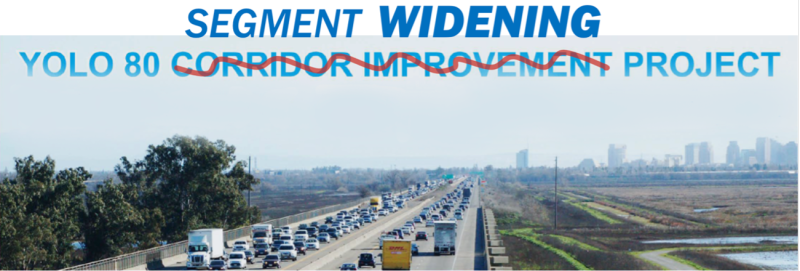
The following letter was submitted this morning by Dr. Stephen Wheeler and the Sierra Club Yolano Group as formal comments for the Yolo 80 Draft Environmental Impact Report (DEIR), addressed to Dr. Masum Patwary, Environmental Scientist C at the California Department of Transportation. A copy was also sent to the Davis City Council. The letter concludes by stating that the Yolo 80 DEIR should be revised and recirculated.
Dear Dr. Patwary:
This letter provides detailed comments on the Yolo 80 Draft Environmental Impact Report (DEIR) on behalf of the Yolano Group of the Motherlode Chapter of the Sierra Club.
I have prepared these comments as an unpaid Technical Advisor to the Yolano Group. In my professional life I am a Professor of Urban Planning and Design in the Department of Human Ecology at the University of California, Davis, and Chair of the UC Davis Community Development Graduate Group. I have studied urban and regional planning topics for more than 35 years, including interactions between transportation systems and regional land use patterns, and was formerly chair of the City of Berkeley Transportation Commission and cofounder of the Bay Area’s regional transportation-land use-housing advocacy organization Transform. I am the author of urban planning textbooks used in universities worldwide, including The Sustainable Urban Development Reader (Fourth Edition, 2023), Planning for Sustainability (Third Edition to be published in late 2024), and Reimagining Sustainable Cities (2021). My awards in this field include the Dale Prize for Excellence in Urban and Regional Planning.
Let me say first that it’s very unfortunate that the Yolo 80 project has proceeded this far without better alternatives being considered. As has been widely known for decades, widening freeways does not fix congestion problems; it just defers them for a few years while increasing overall motor vehicle use, greenhouse gas (GHG) emissions, local air pollution, suburban sprawl, and related problems. The climate crisis gives particular urgency to the need to stop increasing road capacity and vehicle use. Although California is making progress in many sectors towards reducing its GHG emissions, transportation is one area in which it is not. Transportation is also the single largest source of the state’s GHG emissions, accounting for 38 percent of the total.
In order to meet California’s GHG reduction goals, the state has adopted policies that discourage road expansion and its concomitant VMT increases. SB 743, passed in 2013, required agencies to use VMT as a metric for analyzing transportation impacts of new projects after July 1, 2020 instead of Level of Service (LOS). Put another way, this bill made reducing overall motor vehicle use the goal of state policy rather than short-term reductions in road congestion. The California State Transportation Agency (CalSTA)’s Climate Action Plan for Transportation Infrastructure (CAPTI), adopted in 2021, establishes policy that “projects should generally aim to reduce vehicle miles traveled” and counsels agencies that “when addressing congestion, consider alternatives to highway capacity expansion such as providing multimodal options in the corridor, employing pricing strategies, and using technology to optimize operations.” However, Caltrans appears to be disregarding the state’s new policy framework with multiple projects including Yolo 80.
A certain amount of congestion isn’t bad in that it puts realistic constraints on the public’s behavior. However, if congestion is deemed to be a problem beyond that point, the academic and professional literature shows that pricing, better land use planning, and other demand management solutions (e.g. working with large employers to promote vanpools and transit use) are the best strategies. But Caltrans never considered those alternatives in the Yolo 80 case. It clearly wanted to widen the freeway from the start, and indeed appears to have illegally begun widening I-80 east of the Mace intersection and west of the I-50 split in early Fall 2023 well before the current environmental review was completed. This action shows a high level of disregard for CEQA/NEPA processes, and we ask Caltrans to suspend construction activities on Yolo 80 until environmental review is completed and the environmental document certified.
The Yolo 80 DEIR has a great many deficiencies which require revising and recirculating the document. These include the following:
(more…)




 Davisite
Due to the tyranny of Measure J and its [edited] supporters, the ship for commercial development in Davis has long since passed. The owners of existing Davis commercial developments know they can continue to command high rents because they don’t have to concern themselves with very much competition. A while ago I found a quote in the Davis Enterprise about why the current owner of the Oakshade Town Center decided to buy that development. They don’t have to worry much about competition because as long as Davis thumbs its noses at brand new development, they have it made in the shade.
Moderator
Hi Walter,
We’ve edited your comment. We won’t allow ‘NIMBY’ any more.