Davisite Banner. Left side the bicycle obelisk at 3rd and University. Right side the trellis at the entrance to the Arboretum.

Month: January 2024

  • Yolo County MHSA Community Member Survey & related info

    MHSA survey flyer(From press release) The Yolo County Mental Health Services Act (MHSA) Annual Update FY 2024-2025 kickoff began Tuesday January 16th with a Community Engagement Work Group (CEWG) meeting (slide deck).

    As part of the Community Planning Process, MHSA requires counties to engage in community planning and engagement annually to gather feedback on community needs to inform the development of the plan.

    This year Yolo MHSA is requesting support with the following:

    • Yolo County MHSA Community Member Survey (anonymous)
      • Complete and distribute this electronic survey
      • The survey will remain open until February 9, 2024, 11:59 pm
      • Hardcopies will also be available in HHSA buildings and community locations shortly

    • Regional Listening Sessions-participation (TBD Feb/March)
      • Additional information on the listening session dates and formats will be forthcoming by email
      • Email lvila@evalcorp.com if you would like to be invited to a Community Listening Session

    • Yolo MHSA Community Flyer distribution (to the right)
      • Please post and share with others

    Please email MHSA@yolocounty.org if you have any questions or require any additional information.

    Thank you for your interest in Yolo County's Mental Health Services Act Community Planning Process!

    MHSA Team

    Mental Health Services Act

  • League of Women Voters Supervisor Candidate Forum

    League

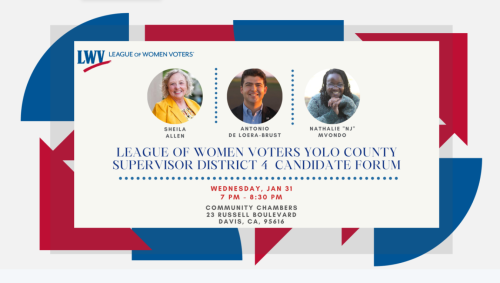
    The League of Women Voters Davis Area is having a candidate forum on Wednesday Jan 31 at 7pm for Yolo County Supervisor District 4.  There are 3 candidates.  The forum is at the City of Davis Community Chambers. Get tickets at: lwvyolosupervisorforum.eventbrite.com.

    Candidates Sheila Allen, Yolo Supervisor’s Deputy, Antonio De Loera-Brust, Farmworker Communications Director, and Nathalie “NJ” Mvondo, Social Entrepreneur will introduce themselves to the community and answer League and community questions.
    The forum will run from 7:00pm-8:30pm. Doors open at 6:45pm.
  • Council to Commit to De-Commissioning Commissions?

    MusicalChairs

    There's some metaphor here… ask the Council about it?


    Today, January 30th, the City of Davis City Council will “Consider Recommendations Related to Commissions”. Please show up this evening – item 5 is scheduled for 7:20pm – or call the comment line at (530) 757-5693 before 4pm.

    Let's look at some recent history first… and then tonight's meeting:

    June 3rd 2021

    “City Council Subcommittee and All-Commission Chair Meeting”. Video. 

    This was a two-hour meeting between all Commission Chairs with then City Council member Lucas Frerichs – who chaired the meeting – and Gloria Partida.

    It’s worth noting that two of the Commission Chairs – Bapu Vaitla and Donna Neville – are now on the City Council. Vaitla does not reference this meeting in the Council sub-committee proposal scheduled for this evening.

    While the meeting is certainly worth a focused viewing, for now I will focus only on statements made at the meeting related to future activity (e.g. further similar meetings with Chairs, Council agenda items, etc):

    “Hopefully not the last meeting” (Lucas, earlier in the meeting)

    “Update to the City Council Coming shortly” (Frerichs @ 1:59:40 – it’s not clear if this meant any minutes from meeting would be passed along to Council)
    “Hopefully on a regular basis” (Frerichs @ 2:00:00 – Referring to an intention for similar meetings with Chairs.)
    “I’m sure that Kelly [Stachowicz] and Zoe [Mirabile] also will […] put together some minutes.” (Partida – 2:01:00 – As no publicly-distributed minutes are taken, it’s not clear what this referred to. )

    At the end Colin Walsh – the Chair of the Tree Commission -  asked about when there would be another similar meeting “in the not too distant future”.  Partida responded:  “It was pretty clear that that’s one of the main takeaways here… we will be setting that up”. She also said  “…What I heard was that people are we really wanting twice a year to meet this way…so I can [should or will be able to] confirm that”  (Walsh, Partida from 2:04:25)

    Despite what Frerichs and Partida said or intended, there were no meetings – between Chairs and a Council non-quorum or in City Council – until February 2023, 20 months after the 2021 meeting. 


    February 7th 2021

    City Council Meeting. Community comments start at about 2:34. Some highlights:

    * Alan Hirsch. gives a good comprehensive look at the overall poor state of things regarding respect for Commissions. 

    *John Johnson – a member of the NRC -  talks about NRC not having enough time to do what it needs to

    * Alan Miller suggests a great, truly-democratic and also streamlined idea for organizing the Council and Commissions. 

    * Roberta Millstein makes clear the paternalistic functioning of Council and Staff

    * Colin Walsh criticizes the generally low-quality process

    Based on Colin Walsh's observation at the meeting, there were very few members of the Public at the meeting. This would indicate a likely lack of communication about the agenda topic. I also don’t understand why it was called a “workshop”, as it didn’t have this form.


    Present Day:

    Two pieces earlier this week in Davisite:

    Council to Eliminate Tree Commission Tuesday

    City Commissions Merger Proposals are Ill Conceived – Testify Tuesday


    In the sub-committee report for today’s meeting: 

    "The Council Subcommittee spoke with all AVAILABLE chairs (or vice-chairs) [emphasis mine] of existing commissions to receive their feedback on what is working in the present structure and what could be improved." [page 4]

    "In reviewing the scopes and structure of each of the City's 14 advisory commissions, the subcommittee undertook the following research: […] * Met with [ALL?] chairs and vice-chairs of each commission to gain a better understanding of what works well and areas of potential improvement, especially with respect to Council direction about what areas of commission activity would be most valuable; [page 7].

    What actually happened? Did the Chairs and/or Vice Chairs coordinate with each other? Did they have the opportunity to e.g. get questions from Chapman and Vaitla and then get input from their Commission before speaking with Chapman-Vaitla?Are there minutes of these meetings?

    The proposal would – in the long-run – have a total of approximately 28 fewer Commissioners than the current 98, so just under 1/3 less participation from the same city (and possibly expanding) population, with similar low to mid level staff, same senior staff and same council numbers, and still minimal involvement from youth (see below)

    While there would be less staff hours, it's not clear if this will reduce staffing expenditure (I don't fully understand how staff gets paid when working evenings, etc)

    The new language comes from state-mandates on General Plans, but it's clear that the "Element" names don't have to be included in the names of the related Commission.

    We then have the proposed "Circulation and Active Mobility" – and they don't get the correct name for the BTSSC again!  – but I think that Circulation is a somewhat old-fashioned term which I believe – and not only superficially – relates to LOS (Level of Service)

    The archaic and unusual name of "Circulation…" as the new name for what’s unfortunately and informally oft-referred to  as the "bike commission" with "….and Active Mobility" which in aggregate is… poor English (just like the current BTSSC, as “Bicycling” is a subset of “Transportation” (outside the sporting context) and “Street Safety” is mostly a quality of the situation, 

    I would prefer e.g. “Efficient, Joyous and Safe Mobility Commission”, as it covers all forms of transportation using conveyances, walking, other means of travel, resources/climate change issues and the social sphere!

    "The required Noise and Safety elements [of the Consolidation] are not listed; community engagement for these will be led by Staff.)" (page four) Seriously, what the actual f*ck?? Is there any actual logic for this or a similar and official mechanism in any other part of the proposal

    There's a promise at the end that no one will have to leave, presumably Commissions will change as people term out, but will there will perhaps be more split votes for a long time due to math: 7 to 7, 6 to 6, 5 to 5, 4 to 4 votes (before Commissions "settle" again at 7 members.

    There's NO proposal for a Commission of Youth Members/Youth Commission. About 90 cities and towns in California have these!  At the very least, there's no proposal for more youth OR age of minority-age ex-officios for ALL Commissions

    There’s NO promise of more communications – via social media, the City’s website, etc – to encourage more attendance and attention of Commission meetings and ongoing work, inclusive of biographies of Commission members. One should not have to Google a Commissioner’s name to see their affiliations, job, a bit about their experience, etc.

  • Council to Eliminate Tree Commission Tuesday


    Image001

    Before the Tree Commission: 2nd & G Street Downtown


    Davis’s 60 year old tradition come to an end

    By Alan Hirsch, the Davis Lorax

    Value seem to have changed: Tree Commission will likely be ended by City Council Tuesday

    Tree advocacy & policy work will be subsumed into the Natural Resources Commission that will be renamed the “Climate and Environment Justice” commission.  (Seems pollution and consumption of natural resources out of style). 

    The husk of the Tree Commission work will be retained in an ironically renamed “Tree Removal Commission.” per the staff memo summarizing one year of behind the scenes work by Josh Chapman and Bapu Vaitla.

    This signals an historical shift in vaiues for Davis:  The 60 year old Commission is one of oldest in city. It was founded 1963 as the “street tree committee”. Davis was a leader in municipal arboriculture at the time and was one of the first “Tree Cities” designated by the National Arbor Day Foundation. The city passed on of  first Parking Lot Shade ordinance in the county (1979).  This in not surprising as Davis , located next to the foremost arboricultural research universities in the world.   LINK to tree history of  Davis  

    However this move might also be seen as consistent with city management failure to enforce and update the Code section 37 Tree Protection Ordinance. It might also bode poorly for role of Trees in the proposed rewrite of the city general plan= the city planner failed to put enforceable promises about tree in the recently approve Downtown Plan despite much input form public, Tree Davis, and the Commission.

    This move was a surprise to the Commission members, so seem not to have been surveyed. Deputy City manager Kelly Stachowicz  share this likely decision with Tree Commission for the first time on Friday at 5pm council.

    The council  agenda item on this and elimination of two other commission will be heard 7:20 pm  or later:  Member of public can attend or call in their thought  (2 minute)   Tuesday between Noon and 4 Tuesday 530-757-5693. https://documents.cityofdavis.org/Media/Default/Documents/PDF/CityCouncil/CouncilMeetings/Agendas/2024/2024-01-30/05-Commissions-Subcommittee-Recommendations.pdf


    Thoughts of the Lorax based on my attending 14 years of tree commissions meetings; 

    1. It seems to me; elimination of the Tree Commission subverts Urban Forest Master Plan (UFMP) call for more community participation.
    2. Bodes poor for Trees in the General Plan: We all can remember Trees were not including in the DT Plan other than with platitudes and unenforceable promises.
    3. Reflects current Culture of city hall staff relative to citizen participation: Peter Drucker said: “Culture eat strategy for breakfast.”


    UNPACKING

    1. I have long though there needs to be a rethinking of commissions structure and specifically the  role of Tree Commission. See this article I wrote almost exactly a year ago:  Rethinking Our Failing Davis City Processes  How can we build more durable consensuses?
    2. UFMP: How is elimination of the Tree Commission (TC) consistent with the $250K Urban Forest Master Plan (UFMP) we just completed?
    3. Decrease Community Engagement with Tree. Most of us have thought city recommitment to urban forest involved more community involvement, not just adding one person to small staff of 5 managing over 30,000 trees.  We can learn from history about the  effect of the subsuming of tree Commission into the Natural Resource Commission. About 8 years back the  Bike Commission was combined with the Traffic, Parking and Street Safety Commission Is now BTSSC.  Bike  commissioner members were all enthusiastic ats time, but for the first 12 month this combined commission had not a single bike item on its agenda– staff control the agenda recall. The amount of attention to bike/active mode has dramatically declined from before the new combined commission. 
    4. This reorganization likely signals diminished role of trees for the new General Plan rewrite. City Council did not put tree in the DT Plan building code despite many letters from many stakeholders. And council has failed to follow up on promise to remedy this in a separate DT tree plan. With elimination of Tree Commission this bodes poorly for anything more than unenforceable platitudes in a new General Plan.
    5. How will UFMP be assured of implementation with ending of consistent  accountability & visibility . There are ~120 goals in UFMP to do over the next 40 years yet there is  no 3- or 5-year plan milestones -  so where is the mechanism for accountability the UFMP will ever be implement? We are now moving toward an “urban Forest czar” model like in most cities; their  actions are largely invisible to public only the city manager see it.  This relegates trees to feel god performative plantings. We need policies to grow and protect tree, not just plant them.
    6. Good Intents won’t counterbalance lack of check and balance: Urban Forester Charlie Murphy has good intentions, but his action will  be invisible and beholding to city manager as tree stakeholders will no longer have a seat at the table — i.e. the UFMP will likely go the way of similar plan in cities like Woodland. Developments also will proceed without proper consideration of tree. The Sutter Hospital tree debacle was caused by City management short cutting public process.  just like city decision to allow removal 50 tree at Cannery (50 people show up at council one night to complain night). Expedient decisions on trees are made behind  closed door by  top city management who override the city arborist and wave fines when trees are cut illegally.  The decision like to lack of trees in DT plan and failure to enforce tree ordinance will go unnoticed without a Tree Commission who are consistently involved and charged with “speaking for the trees”.
    7. Signals Participation and Expertise of Community Not Appreciated: Our city has a wealth of expertise on Tree as we are sight next to one of foremost arboricultural research institute in the world,  yet this has never been used by the city. And when It is, it is ignored:  A grad students have contract do to research paper on tree protection ordinance (2012) but this was ignored.   There have been hundreds of volunteer hour put in by the TC members – in three different attempts (2015 2017,2021) — to revise the tree ordinance- All were all ignored by top- city management and set to council  even for feedback.
    8. Davis City Hall Culture override UFMP and Council City Tree Promises   Maybe this proposal is just making it official: the onoy consistent role I have seen for  Tree Commission only role  consistently used by city staff over my 15 year was as the   “Tree Removal Commission.”  This, ironically,  is the only husk of the now 60-year-old commission (founded 1963)  that is being retained. LINK to history:  
  • City Comissions Merger Proposals are Ill Conceived – Testify Tuesday!

    997436a9-42d2-42cf-856b-30517f0720da


    The City Council is hearing proposals to consolidate commissions on Tuesday night. These changes have serious implications. Here are the proposals:

    (more…)

  • Arnold calls $465mil I-80 Widening “Insanity”

    Council Member & Former Caltrans Employee’s Remarks on I-80

    Will arnold picture

    Submitted by Alan Hirsch

    Below is a transcription of Councilperson Will Arnold remarks on the I-80 widening for the video of the 1/9/24 Davis Council meeting. Arnold was the Manager of Media Relations at Caltrans HQ until August  2023.  His testimony adds to that of the Hi level whistle blower Jeanie Ward-Waller  She accused Caltrans of violations CEQA in moving ahead freeway widenings and I-80 project in specific. YoloTD Board has never asked their staff or Caltrans a single question about that in any open board meeting.

     (Link to city website with video see time stamp  3:51:29)


    Thank you,  Mayor Chapman.

    There is an important note I want to read:

    ‘Highway investments over the years have contributed to a dependence on automobiles and supported development patterns that have made walking, cycling and transit use inefficient, challenging and sometime dangerous in many parts of the state.  Highway investment have also contributed to the displacement and division of some neighborhoods and imposed noise and safety hazard on many others.

    Further research over the past several decades had demonstrated that highway  capacity expansion has not resulted in long term congestion relief and in some cases has worsen congestion, particularly in urbanized regions. (ed note: all emphasis his)  Projects in urban area that add travel lanes result in changes in travel behavior due to a short-term reduction in travel time and improvement in reliability. This phenomenon known as “Induced travel” explains why adding capacity has rarely succeed in reducing congestion over the long term or supported alternatives to driving and more transportation efficient land uses.

    Finally, highway expansions are costly. Expansion of the existing highway system means less available funding for other transportation needs and priorities as well as continued increase to long term maintenance costs for the existing system. As a result, we cannot continue the same pattern of highway expansion investment in California and expect different results.  3:52:52

    Rethinking our approach to highway expansion programs will be a critical part of insuring we are working toward equitably meeting our climate change goals.  3:53:01 ‘

    This is part of the state Climate Action Plan for Transportation Infrastructure, known as CAPTI. This is a document passed in 2021 by the state transportation agency signed by Davis Hi Alumnus David Kim, former (CA) Secretary of Transportation 

     They Know. THEY KNOW (Arnold emphasis), They know what we are saying it true. 

    This isn’t a secrete in Sacramento, this it isn’t a secrete in any of the 12 Caltrans districts, even District 12 in Orange county. They know.

    And yet, we reach these inflection points where it’s time to put our money where our mouth is as a state in how we invest our limited transportation dollars, and we each these inflection points and the same thing keep happening when we invest in what we know, which is more freeways, or lanes expecting a different result. 

    Which we know is the definition of Insanity.” ends 3:54:18

  • Sierra Club Endorses No on Measure M – No on the Floodwall in Woodland, CA

    (From press release) Citing “the potential to induce sprawling growth”, the “potential adverse impacts on prime farm land”, “lack of proper public process”, devastating environmental and social outcomes including climate change, air pollution, and loss of biodiversity, the Sierra Club announces its opposition to Measure M in Woodland CA on the March 5, 2024 Special Municipal Election Ballot. Measure M is a vote to allow the construction of the Lower Cache Creek Flood Risk Management Project or, as it is referred to locally, the “Floodwall”.

    In 2004, a majority of Woodland voters passed Measure “S”, which added a section to the Woodland Municipal Code that provides that the City shall not fund or take any action that supports the Lower Cache Creek flood barrier or a “substantially similar structure”.

    A "No" vote on Measure "M" will keep that prohibiting language in the Woodland Municipal Code in its current form as originally enacted by Measure “S”, and will not allow City Council authorization for the construction and funding of the Lower Cache Creek Flood Risk Management Project.

    The Lower Cache Creek Flood Risk Management Project consists of a 5.6 mile massive earthen structure from 6 ft to about 16 ft above grade, depending on its location, and the existing topography of the land. It will run east-west just north of the northern urban limits of the City of Woodland connecting to an existing levee on the Cache Creek Settling Basin.

    The endorsement of the opposition to this ballot measure follows an extensive evaluation process by the local Sierra Club Yolano Group Management Committee, the Sierra Club Mother Lode Chapter Political and Executive Committees, and the Sierra Club California Local Measure Review Committee.

    (more…)

  • Soroptimist financial literacy series begins Jan. 24

    Jenkukis

    Jen Kukis (Courtesy photo)

    (From press release) Women and investing will be the topic of the Wednesday, Jan. 24 meeting of Soroptimist International of Davis. The free program, open to the public, will be from 11:45 a.m. to 12:45 p.m. in the conference room at University Inn and Suites, 1111 Richards Blvd., Davis.

    Women experience a gender pay gap and have smaller pensions than men, yet they live longer. They also spend more time caring for others, which impacts their income and savings. Soroptimist International of Davis wants to empower local residents by offering a series of financial literacy talks. The programs are educational and free from sales pitches.

    Jen Kukis, an Edward Jones financial adviser from Davis, will give the Jan. 24 presentation, Future programs, each led by a new financial expert, will be Feb. 28, April 24 and May 29.

    With five money questions, Kukis will help attendees identify their financial goals and set strategies. Participants will be given tools to assess their financial positions, establish objectives, and begin formulating plans on ways to get there while staying on track.

    Lunch is provided by the club, with donations accepted to cover costs. First-time guests are always free.

    Soroptimist is a global volunteer organization that provides women and girls with access to the education and training they need to achieve economic empowerment. It was founded in 1921 in Alameda County. Soroptimist International of Davis was chartered in 1954. Local members join some 75,000 Soroptimists in 122 countries and territories to contribute time and financial support to community-based projects benefiting women and girls. Its core values are gender equality, empowerment, education, diversity and fellowship.

    SI Davis offers cash Live Your Dream Awards to female heads of household seeking education or training, and assists King High students through its Dream It, Be It: Career Support for Girls program. It also funds high school scholarships, and grants to nonprofits that align with the Soroptimist mission.

    SI Davis members meet twice a month on Wednesdays – once at lunchtime and once in the evening – and connect for other fun activities and service. Learn more at https://www.sidavis.org/.

  • Tree Davis Seeking Feedback on Plans to Transform Sections of Robert Arneson Park into Climate-Ready Landscapes

    Arenson Park No Monument (1) (3)

    (From press release) Wildhorse neighborhood residents and Tree Davis have been developing a concept to transform under-used portions of Robert Arneson Park (the park adjacent to the intersection of Moore Boulevard and Bonnard Street in Northeast Davis) into Climate-Ready Landscapes. Climate-Ready Landscapes are spaces that are visually vibrant, drought tolerant, and support local nature. At Robert Arneson Park, this will be in the form of pollinator gardens and mini-forests. The Robert Arneson Park concept is related to work that Tree Davis has been working on at the Memorial Grove in West Davis on Shasta Drive.

    Tree Davis is seeking feedback about the concept from park users and other stakeholders to gain insights about what changes will work best. There will be two in-person feedback sessions at the park. Before proceeding with this project, it is important that the Wildhorse community and other park users are comfortable with the changes that are proposed for the park. Tree Davis staff will be tabling, answering questions, and accepting feedback on Thursday, January 25th from 2:30pm to 5:30pm and Saturday, January 27th from 8:00am to 12:00pm near the central rotary off of Moore Drive.

    Those that would like to share their thoughts but are not able to come to the in-person sessions can share feedback through an online survey, which can be found at: https://forms.gle/AfjBDcvJV3wERngA9 To see the project plans and learn more, visit our website at: https://www.treedavis.org/robert-arneson-park/

    Tree Davis is a 31-year-old local non-profit that was established by local leaders to ensure the health of the city’s urban forest. Over the years the organization’s focus has grown – today the mission is to improve the health and resilience of local communities by enhancing and expanding Climate-Ready Trees and Landscapes through direct action, community engagement, and advocacy.

  • ML King’s Lesson on how needed structural change is slowed by cities

    By Alan Hirsch  

    This year's Davis city-sponsored King celebration is on Peace Activism. It will take place on Monday at 10 am at the Veterans Memorial Center.

    This 53-second viral YouTube video of Stokely Carmichael/Kwame Ture discussing peace and justice provides the context in which King was working.

    I believe local cities, especially progressive  Davis can best honor King by learning from him about how change happens- what it feels like when you are in the middle of the story.  We can learn by analogy what it looks like when a local community is grappling with deep structural change—and how local civic leaders respond when they recognize the need for a change in the traditional way of doing things.

    King’s goal in 1960’s was to reform the structural evil of Jim Crow, deeply ingrained in the culture of Southern cities.

    Today, we are in the middle of a story of how to deal with the climate crisis -  a  society dependent on burning fossil fuels creating a crisis for long-term survival.

    For Dr. King the obstacle to change was not Washington but local government. The Supreme Court had just equipped local governments with tools through rulings like Brown vs. Board of Education. The Eisenhower and Kennedy Administrations were sympathetic, yet in the 1960s South, it was local  businesses  & governments that resisted. They sought to first maintain peace, of the status quo, fearing that change would be disruptive, leading to divisiveness and disorder.

    Similarly, in addressing climate change, the State of California has established strong goals and policies. It has provided local governments with tools under the environmental impact process to reduce our dependence on fossil fuels. 

    Local leaders are aware of what is at stake for climate.. During a discussion of the I-80 freeway widening January 9th Davis Councilmember Will Arnold shared what he learned when he was a Caltrans employee.  He read from Caltrans HQ policy states freeway widening does not fix congestion for long  and also undermines the state climate change plan…. local caltrans district need to stop advancing these projects.  Arnold summed it up dramatically:
       "We know this," widening freeways is "insanity."

    (more…)