Davisite Banner. Left side the bicycle obelisk at 3rd and University. Right side the trellis at the entrance to the Arboretum.

Month: January 2022

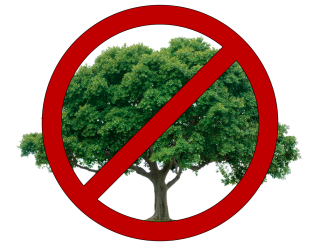
  • A Treeless DiSC?

    Trees2Developer Proposes Baseline of Zero Trees Planted in New DiSC Development

    The below letter was sent to the Davis City Council regarding a lack of commitment to planting trees in the massive new development. The Davis City Council takes up DiSC 2022 at the Feb. 1 meeting. You can find the agenda here. The agenda contains information for how to view the meeting and offer public comment. The DiSC proposal can be found here.

    ________________

    Dear Davis City Council,

    The below letter is informed by my work on the Tree Commission and on the Tree Commission subcommittee on DiSC 2022, but represents my own point of view, though others on the Tree Commission may share it.

    Initially I was encouraged to hear the DiSC project was adopting a goal of planting 1,500 trees as the Tree Commission recommended. Then I read the actual language of the proposed baseline feature,
    "The Project will add no less than 1,500 new trees to the City’s urban forest to sequester carbon, improve mental health, deter the heat island effect, and provide shading. If less than 1,500 trees are planted onsite, Developer will ensure that the remainder will be planted elsewhere in Davis."
     
    This baseline feature actually commits to planting zero trees in the project itself. The Baseline has no baseline. The language is carefully crafted to commit to only adding trees to "the City's urban forest." The language allows for every single tree to be "planted elsewhere in Davis." The baseline features make no commitment to any number of trees in the project itself. That is totally and completely unacceptable. The vast majority of these 1,500 trees, if not all of these trees, need to be planted in the DiSC project itself.
     
    The ground for planting a tree is the hardest part to come by for planting a new tree, if the developer doesn't commit to planting these trees in the project itself, there is little prospect of planting 1,500 trees elsewhere in the City of Davis anytime soon. The DiSC Baseline Features and Development Agreement provide no mechanism for planting trees "elsewhere in Davis" and no enforcement for assuring trees are planted and maintained elsewhere. That is a further reason why committing to zero trees actually planted in the project is entirely unacceptable.

    (more…)

  • 2022 Virtual Celebration of Abraham

    Hope in difficult times     flyerHope in Difficult Times: An Interfaith Conversation

    (From press release). The Celebration of Abraham, which is the only interfaith organization guided by the laity in Davis and Woodland, will hold another virtual celebration this year, Sunday February 6, 2022, 3 pm-4:30 pm. We deeply miss gathering with everyone in person and look forward to doing this again as soon as we can do so safely.

    We recognize that the pandemic, environmental destruction, and political unrest continue to affect our well-being and therefore our ability to sustain ourselves as we face these challenges. For this year’s theme, “Hope in Difficult Times: An Interfaith Conversation,” we have chosen three young leaders to offer guidance grounded in their faith traditions: Leah Julian, Rabbinical Student; Tara Rogers-Soeder from the Davis United Methodist Church; and Omar Abdel-Ghaffar from Muslim Davis Engagement and Interfaith Network (DEIN). Our speakers will explore how we can live with hope without turning away from the difficulties that we face in our individual and collective lives. After hearing from the three speakers, we will invite attendees to discussion breakout rooms to share their thoughts.

    Randy Farris will again lead us in singing Children of Abraham. We will raise donations for the International Rescue Committee. To sign up for the free event hosted on Zoom, please go to  http://bit.ly/COAHope. This link is case sensitive. You can also sign up by going to our website at http://www.celebrationofabraham.net.

  • DiSC 2022: Same Old Choices

    Im-with-herBy Larry D. Guenther

    On Tuesday, the City Council will decide whether or not to put DiSC 2022 on the ballot again. DiSC 2022 is a new version of the project on the outside of the Mace Curve that was voted down in its last iteration. It is now about half the size of the previous project. One of the Council’s goals is economic development. Another of the Council’s goals is Carbon Neutrality by 2040. In our current development paradigm, these goals are contradictory. That’s because our current development paradigm is centered around the automobile and commuting workers.

    Approximately three quarters of our community’s total Green House Gas Emissions (GHG’s) come from transportation (78% projected for DiSC) – and the lion's share of that is single-occupancy vehicles; i.e. commuters. Hence the problem. DiSC is designed for commuters – it is designed in the current paradigm. The EIR for the DiSC project says that this project alone will increase the City’s total GHG’s by 4%. The EIR also states that this project will not allow the City to reach its carbon neutrality goal. These are not statements from opponents, this is from the project’s EIR.

    There is scientific consensus that if the average global temperature increases by 1.5°C, our environment (that is to say, ‘we’) will suffer extreme and irreversible negative consequences. There is also scientific consensus that the average global temperature has already increased by 1°C. Additionally global GHG’s – the primary cause of increased temperatures – are still rising. This project would continue that trend.

    (more…)

  • Seven California Community Power Members Contract for 69 Megawatts of Long Duration Energy Storage

    Project marks first major procurement milestone for CCA Joint Powers Agency

    Participating CCAs
    Participating CCAs

    (From press release) At the January 19 California Community Power (CC Power) board meeting, members of the Joint Powers Agency voted to enter into an energy storage service agreement with REV Renewables for 69 megawatts (MW)/552 megawatt hours (MWh) of long-duration energy storage.

    The REV Renewables Tumbleweed project will be a CAISO grid-connected, lithium-ion battery storage resource located near Rosamond, in Kern County, California, with an expected online date of 2026.

    “Long-duration energy storage is a vital resource, needed to amplify the value of renewable power and accelerate California’s shift to a clean, reliable and affordable grid,” said Girish Balachandran, California Community Power board chair and Silicon Valley Clean Energy CEO. “This first project is an exciting milestone that shows how CCAs work together to advance our shared goals in the transition to a carbon-free grid.”

    The California Public Utilities Commission Mid-Term Reliability Procurement order (Decision 21-06-035) requires all CPUC-jurisdictional load-serving entities, including CC Power members, to procure from energy storage facilities capable of discharging for a minimum of eight hours. This project satisfies approximately 55% of the long-duration storage compliance requirements of the participating members.

    (more…)

  • Leaf blowing is also a habitat and a labor issue!


    Progress is progress, but perhaps lost in the progress to reduce the harm caused by leaf blowers to creatures large and small – with university degrees, naked, multi-legged or winged – is the need to make sure that changes in practice don't interfere with the ability of property maintenance workers to make a living and to improve their work environment, wages and skill sets… all while improving nature in our corner of the Universe.

    This evening the City Council will take the long-awaited next step to study the use of leaf blowers in Davis. The agenda item should start on or after 7:20pm.

    First of all I appreciate the findings of the Natural Resources Commission, though I wish their recommendation was for an earlier complete phase out than 2024. A major fault, however, is that the recommendations do not apply to commercial areas. The problem seems obvious: Pollution caused by gas blowers or stirred up by electric blowers affects adjacent properties – which may be residential, part of the proposed eventual ban – and really everywhere because of, you know, air.

    Another way to look at it is that we currently ban leaf blowing when AQI reaches 1oo if that threshold is crossed by just before 7AM – and then there's no decision for a ban for another 24 hours no matter how many firestorms spring out of hell during the interval – based on an air monitor that's outside of the City, just south of West Village. But then it's okay for your commercial neighbor to blow 20 feet from your open window with your asthmatic child.

    That doesn't make sense and it's perhaps I am not explaining it clearly… but I make no apologies: The proposal, though an improvement on the current state of things, is too complicated and therefore hard to enforce. By the way, commercial properties are also the residences of numerous animals who simply happen not to be human.


    Yards are Habitat!

    Leaf blowing makes yard clearance of what's perceived as waste far too easy. This kills habitat for creatures small and larger ones that eat them.It depletes trees of food. It makes it easy to put yard waste in the street, including bike lanes, even though the latter is not allowed. This threatens children on bikes. Leaf blowing is dangerous for children and other living things. It's been city guidance for years to let leaves degrade where they fall, or alternatively compost them on site. (Clean those concrete paths with a broom and a rake, very clever!)

    The choice is simple: Phase out all use of all leaf blowers, allow leaf vacuums IF they don't also pollute, and ban gas-powered equipment. Do this all as soon as possible.

    There's also a recommendation from the Recreation and Parks Commission based on their perspective which is that gas blowers work better than electric blowers so there needs to be more money for lots of batteries and such like — but the way I see it is like this: In relation to air quality and the state of living environment in the city, the NRC has clear priority over Rec and Parks. It's a mistake to consider them equal – or equally relevant – Commissions on this issue.


    It's time to bring a labor angle into this, friends!

    There's more Commission missions about the emissions missing from these missives: About labor. All these guys – mostly guys – disproportionately Latino – who need jobs, jobs that are good for them, get better and give them more in healthy challenges and pay.

    The leaf blowing survey results in the staff report and Commission recommendations detail the nuances of companies and how they work and what tools they use. It's not really explained why some use manual tools and some use electric – aside from the AQI-based bans. But to make things simple let's say that banning the use of blowers increases the amount of work needed, and expenses. With a deep ecological perspective it's simple to say that the people that benefit most from this – owners of properties – are simply entitled. The leaf blowing solution is artificial. 

    It's not pleasant work. We need to humanize it. The goals here likely to keep the same number of people employed and to increase wages, while we improve the environment. It has to be this. We can't settle for less.

    Our aim must be to improve the skill sets of workers, by having them care in a more nuanced way for yards… to plant, to collect acorns, to add habitat for bees… to build boxes and other structures for on-site composting.

    We don't have a labor commission, but we do have a Social Services Commission. Perhaps also Utilities or Fiance and Budget have a role to play? Overall – and clearly – this is an equity issue and it can't be solved only through input from Natural Resources and Parks and Rec. But to be clear, it's up to the workers themselves to decide what they want.

    The Council needs to go forward on the best recommendations made so far but then send this work back to these additional commissions and the citizens for more input and wisdom. We have a tremendous number of experts in related disciplines at UC Davis who will want to help. We have labor experts in the county and region who have to help.  It's not simply a matter of copying best practice from other progressive cities, but improving upon it!

  • Letter from DISC developers to Davis Automobile Association

    AutoCenter
    It took some digging but I found a key letter from the DISC developers to the City of Davis Association of Private Motor Vehicle Sellers and Suppliers:

    Dear CDAPMVSS,

    Following are what we plan on the primary characteristics of DISC in regards to your organization’s mission:

    1 – Most of the day a connection by private automobile to Downtown Davis, UC Davis and West Sacramento will be extremely convenient and fast.

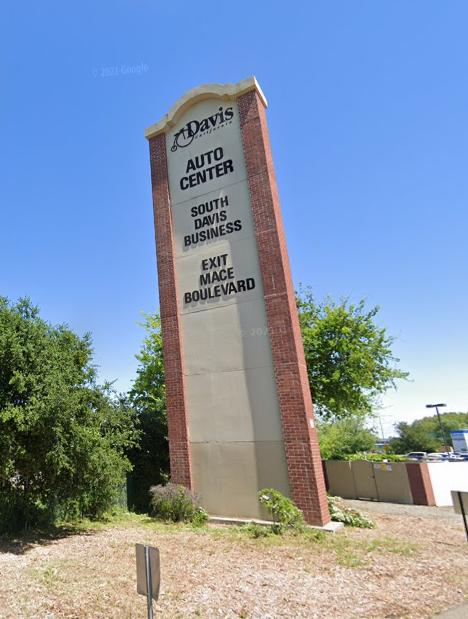
    2 – A private automobile will be required to conveniently and quickly travel to Pioneer Elementary, Nugget (on Mace) and surrounding stores, and of course to the Davis Auto Mall (identifiable by its bicycle logo from I-80).

    3 – Travel by cycling and walking to Harper Junior High and Korematsu Elementary will be significant until a crossing guard is killed and two students are injured at the intersection of Alhambra and Mace. In response we plan to place small posters at bus stops in the area to direct drivers to slow down. We were going to pretend to compromise and pretend to return to our spoken-only agreement the construction of a grade-separated crossing of Mace but in the end the Council didn’t ask for it.

    4 – Travel by automobile to schools outside of east Davis will be the majority mode, especially to Davis High School, and drivers will threaten students crossing E. Covell to get to Birch Lane Elementary, crossing F and 14th to get to North Davis Elementary and the high school.

    5 – The TDM plan will determine that carshare is not interesting for nearly all residents who have opted to rent a parking place near their home.

    6 – Caltrans has confirmed that they have no interest in assisting in building a safe and dedicated bicycle and pedestrian facility across I-80 in the vicinity of Mace, similar to their same position on the I-80 Managed Lanes project.

    7 – Some residents will ride cargo bikes to Target and surrounding shops until a user is killed at the corner of Mace and 2nd.

    8 – The Chevron station at Mace and 2nd will gain business.

    9 – Mode share of the fare-free shuttle to Davis Depot and Downtown will be insignificant due to duration and inability to match fluctuating schedule of Capitol Corridor trains due to problems outside of their control, such as shipping traffic on the Carquinez Strait that requires bridge interruption.

    Thanks, the DISC development team.

  • Hope in Difficult Times: An Interfaith Conversation

    Hope in difficult timesFREE 1.12Join the Celebration of Abraham, Sunday February 6, 2022, 3-4:30 PM, for their Annual Community Conversation – Virtual!

    You must register to attend! Please register here:

    bit.ly/COAHope

    Monetary donations will be collected for:

    International Rescue Committee, Sacramento (https://help.rescue.org/donate/us-northern-california-ca)

  • DISC 2022 Transportation – Planning Commission falls for Developer’s Trick

    TrapBacThe trap was set likely shortly after "DISC  2020" was defeated by voters.  When the developers of this peripheral sprawl – or I'll be nice and call it West West Sacramento – were planning to re-introduce it last year for a vote this year – they realized that a key demand was a grade-separated crossing of Mace. So they removed it from the Baseline Features… fully-intending to agree to do it as a concession.

    Back story

    The City Council-approved Street Standards (2016) don't mention e-bikes at all. What this means is that the width, curvature, and proper siting of infrastructure that would optimize the use of e-bikes – in particular the Type 3 variant that has assistance up to 28 mph – is totally missing in Davis, or more immediately in concepts, plans as well as development agreements and baseline features in current and near-future projects.

    To address this, over two-and-a-half years ago when I was on the Bicycling, Transportation and Street Commission (BTSSC) I got support for adding an item to the long range calendar which would address it; this first appeared on the LRC in September 2019, with a possible date of December 2019 for the agenda. (It is abbreviated somewhat erroneously as "intersection design guidelines / standards"). It has been pushed back repeatedly since then, and the BTSSC did not support forming a sub-committee about it during 2020.

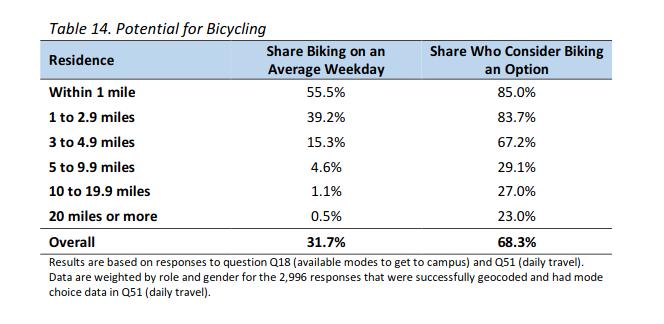
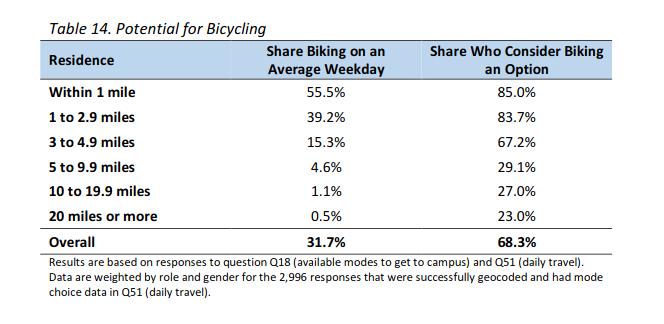
    What this means is that significant concepts and projects which could alleviate transportation problems, such as Reimagine Russell, the new-ish Class I multi-user path on the south side of Russell (chronically and clinically-referred to as a "bike path) or smaller projects all over the city are not future-proofed for the increase of modal share for cycling we desperately need to improve everything from climate impacts to conviviality to fitness to transportation crashes. Our city is simply too large now in size to have a significant modal share with "acoustic" bicycles. Not convinced? Look at the low bike modal share from peripheral areas of town in the UCD Campus Travel Survey, which shows low share even for people with campus destinations where car parking is not always convenient, and not fare-free. It's not hard to extrapolate – necessary, as the City has essentially refused to do its own counts for years – that almost no one regularly rides from Mace Ranch or some other peripheral areas to Downtown for a coffee or beer – sort of the most normal thing in the Universe in a bicycle-branded cycling city.
    SurveyCycling

    UCD Campus Travel Survey 2019-2020 (pg. 30) – By bike, DISC is just over four miles from ARC, a central point on campus when considering agricultural facilities. This distance has about a 10% modal share for cycling, and includes mostly students, many who don't have their own cars.

    However, as we can see from the example above, the faster type of e-bikes are quite expensive. I've seen nothing lower than just over $3,000. Though important – or all – major arteries in Davis – should be optimized for this type of bike – the idea is not only to optimize for them but make safe for all users, including on acoustic bikes – it cannot mean that this type of bike should be essentially required to live here and enjoy the purported high quality of life. Infrastructure optimized for fast bikes is also a significant improvement for all bikes, as it's direct, requires a minimum of stops, is not shared with motor vehicles… or pedestrians and dogs.

    To be more precise, the goal should be the 15-Minute City. This is a relatively new standard or classification of a very, very old sometimes organic strategy to make key locations in a city within 15 min from anywhere else, for all means of transportation. This seems to also serve as a kind of proof of the bicycle modal share results in the Campus Travel Survey. It's definitely something that should be part of our new General Plan, or even worked on earlier by a joint Commission process (BTSSC, Planning… perhaps Natural Resources and Social Services…). I would argue that it should also be about effort, so a 5 or perhaps 7-minute walk is the equivalent of a 15 min bike ride. I've said that if kids can't walk unaccompanied 5-minutes from where they live to buy ice cream cones, it's a failure (and that's just one example, a single ice cream place or a truck at DISC doesn't make it sustainable.)

    It's also quite important to be reminded that the City of Davis has for over four years not had a senior civil engineer with a transportation focus. Many projects have gone forward – sometimes to completion, often with significant flaws – without the benefit of this experienced and wise counsel.


    Last Night

    At the Planning Commission review of Disc 2022 last night – and early this morning – I was actually quite impressed by the comments from multiple Commissioners regarding negative transportation issues of the planned project, and even the general discussion about its unavoidable impacts and uncertainly of benefits from transportation demand management… well, at least earlier in the discussion. Commissioner Shandy was particularly right on with her criticism of planned widening of Mace – presented by the developer as a kind of unquestioned religious observance – contradicts claimed benefits for people cycling and walking. There were other positive and thoughtful comments by a majority of Commissioners.

    I knew that the grade-separated crossing of Mace was a kind of sneakily-hidden prize and tried to point out in my sort of sloppy recorded comment that that a safer crossing of Mace would not on its own make DISC 2020 excellent for cycling (this is better than "cycle-friendly"), because of distance from Downtown and places further west, and besides that, safe crossings directly to the south along Mace across 80 would cost many millions and be very complicated (and at least in my head I know that Caltrans District 3 and the Yolo County Transportation District have withdrawn the earlier plan – it was supposed to be built first! – of a new bike and ped bridge across the Bypass as part of the I-80 Managed Lanes Project.)
    Screenshot from 2022-01-13 02-14-21

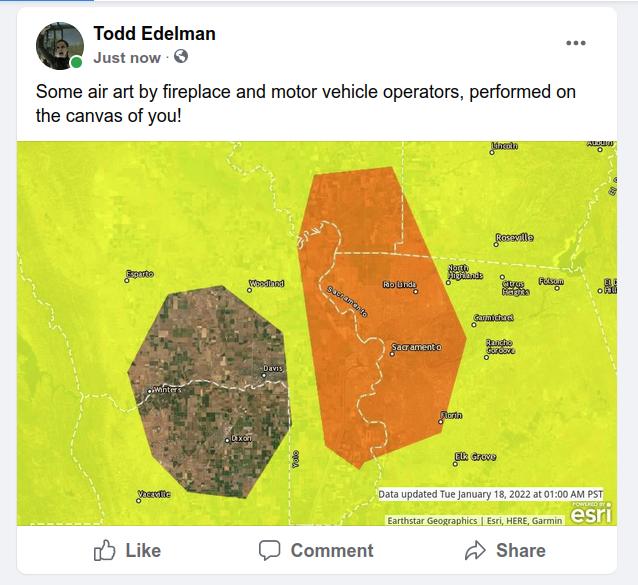
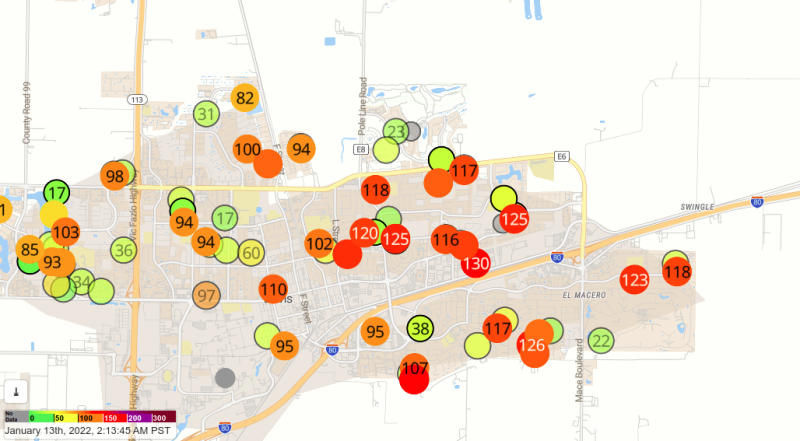
    Just an aside about the bandied about "globally-known sustainability of Davis": This was the air quality last night shortly after the meeting was over (via Purple Air)


    The Trap is Sprung

    Though it was fully-intended to be a positive thing and I will give credit to Commissioner Shandy, the discussion and lead-up to a vote turned sour when she proposed that a grade-separated crossing of Mace and a Class I trail across the undeveloped land south of Harper Junior High would make her feel better about the planned Mace widening and other traffic impacts. She suggested nothing about safe cycling and walking connections to other places, such as the Nugget and popular restaurants across 80. But the problem is that, for example, the area planned for housing at DISC 2022, on the north and eastern side of the project area, is more than 15 minutes away by bike from Downtown and at leat 20 to 25 minutes away from the UC Davis campus that is the raison d'être for DISC 2022! Moreover, the route has almost no optimized cycling infrastructure the whole way (varied from local streets to arteries, no protected bike paths, lack of priority at stops, etc… there is no proposal for any of this in any proposed development agreement or baseline features). But mainly it's too far by bike… never mind walking! Most of the time people – with free or with un-bundled parking – will take I-80 between campus and DISC, even more so to many facilities etc on the west side of campus related to agriculture. I-80 is such a fantastic route much of the day that nothing can compete with it, including shuttles and express buses, which I am sure will at best have a tiny modal share.  This creates huge challenges for any development more than 15 min away from key locations, and it means simply that they should not even be considered. (Oh, wouldn't it have been great if staff were directed to work on the General Plan and told the developers that there was no capacity to work on stuff that would very likely be in violation of a progressive outcome for it?)

    So the Planning Commission has recommended the two elements mentioned above that are supposed to address problems on Mace to the City Council. My conclusion is that the developers will signal their intention to accept them – perhaps with a little drama – and the Council will praise them for doing so. But again, even with everything promised (e.g. shuttles, TDM) and not promised (e.g. e-bike-optimized infrastructure) there's still no place for DISC. Still no way to successfully do something better than I-80 via private vehicle for anything but a minority. There's really nowhere to walk to from DISC. Hopefully the voters will see through this ruse and others and reject DISC 2020.

    Galadrieltempted

    In the ALTERNATIVE timeline, Lady Galadriel was tempted by but in the end did not succumb to the Power of the Grade-Separation ring
     

    Denethor

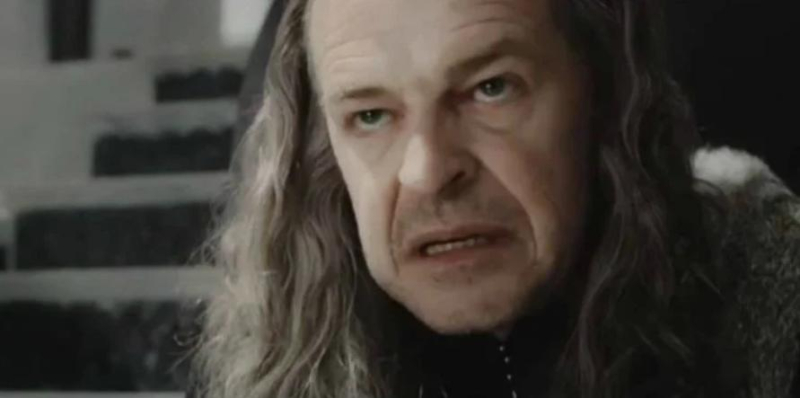
    In the REAL timeline, Lord Denethor, Steward of Gondor, was consumed by the Grade Separation Ring and driven mad.


    Question

    Last night I was quite surprised when the developer said with much conviction that baseline features were not necessary to enforce the creation of certain designs and programs at DISC 2022, as these would be required by CEQA. Then why have baseline features as a solution for any of these things, in all the discussion for years up until now? If a reader could enlighten me I would truly appreciate it.

    Afterword

    I am all for more housing – for all income levels, but with a significant proportion below market and lower income – and workplace and related development in Davis. I have never said I was against these things in any local discussions, for example in the Davis Vanguard. But they have to be infill, they have to be on greyfields such as parking lots, industrial areas along 5th St – not only the PG&E yard – and in the eastern side of South Davis and other areas much closer to Downtown and especially for what DISC 2022 purports to be about much closer also to campus. With electric shuttles on fixed routes, optimized cycling infrastructure, a new connection across 80 around L St., mixed-use above (existing) parking lots and so on many if not close to all of the actual benefits of a project like DISC 2022 can be realized. It's not impossible, it's not rocket science, it simply requires conviction, creativity and less b.s. and false claims about sustainability. Hopefully Council, Commissions… local media… and organizations such as Bike Davis and Cool Davis re-direct the citizenry towards an alternative to DISC or a truly sustainable version of it… closer to and integrated with the City of Davis and the UC Davis campus.

  • No DiSC Baseline Features to Reduce Traffic and Related GHG Emissions will Produce even Greater Adverse Environmental Impacts than Those Projected in the EIR

    The following email was sent to the Planning Commission this afternoon.

    Dear Planning Commissioners:

    Firstly, I sincerely apologize for the late hour at which these these comments are delivered to you.

    I understand you have received a letter yesterday from Roberta Millstein discussing how the Baseline Features have been throttled back at DiSC 2022 relative to DISC 1.0. However, her communication only discussed the Baseline Features which were originally proposed for DISC 1.0 and then materially weakened or removed entirely in DiSC 2022.

    There were a number of other important recommended Baseline Features proposed by various Commissions which never saw the light of day in either DISC 1.0 OR DiSC 2022. This communication focuses only on those unaccepted Baseline Features recommended by the Natural Resources Commission that could have profoundly beneficial impacts in terms of reducing expected traffic problems and reducing GHG emissions otherwise associated the project

    According to the EIR, transportation represents 78% of the 55 million lbs of new GHGs projected to be produced by the DiSC project. In fulfilling their project review objectives, among many worthwhile suggestions, the NRC in particular recommended 3 very clearly identified Baseline Features for the project to reduce adverse traffic impacts and associated GHG emissions from the project. All were rejected by the Developer of the project.

    We recommend that the approvals for this project not be granted until the Developer has agreed to the NRC-recommended Baseline Features identified below.

    Respectfully submitted,

    Alan Pryor

    (more…)