Davisite Banner. Left side the bicycle obelisk at 3rd and University. Right side the trellis at the entrance to the Arboretum.

Month: May 2021

  • This sounds fishy!

    Sound-spikesBy Robert Canning

    At next week’s city council meeting, council will be asked to change the city’s sound ordnance. With little discussion or notice, city staff have added an item to the agenda that could have big implications for city planning and residential neighborhoods in Davis.

    In a nutshell, the amendment would, as one person has put it, allow someone to stand in front of your house and blow an air horn for a minute or two every hour without violating the sound ordinance. This would be allowed because city staff have decided it is better to measure sound by averaging it over an hour, rather than use a simple measure like the maximum allowed sound, how the current ordinance works. A quick check on the web shows that two other college towns – Chico and San Luis Obispo – have existing sound ordinances that use the “maximum” sound standard. Others have found that most cities use the maximum allowed sound rather than an average.

    And this makes sense. Using maximum allowable sounds – particularly during quiet periods like nighttime – eliminates repetitive loud noises like, to use an extreme example, pile drivers and other such concussive noises as the Chico ordinance notes. San Luis Obispo has sound levels for daytime hours that are meant to limit loud noises such as leaf blowers and the like.

    (more…)

  • Davis Housing Element Fails Affordable Housing

    Housing elementOn 5/26 the City of Davis Planning Commission met to discuss the draft housing element. The Housing Element is a state mandated component to the Cities General Plan since 1969, California has required that all local governments update the Housing Element on regular intervals to meet the housing needs within the community. The City of Davis is receiving comments on the 2021-2029 housing element through July 1st at 5pm. you can learn more about the 2021-2029 Davis Housing Element here Link .

    What follows are the comments of Rik Keller to the Davis Planning Commission.

    __________

    5/26/2021

    To: City of Davis Planning Commission

    From: Rik Keller

    Re: Housing Element Update

    I have been a long-term affordable housing consultant and advocate since the mid-1990s. Locally, I have recently advocated for increased affordable housing for various projects in the City review process…

    …and for more equitable and inclusive housing policies in general:

    I am a strong advocate for addressing exclusionary housing practices. We already have tools in place to counter “snob”/exclusionary zoning. These include inclusionary zoning (IZ) policies that the City of Davis has in place as part of its Affordable Housing Ordinance [AHO] (see Article 18.05 of the Davis Municipal Code: http://qcode.us/codes/davis/view.php?version=beta&view=mobile&topic=18-18_05)

    Unfortunately though, the City of Davis has drastically weakened its IZ policies in the past decade. In 2011, in response to pressure from development groups, it suspended its Middle Income Ordinance that was targeted to provide housing affordable to the local workforce. And in early 2018, the 25-35% requirement for inclusionary/affordable housing in the City’s Affordable Housing Ordinance (AHO) was reduced to 15% “temporarily” because of a need to respond to State rules. In the almost 3.5-years since, the City has been promising to update its IZ requirements, but has repeatedly broken its own deadlines, and hasn’t completed the required studies to update it.

    (more…)

  • “Should Trees Have Standing?”

    IMG_7711The legacy of Christopher D. Stone.

    By Nancy Price

    It is fitting to honor Christopher Stone just when the Vanguard is hosting a webinar on the topic of Climate Change, SocioEconomic Disparities in Tree Cover and Sustainability on Sunday morning (May 23).

    For those who have never read Stone’s seminal article, he is remembered by so many as the father of environmental law for his inspired, path-breaking article, “Should Trees Have Standing? Toward Legal Rights for Natural Objects.”

    In this 1972 article in the Southern California Law Review where he taught at the USC Gould School of Law for 50 years, Stone wrote: “I am quite seriously proposing,…that we give legal rights to forests, oceans, rivers and other so-called ‘natural objects’ in the environment – indeed to the natural environment as a whole.” He went on to propose that these rights would be asserted by a recognized guardian, much as the law allows for guardians for children, incapacitated adults and others who have rights but require someone to speak on their behalf. As Stone pointed out, “the world of the lawyer is peopled with inanimate right-holders – such as trusts, corporations, joint ventures, municipalities…and nation states.” Stone was insisting that rather than treating nature as property under the law, that nature in all its life forms has the right to exist, persist, maintain and regenerate its vital cycles.

    (more…)

  • Rainbows will be ready for Davis Pride

    2019crosswalk2

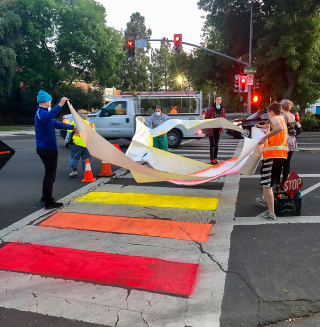
    Davis Pride volunteers move stencils on May 10, 2019, while painting temporary chalk on a Fifth Street crosswalk in Davis. (Wendy Weitzel/Courtesy photo)

    (From press release) Rainbow crosswalks, live music, drag queens and skating are all on the calendar as Davis celebrates June is Pride Month.

    The Davis Pride Festival will be Sunday, June 13 in Central Park, 401 C St., Davis. Several activities lead up to and follow that celebration:

    On Thursday, May 27, Davis Phoenix Coalition representatives will speak at the virtual Davis Chamber of Commerce meeting. The presentation will offer practical tips on how businesses can be welcoming to LGBTQ+ individuals. Participants will receive a rainbow poster to hang in store windows that show their support of Pride Month.

    The popular rainbow crosswalks will be painted around Central Park on Sunday, May 30. Volunteers will begin spraying the temporary chalk paint at 6 a.m., and continue until about 11 a.m. To volunteer, go to http://bit.ly/rainbowcrosswalks.

    (more…)

  • Mother Nurture Art at the Episcopal Church St. Martin’s in Davis, California

    Image1 5

    Photo of "Mother Nurture" by Ann Liu

    (From press releatse) As part of the Episcopal Church of St. Martin’s theme of healthy soil, healthy plants, and healthy community, the church has accepted an offer to host an art installation from the Arts, Cultures, and Designs of Remediation research cluster at UC Davis.

    The Arts, Cultures, and Designs of Remediation cluster is a working group of faculty and graduate students from the performing arts, environmental design, and soil sciences. Their mission is to challenge us to think about how we can remediate and heal our soil, and tell our stories by doing so.

    They have invited St. Martin’s to display a beautiful and creative art piece named Mother Nurture in its developing garden space outside of the Parish Hall facing Hawthorn Lane. It was recently shown at the International House in Davis and is now at St. Martin’s from May 14, 2021 to June 14, 2021.

    (more…)

  • The Yolo Way meets the American Rescue Plan

    Our recovery from the pandemic must also be a response to the climate emergency
    By Adelita Serena
    You may have seen an internet meme that began as a March 2020 Graeme MacKay editorial cartoon. In one version, a “COVID” tsunami threatens a coastal city; behind it comes a larger “Recession” tsunami; behind it a “Climate Change” tsunami; and finally behind it a “Biodiversity Collapse” tsunami.

    Despite Yolo County’s inland location, we need to take seriously the message of this cartoon — that our recovery from the pandemic must also be a response to the climate emergency. It must also address deeply entrenched economic and social inequities causing these crises to strike some communities and demographics much harder than others.

    One immediate way to do this is to use our American Rescue Plan funding to develop narratives, programs, and projects that do all three: repair damage from COVID-19, fight climate change, and follow the leadership of frontline and long-disadvantaged communities for whom these efforts have the highest stakes. We can call our approach to these problems “The Yolo Way,” by which we signal our local recognition of what Martin Luther King called “an inescapable network of mutuality” and our commitment to making that network more healthy, just, fair and sustainable.

    (more…)

  • Letter from the Yocha Dehe Wintun Nation concerning the Cannabis Land Use Ordinance

    The following letter was sent to the Yolo County Board of Supervisors on May 4 and shared with the Davisite for publication.

    Dear Chairman Provenza and Board of Supervisors:

    On behalf of the Yocha Dehe Wintun Nation, I write to voice our continued strong concerns about the manner by which the County of Yolo is proceeding with regard to its Cannabis Land Use Ordinance ("CLUO"). Our concerns are far-reaching and fundamental. We continue to believe the Environmental Impact Report the County commissioned is deficient under the California Environmental Quality Act ("CEQA"), for all of the reasons stated in our prior correspondence and which we hereby incorporate by reference.  For reasons we cannot fathom, the County continues on a myopic course, refusing to supplement or expand an analysis to one that measures the actual environmental impacts of an industry the County unleashed four years ago as an admitted experiment, and without any CEQA analysis whatsoever.  On a matter of such great import, involving a land use policy affecting so many people's lives, we fail to understand why the County is unwilling to take the time needed to get it right, or meaningfully consider reasonable alternatives to  protect people and their property. Instead, the County seems dedicated to moving forward against this deficient record, and recommending final action on an ordinance that will establish legal rights for a problematic industry.

    We implore the Board to step back and review the record. The comments from long­ time Capay Valley farmers and residents are generally consistent. Furthermore, County responses to people's grievances are revealing, as they are largely dismissive and conclusory, and protective of the cannabis industry generally. By this correspondence, we ask the Board to take corrective action and slow this process down to ensure CEQA is satisfied and that the best land use policy is developed. At the same time, we ask the Board to grant the Tribe's and our neighbors' request to protect the Capay Valley region, and in particular to, carve cannabis grows out of the rural residential communities west of Interstate-505 along State Route 16, which are simply not suitable to cannabis cultivation. As noted, the Tribe would help mitigate the impacts to growers who invested in the Capay Valley, by helping finance their relocation.

    Our Efforts to Reach A Resolution That Would Protect Much of the Greater Capay Valley Region from Cannabis Cultivation.

    (more…)

  • Capay Valley is Being Overrun by a Disproportionate Share of Yolo County Cannabis Farms

    The Overwhelming Majority of the Owners of these Cannabis Farms are NOT Capay Valley Residents

    by Alan Pryor

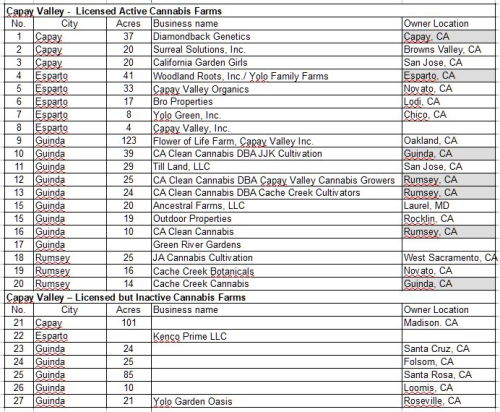
    According to records provided by residents of Capay Valley opposed to the proliferation of cannabis farms in that rural and semi-rural area, there are 54 licensed pot farms in Yolo County with identified APN parcel numbers. Of these 54 farms, 27 (50%) are located in or near the unincorporated towns of Guinda, Rumsey,  Capay, and Esparto in the geographically short and narrow Capay Valley. The remaining 27 farms are located in other widely dispersed unincorporated areas of Yolo County. Based on land area alone, this is obviously a hugely disproportionate concentration of cannabis farms in this generally less wealthy area of the County.

    Capay Valley Cannabis Farms

    It is further noteworthy that of the 27 cannabis farms in the Capay Valley, only 7 (26%) have a person or business owner with an actual identified mailing address in the valley itself – everyone else is from somewhere else.. (Note: County records are incomplete or inaccurate so some property/business owner information was not released or otherwise unobtainable. As a result, not all information is currently available for all cannabis farms licensees).

    (more…)

  • Should Davis spend millions of dollars on a ladder fire truck?

    UC Davis Ladder Fire Truck no 34

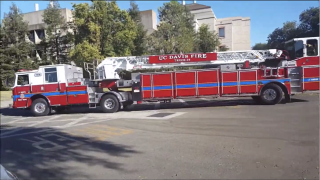
    UC Davis's Ladder Fire Truck – Truck 34

    By Roberta Millstein

    Is now the time for the City of Davis to be spending millions of dollars on a ladder fire truck when it currently only needs this type of truck approximately once per month at most, when it can currently borrow UC Davis’s ladder truck for free?

    What information do we need to answer this question?  What do we know and what do we need to know?

    According to the Davis Enterprise, on March 16 the Davis City Council “expressed unanimous support for acquiring a ladder truck for the Davis Fire Department and directed staff to move forward both on securing a detailed cost estimate for a truck as well as developing plans to modify the downtown fire station to accommodate it.”

    The estimated costs discussed thus far are as follows (with the City possibly being able to obtain some grants to offset some of these costs):

    (more…)

  • Residents United to Demand a Cannabis Exclusion for Greater Capay Valley

    The following group-written letter was sent to the Yolo County Board of Supervisors, several of whom also shared the letter with the Davisite and suggested that other people concerned about this issue can contact the Board at: "Oscar Villegas, 1st" <oscar.villegas@yolocounty.org> "Don Saylor, Chair, 2nd" <don.saylor@yolocounty.org>, "Gary Sandy, 3rd" <gary.sandy@yolocounty.org>, "Jim Provenza, 4th" <jim.provenza@yolocounty.org>, "Angel Barajas, 5th" <angel.barajas@yolocounty.org>, "Patrick S. Blacklock, Co Admin’r" <patrick.blacklock@yolocounty.org>

    [Updated to add signatories].

    Dear Supervisors: 

    We are residents of the rural communities along Highway 16 west of the 505 in Yolo County, with most of us living and some of us farming in and around Madison, Esparto, Capay, Brooks, Guinda and/or Rumsey. This area is a special one, renowned for the quality of its produce and sustainable farming, and variously called the “Capay Valley” or “greater Capay Valley.” We submit this letter to express our strong and united opposition to the cannabis industry in our communities.  

    Since the County first began experimenting with the cannabis industry four years ago, and authorized cannabis cultivation without any prior analysis or environmental review, the greater Capay Valley quickly became overwhelmed with cannabis grows. As you stand ready to approve an Ordinance that will bring some permanence to this industry, we ask you to hear us.  While we recognize the County wants this industry because of the revenues it will generate, the Board needs to consider the real costs this industry poses to our way of life.  

    Many of our families have lived in this region for generations. We have personally witnessed – and experienced – the harmful impacts of this industry. We want to make it clear to you, the elected Board of Supervisors, including our District 5 Supervisor Angel Barrajas, that we want the cannabis industry out of the greater Capay Valley, which needs to be protected from cannabis cultivation and related uses with an express exclusion or ban.

    (more…)