

More than one person has asked me…
By David Abramson
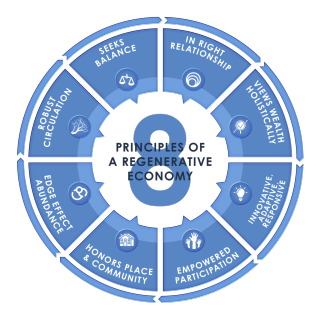
No, it’s not a fancy economists’ term like “Asset Turnover Ratio”, “Speculative Motive”, or “Marginal Standing Facility”. It’s not the latest econ diet fad, scheme, or tomorrow’s scandal. No I didn’t invent it . It’s not even defined by a single person or a single idea, but it is a collection of ideas under shared guiding principles. You may already have a sense of what it might entail by hearing the words Regenerative and Economics joined together. To me:
Regenerative Economics represents an economic system, or many interlinked economies that are in line with the needs of our planet and the needs of people who live and work in our communities. It represents a measure of wealth defined by a healthy planet and thriving people.
Simple, right? Well perhaps not, if you consider the role of the current economic system in our ongoing ecological and social crisis.
The Hard Questions
How does the money we spend contribute to our global greenhouse gas problem? How much does it contribute to usage of chemicals that pollute our air, water, and soil? How does it drive deforestation and ecosystem degradation, habitat destruction, extreme inequality, poverty, and human rights abuses?
That’s tough stuff to look at. But it’s been the history on this continent for 400+ years, and beyond 10,000 years of human history in various parts of the world.
Time to Integrate
While we have seen the ecological ruin and extreme privatization of profits in our economic system based on endless growth, we are not too late to close the loop. We do not need to throw everything away that we have learned on the way. There is a place for everybody in developing a vision of what we need our economic system to look like to survive the ongoing challenges. We may look to many of the leaders of the old extractive paradigm for guidance along the way as we develop a new (and old) vision of what makes a strong economy.
There are amazing real-world examples from micro-scale to manufacturing-scale of what a regenerative economy can look like. Please take a look through some of the resources below if you are interested in some of those! We have all the solutions available around us, we just need to face the same direction and figure out how to get there together while we still have a chance.
There is but one area of our economy near and dear to our hearts that I believe that Yolo County has the chance to take the lead on, to benefit of industry, people, and planet.
Food.
Stay tuned for more and please reach out if you want to collaborate on a collective vision for a Local Green New Deal in Yolo County.
David Abramson is a Candidate for Yolo County Supervisor 4th district.
https://davidabramsonforyolo.com
Resources
Rethinking Progress: The Circular Economy
TED Talk: A Healthy Economy Should be Designed to Thrive, Not Grow
Democracy Collaborative – Building Community Wealth
One Small Town Can Change the World (Video)
Regenerative Organic Certification
Savory Land to Market Sourcing
FFA2017 Ellen MacArthur Keynote Speech on Circular Economies
Article: “Cities Building Community Wealth”
Article: Business Models – From Linear to Circular to Regenerative

 Davisite
Leave a comment