

 By Matt Williams
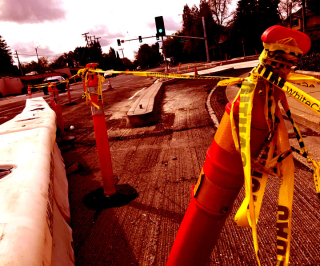
Some Davis residents have pointed to the problems with the Mace Boulevard Improvements (stylized as the “Mace Mess”) and the delays caused by the Cannery grade-separated crossing project on Covell near L Street as two examples of significant contributions to increased traffic congestion in Davis. (see the prior Davisite articles HERE and HERE and HERE, in the Enterprise HERE and HERE, as well as in a Davis Vanguard comment thread.
The difference between the Covell and L project and the Mace project is that the lane reduction due to construction of the Cannery grade-separated crossing is temporary. Once the construction is completed Covell will return to two vehicle lanes each direction plus the enhanced and protected bike/ped lane. In the case of the Mace project, what was originally five vehicle lanes plus two bike/ped lanes will permanently become three vehicle lanes plus four bike/ped lanes.
Further, the Cannery grade-separated crossing had extensive public hearings, several at the Council level, so there was plenty of discussion/exposure/debate of the design alternatives, with a very clear disclosure of staff’s objective for the project. In the case of the Mace project the public meetings were quietly held over 5 years ago. The objectives of the project were not discussed/exposed/debated at even 5% of the level that the objectives of the Covell-L project were.
— The objective to convert Mace from an arterial to a neighborhood street was never discussed. It was presented fully formed by staff to the Bicycling, Transportation & Street Safety Commission (BTSSC) on April 9, 2015, the Staff Report of which can be accessed HERE.
— The objective to reduce the customary speed of vehicle traffic on Mace from 40 MPH to below 25 MPH was never discussed anywhere outside the two BTSSC meetings (one in 2015 and one on July 12, 2016, the Staff Report of which can be accessed HERE.)
— The plan to exclude the County portion of the Mace right of way was never discussed (with either “these South Davis people” or the County Supervisor or the County Public Works staff) at any time.
— The plan to exclude the first 15 feet of westernmost portion of the right of way in the City was never discussed with the public. Members of the BTSSC might have been aware of that plan.
— The plan to go from two bike/ped lanes in the existing design to four bike/ped lanes was never clearly discussed at any time with the public in the past five years.
— The plan to go from five vehicle lanes (four thru lanes and one protected turn lane at the traffic lights) in the existing design to three vehicle lanes (two thru lanes and one protected turn lane at the traffic lights) was never clearly discussed at any time in the past five years. It was presented by staff in the BTSSC project documents, but there was no public discussion.
— Other than the two BTSSC meetings, the last public discussion of the design prior to the commencement of construction was prior to 2013
— No one who lives east of Mace ever received a notice from the City about the project or the BTSSC meetings. No notices were sent to anyone who lives in the County, and the owner of the commercial building on the southeast corner of the Mace-Cowell intersection, which is in the City, stated in the January Fire House meeting that he did not receive any notice about the project.
— The County was not given any notice by the City, so the County did not have any opportunity to send County residents notices. The County was also not invited to participate in either of the City’s two BTSSC meetings.
— The Acting Fire Chief at the January meeting at the Fire Station told the people in attendance that he had not been involved in the planning of the project. He reported to the 100+ people in attendance that any planning was before his time and that the background briefing that he received when he arrived in Davis to assume Fire Chief duties.
— It is reported that no one who lives in the City off of Cowell east or west of Mace was notified.
So there are a myriad of reasons why the Covell-L project and the Mace-Cowell project are apples and oranges.
————————————
When one reads that recap of events, what jumps out in bold relief is the almost total lack collaboration between the City and the County on either planning the design of the 95-foot right of way that they share, or with respect to citizen impact and noticing . . . a responsibility they share as well.
The BTSSC meetings/discussion would not have generated much in the way of public participation, but that point does not address the fact that any BTSSC noticing and discussion would cover only City residents. It also does not address why the project ignored and/or wasted the County portion of the right of way.
If the City and County had collaborated with one another, the project could have accomplished all the goals stated in the City/BTSSC documentation, and at the same time continued to have two northbound vehicle lanes in addition to the fully protected cycle track (which currently occupies one of the vehicle lanes).
A lack of collaboration is a recurring theme for the City. In this case it is collaboration between the City and the County. In the February 5th Broadband contract item that was placed on the Council consent calendar, and then pulled because City Information Technology staff had not worked with City Economic Development staff or City Finance staff or the City Broadband Task Force.
A similar example happened in the December 4, 2018 Council consideration of the results of the Solid Waste Rate Study, which proposed a 41% increase in rates. When Will Arnold made a motion directing staff to come back with some additional analysis that might have saved ratepayers some money, which all five Council members supported, Public Works staff explained that doing that fiscal analysis would mean the Prop 218 notices, which were fully designed and ready to go to the printer the next day would have to be scrapped and delayed. Clearly there was a lack of collaboration between Public Works staff and Finance staff … and the net result was that Will Arnold withdrew his motion and the rest of the Council concurred and the ratepayers probably paid higher rates as a result.
The lack of collaboration between Open Space staff and Economic Development staff (as well as the Open Space and Habitat Commission and the Innovation Park Task Force and the Business and Economic Development Commission (BEDC)) resulted in the Mace 391 consent calendar controversy and community polarization.
Council recently did away with the inter-Commission liaisons. Travie Westlund, the Recreation and Parks liaison to FBC, was a very thoughtful, productive and proactive participant in FBC discussions. That was both efficient and effective, but it, and other similar collaboration is no more.
I could go on, but you get the drift. The question is, do we as citizens and taxpayers need to decide whether we want a local government that is collaborative, efficient and effective.
———————————————
The key to arriving at a good solution of the Mace Mess is collaboration. What can collaboration look like going forward on the Mace project?
One possibility is to have two vehicle lanes going north and one vehicle lane going south. That would leave a pedestrian-only 10-foot sidewalk on the west side of Mace and two protected bike/ped lanes, in addition to the total of four vehicle lanes (two northbound, one turning, and one southbound).
I also really like Sharla Chaney’s idea for converting the I-80 on-ramps at Mace into an extended “chute” configuration like the one at the intersection of I-80 and I-5. The extended on-ramp cuing capacity that such a configuration would provide would “draw” additional cars off of Mace, both northbound south of the Chiles Road intersection and southbound on the Mace Overpass and Mace-Covell curve.
One of the pre-conditions for any consideration of a reopened MRIC application could be funding of Sharla Chaney’s idea by the MRIC project.

 Davisite
Leave a comment