

 by Christy Corp-Minamiji
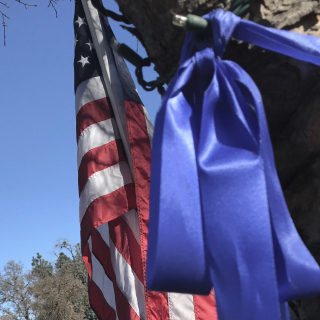
I've been thinking a lot about symbols the last few days. They've been everywhere — blue ribbons and "Blue Lives Matter" flags stipple my hometown like dotted lines perforating the blocks; pink pussy hats fill videos; red ball caps framed the faces of young men mocking a Native American elder.
The thing with these symbols is they all cause pain to some, and bring feelings of belonging and support to others. None of these is "just a hat", "just a flag," "just a ribbon."
Symbolism digs deep into our DNA. It touches how we think, feel, and connect with others. Symbols give us a shorthand for the things we cherish — identity, our sense of the sacred, unity, and connection.
A flag is not just a piece of cloth. A cross is not two boards affixed at right angles. A star is more than two triangles.
Symbolism is ingrained in our minds before we can read, before we learn to question what we see or are told. They comprise our first understandings of the social contract. Red lights mean stop because everyone agrees to stop when they see them. They only work when everyone agrees on the meaning. So what happens when this shorthand fails or is weaponized?
Pink pussy hats seem harmless, cute in a subversive way. But that symbol causes real harm to those women who are not included. Those whose genitalia isn't any shade of pink, or who possess the "wrong" genitals to fit the hat — they are excluded, marginalized, and shunned once again.
The MAGA hats aren't just headgear. To those who wear them they speak of a sense of belonging, of dreams deferred. To many, however, they speak of racism, terror, misogyny.
If symbols hold the power of the sacred, we have to also acknowledge their relationship with the profane.
A cross symbolizes redemption — until it is used to remove children from their lands and homes, until it is burned on a lawn, until it sparks invasion or torture.
A six-pointed star symbolizes a rich history, connection, and faith of an often-displaced people. Yet, placed on yellow cloth, it became a mark of death; woven in blue on a white field, it means loss of home and life to many.
A flag woven in primary colors with 13 stripes and 50 stars represents deeply complex and often conflicting concepts of freedom and unity. Drained of its color and striped down the middle with blue, those ideologies become more complicated and simultaneously sacred and profane depending on one's uniform, skin color, or personal experiences.
If symbols foster inclusion, we must acknowledge the flip side, not merely exclusion, but ostracism.
A weapon's capacity to damage is independent of intent. The penetration of the bullet, slash of the blade, char of the flame can all destroy equally by intent or by accident.
A color-stripped flag symbolizes the support of those having chosen a life of service to those on the inside. To many, however, it speaks of state-sanctioned genocide.
When we wield symbols we cannot speak and think only of our intent or only of the meaning to those on the inside. In any societal interaction, whether we use words, pictures, rocks, flags, or guns, we are responsible not just for our intentions but also for the outcome.
It is particularly incumbent upon those of us in the privileged middle to question, understand, and weigh the power of the symbols we use.

 Davisite
Leave a comment