

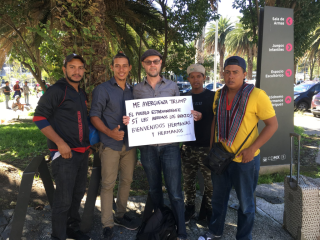
Yesterday I had the unique opportunity to meet up with migrant caravan that has been traveling up from Central America.
By Nick Buxton
This is a long post but I wanted to share the experience.
Of course, if you believed the news or some political leaders I was about to go and meet up with a gang of criminals, terrorists and armed invaders. But it’s that racist rhetoric and politics of hate that made me determined to go to show my solidarity and support and my opposition to the hostility towards migrants that dominates the airwaves. So I wrote a banner in Spanish that translated roughly says “Trump is a disgrace. But from the peoples of the US we open our arms to you. We welcome you brothers and sisters #WorldwithoutWalls” I walked into the stadium holding the banner initially a little shyly, but then more confidently aloft so everyone could understand why I was there.
I have been in Mexico City for the last few days for a forum that by coincidence was on the theme of migration, when I learned that the caravan had just started to arrive in a stadium at the edge of the city. So I decided to go and visit in the last few hours of my stay in Mexico.

Then a middle-aged woman, Ana Luisa from Guatemala read the banner and threw her arms around me and gave me the most fierce beautiful hug I have ever had. She cried – and I did – as she told me that she had traumatic experiences but that all along her journey she had met people who have shown them love and care. And that it gave her the courage to keep going. “There are good and bad people everywhere”, she said.
It echoed what I heard this week of stories of towns pooling their money to feed the caravan, of the thousands who come daily to provide clothes and food, even of one village where women every morning get up to throw food into a train carriage carrying migrants they never will even meet.
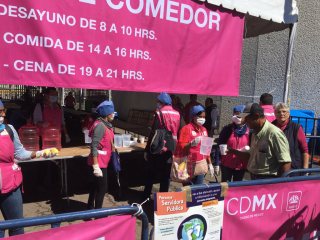
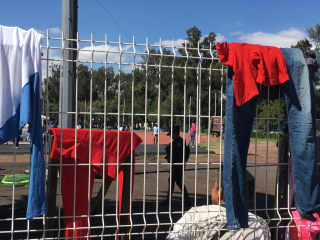
As I walked further into the stadium, there were queues of people receiving food from the municipal government, children playing and balancing on walls just like my six year old does, families washing clothes, men stripped to their waist shampooing their hair next to giant tanks of water. The majority were young men, but I saw families, women, kids, one guy in crutches. Everywhere, people would stop, read, smile and give me the thumbs up or ask to take a photo of me. Many looked tired not surprisingly, others seemingly relaxed and indistinguishable from the volunteers helping out.
Soon a big group had gathered around me. I was asked if Trump would really shoot at them if they came to the border. I said I didn’t know but it was a possibility (border guards already have killed migrants). I was asked if people in the US would really welcome them. I said many would but that others wouldn’t because of the racism and media and politicians fomenting fear. I was asked if people in the US help refugees and could come to meet them at the border. I said I understood groups were organizing in this way but what they could do against an armed police is unclear.
The hardest question to answer was whether they had any chance of getting into the US. I knew deep-down from the stories I have heard over the last few days that some may not even get to the border, let alone the US, given the violence and wave of disappearances in some of the states between Mexico city and the US border. Many have died even after crossing the border in the harsh desert landscape or crossing rivers. I know from other stories that I have heard both in Mexico and California that even if they make it to towns in the US, many could end up being detained in prison for months or deported. Those who stay may end up in exploitative jobs, paid terribly, or underemployed because their undocumented status makes them so vulnerable. The American dream is not much of a dream for a large number of its citizens. But I found it impossible to say any of this when I could see in their eyes a mix of exhaustion, determination and hope that US might offer a better future for them.
So instead I asked them what their message would be to my friends in the US. One man, Luis, said that he hoped the people of the US would understand that they are not criminals, but human beings that had to leave their country because there is no future there. He told me of the corrupt politicians who receive money and support from the US government and steal it and who have overseen a huge rise in crime and killings of ordinary people. He and a number of others said, we come to the US not to take things but to work hard for a dignified life and for money for our families. I promised to take these messages back.
I left the stadium to take a plane back to California. I couldn’t help feel guilty at the perverse irony. Here I was – thanks to the privilege of my birth country, skin colour and class – able to fly in a few hours over the militarised border that they will take weeks to walk to and may never cross. We live in a world where so much of life’s chances rides on profit and privilege.
Trump has tried his worst to make it a specter, but the power of the migrant caravan is that those who seek a different life are coming together, making themselves visible, using numbers as a way to resist criminal gangs and military abuses. I heard the word ‘exodus’ used a number of times – a powerful metaphor from the Bible of the Jewish people escaping slavery. I feel certain – due to the toxic combination of US’ decades of intervention in Central America on the side of its corrupt elites (supporting death squads, imposing trade deals, drug war etc etc), the corporate looting of the region, deepening inequality, and now the growing impact of climate change that we will see many more exoduses in years to come.
How we will respond?

 Davisite
Leave a comment