Davisite Banner. Left side the bicycle obelisk at 3rd and University. Right side the trellis at the entrance to the Arboretum.

Month: September 2018

  • Is this really your view on Measure L, Davis Enterprise?

    Davis enterpriseIs this really your view on Measure L, Davis Enterprise?  Because I'm having trouble believing the words in front of my eyes. 

    Did you really write, "If WDAAC gets built and all the white Davis seniors move into it, then it will give more opportunity for minorities from out of town to move into the single-family houses the seniors vacate"?

    In other words, it would be OK if WDAAC were composed completely of white Davis seniors?  And the reason it would be OK is that nonwhite individuals would have the "opportunity" to move into the vacated houses formerly occupied by white individuals – even if the nonwhite individuals didn't have the opportunity to move into WDAAC itself?  Just the bare possibility that "minorities" could move into Davis would be enough to justify an exclusionary program?

    (more…)

  • What Are “Internal Housing Needs” in Davis?

    “That directive and those words means something!” — David Taormino on Measure R, 9/19/2018[1]
     

    Header-1

    By Rik Keller

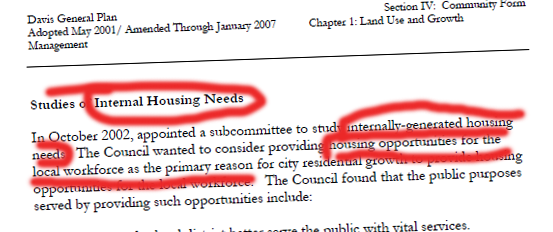
    Measure R (the “Citizens’ Right to Vote on Future Use of Open Space and Agricultural Lands Ordinance”) was passed by the voters and adopted by the City of Davis in 2010. Davis Municipal Code Section 41.01.010(a)(1) states that the purpose of the Ordinance is [my emphasis] “…to establish a mechanism for direct citizen participation in land use decisions affecting city policies for compact urban form, agricultural land preservation and an adequate housing supply to meet internal city needs…”

    This article will examine what the phrase “adequate housing supply to meet internal city needs” means. First, while the word “need” is used several times, “internal needs” is not further mentioned in the adopted ordinance or in the ballot language that went to the voters (ballot language is purposely streamlined). Is this sui generis language that just appeared out of nowhere? Can it mean that any type of housing is sufficient to meet some sort of undefined “internal need” in Davis and should be allowed to convert agricultural lands? Measure R does state that “continued conversion of agricultural lands to meet urban needs is neither inevitable nor necessary,” so the Ordinance must have some criteria in mind to achieve this goal of not unnecessarily converting ag land, right?

    As will be demonstrated in the following, the phrase “internal housing need” as used in City of Davis policy framework, documents, and studies actually refers primarily to low and moderate income workforce housing, and indeed that category is the only one specifically mentioned and for which specific policies have been crafted to meet the need.

    (more…)

  • Bob Dunning’s False Equivalency Regarding the Testimony of Christine Blasey Ford and Brett Kavanaugh

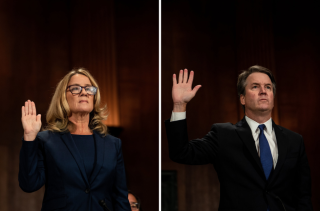
    Ford-kavanaughAlthough Bob Dunning and I agree on one thing (that Dr. Blasey’s testimony was “compelling and believable without holes or hesitation”), I otherwise find much to disagree with in his recent column in the Davis Enterprise, “Truth gets lost in the crossfire.”  In particular, I object to his casting this as a purely political disagreement, where Republicans are taking Brett Kavanaugh’s side and Democrats are taking Christine Blasey Ford’s side, where “reasonable people can disagree over which person they believe,” and where “if everyone in America believed that Judge Kavanaugh had assaulted Dr. Ford, he would not be confirmed.”

    Maybe the debate over Kavanaugh’s nomination started out as a purely political disagreement a month ago, but it stopped being that the moment that Dr. Blasey came forward with her testimony of sexual assault – her testimony that, 36 years ago, Brett Kavanaugh laid on top of her, tried to rip off her clothes, covered her mouth so that she couldn’t scream and couldn’t breathe, and then laughed about it.  And that the only thing that saved her was that he and his buddy, Mark Judge, were too drunk to follow through on what they had begun.

    (more…)

  • Will There be No Place in Davis for Low Income Seniors

    By Bill Powell and David Thompson

    “Each day I get five calls from low income seniors looking to find housing in Davis” says Susan at Shasta Point Retirement Community. “And each day at least one senior arrives at Shasta Point anxious to get housing and hoping by turning up they may have a better chance than just calling.” They don’t.

    Every day there are five to 10 emails or phone calls from low-income seniors to the two staff members at Eleanor Roosevelt Circle. At ERC about three seniors per day walk through the door hoping to get a place. They can’t.

    In 2018, there is a waiting list of 441 seniors for the four largest Davis affordable senior communities; Davisville (70), Shasta Point (67), Eleanor Roosevelt Circle (59) and Walnut Terrace (30). In 2017 there were a total of 14 turnovers. Only 14 of the 441 waiting in line got in. At that rate it would be 31 years before the last of those seniors get housed. The actual wait for an extremely low-income senior can be from three to five years.

    (more…)

  • Santa Clara County secures massive funding from Stanford University

    The headline in the Daily Post (#1 in Palo Alto and the Mid-Peninsula) is

    "STANFORD HIT WITH HOUSING BILL"

    ….. and then underneath

    "$155.8 million for expansion".

    Yes,  you read that correctly, Stanford is paying Santa Clara County over $150,000,000 for permission to expand.

    This is such good news.  The money goes to affordable housing in the County exchange for expansion of academic buildings associated with Stanford University.

    Bravo Santa Clara County!

    There is also an additional requirement to build affordable housing on campus.

    Gosh, it is so refreshing when a university provides valuable resources (like cash) to the local areas where it is located.  

    Way to go Stanford!!

    John

  • That housing deal among UCD, City of Davis, and Yolo County

    To be sure, I am still learning about this "deal".  And I am willing to be enlightened.  So, my comments are preliminary….. but concerned.

    It seems like the deal is totally future oriented.  That is, it takes a "go forth and sin no more" form of agreement i.e. it only pertains to the students who come to this area due to the (additional) incremental growth of the University.  That is often a good approach, sometimes makes it easier to come to an agreement.  Particularly if parties are inclined to maintain previously entrenched positions.  *

    But how about the 20,000 "temporary occupants" who are already inhabiting Davis and nearby towns? By this I refer to undergraduates who should be housed on campus who currently live in the community and drive rental rates up and availability of housing down. I don't mind if grad students are living in the community, that's fine. It is not unusual for "adult learners" to continue to live in the communities that contain the university where they did their grad work.

    (more…)

  • Downtowndavis.org and Downtown Parking

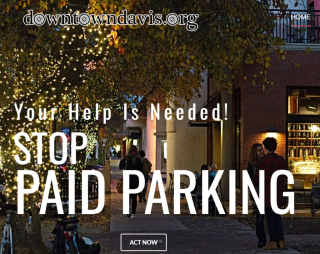
    WebsiteLocal businesses want parking.

    By Colin Walsh

    A new organization is growing in Davis. A group that is feeling shut out of Downtown planning. They are not your typical old Davis activists accused of protesting everything instead they are at the very heart of the downtown economy – Davis business owners. You can find them at downtowndavis.org

    The website makes it clear what has this new group rising, "STOP PAID PARKING," and "ACT NOW."

    (more…)

  • Davisites’ attitudes towards Kavanaugh, Thomas, #metoo, #whyIDidntReport

    I posted a link to this Davis Media Access video to the Davisite Facebook page a few days ago, but I can’t get it out of my head.

    In the video, you see men supporting (now Supreme Court justice) Clarence Thomas, and men supporting Professor Anita Hill.  You see women supporting Thomas, and women supporting Hill.  But most of all, you hear exactly the same arguments on both sides that you are hearing in the media today concerning Supreme Court nominee Brett Kavanaugh, who is now facing three separate sexual assault accusations: one from Prof. Christine Blasey Ford, one from Deborah Ramirez, and one from a number of as-yet-unnamed women who lawyer Michael Avenatti is representing.

    If DMA were to redo those interviews in Davis today – in the #metoo #WhyIDidntReport #BelieveSurvivors era – would the results be much different?

    I’d like to hope that they would be.  But I fear that they wouldn’t.

  • Planned West Davis Adult Community, if Approved, Would Perpetuate Racial Imbalance in the City of Davis

    Complaintimage(Press release) The proposed restrictive West Davis Active Adult Community on the City of Davis’ November 6 ballot which advertises its purpose as a planned community “Taking Care of Our Own,” is being challenged in federal court because it will perpetuate racial imbalance and discriminate against minorities by restricting sales to residents of Davis

    In a federal complaint filed Monday, September 24, by Sacramento civil rights attorney Mark E. Merin, plaintiff Samuel Ignacio, a Filipino/Hispanic senior on behalf and all other minorities outside of Davis, seeks to stop the project because it excludes those living outside of Davis from buying most of the 410 planned for-sale units.

    Davis, a city whose senior population is disproportionately “white” as a result of historic racially restrictive covenants, red-lining practices, and previous University of California hiring practices, approved the project with 90% of its units restricted to “purchasers with a preexisting connection to the City of Davis.” The result of this “local resident” restriction, as alleged in the civil rights complaint, is the continuation of a racially imbalanced community and the exclusion of minority would-be purchasers in violation of the Federal Fair Housing Act.

    (more…)

  • How White Is Davis Anyway? A Comparative Demographic Analysis

    Part Two in a series, this article examines historic racial/ethnic demographics in Davis compared to surrounding areas and California as a whole in order to determine what sort of effect historic patterns of discrimination may have had.

    "The Past Isn't Dead. It Isn't Even Past"

    By Rik Keller

    The first installment of this series, “Why Is So Davis So White? A Brief History of Discrimination”, provided an overview of mortgage loan redlining, restrictive covenants, and other discriminatory housing practices in the U.S., with examples from Davis showing the extent of overt discrimination in housing practices that led to excluding non-white populations from specific areas.

    The article concluded with a brief summary that described how In Davis—as in many areas of the U.S.—redlining, restrictive covenants, and other discriminatory practices effectively locked out minorities from being able to participate in one of the greatest mass opportunities for wealth accumulation in U.S. history: the post-WWII housing boom. And even as overtly discriminatory practices started to be curtailed, post-WWII municipal zoning practices in the 1950s— especially in fast-growing suburban areas—emphasized large-lot single-family homes as a way to exclude more affordable housing types and to continue patterns of racial/ethnic/income segregation. One common misconception when discussing housing is that discrimination in the U.S. ended some time in the 1960s. Davis is an example of how the wealth disparities that were accentuated by these policies and practices persist today with residential patterns and housing opportunities distributed along particular racial/ethnic lines, along with ongoing discrimination.

    (more…)