

 The Yolo County Chapter of the ACLU invites you to:
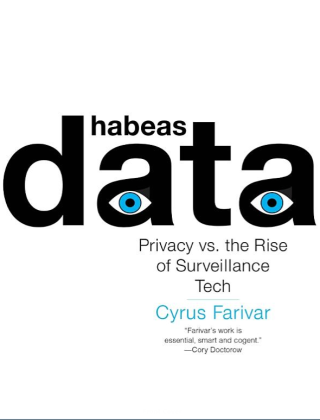
"Habeas Data: Privacy Vs. the Rise of Surveillance Tech" – A Book talk by Author, Cyrus Farivar
This talk is part of the Yolo ACLU's ongoing exploration of how communications technologies also become surveillance technologies that can affect us all.
Join us on July 18th, from 7-8:30 pm at the Davis Branch of the Yolo County Library in the Blanchard room.
This event is free, refreshments will be served, and the book will be available for purchase.
Show me the data! Until the 21st century, nearly all our activities were private by default, and public only through effort; today anything in digital space has the potential (and likelihood) to remain somewhere online forever. That means all the technologies that have made our lives easier, faster, better, more efficient have also simultaneously made it easier for others to keep an eye on our activities as well. In 10 crucial legal cases, "Habeas Data" explores the tools of surveillance that exist today, how they work, and what the implications are for the future of privacy.
The Yolo County ACLU has addressed this issue with its proposed city ordinance to make purchases and use of surveillance technologies by the Davis Police Department both public and transparent. That proposed ordinance is still being considered by the Davis City Council.
Cyrus Farivar is a Senior Tech Policy Reporter at Ars Technica, as well as an author and radio producer.
His second book, Habeas Data, about the legal cases over the last 50 years that have had an outsized impact on surveillance and privacy law in America, was published May 8, 2018 from Melville House.
In 2017, Cyrus Farivar and Joe Mullin won the Technology Reporting award from the Society of Professional Journalists, Northern California Chapter for their August 2016 story: “Stealing bitcoins with badges: How Silk Road’s dirty cops got caught.” Cyrus’ first book, The Internet of Elsewhere—about the history and effects of the Internet on different countries around the world, including Senegal, Iran, Estonia and South Korea—was published in April 2011. From 2010 until 2012, Cyrus was the Sci-Tech Editor and host of “Spectrum” at Deutsche Welle English, Germany’s international broadcaster. He has also reported for the Canadian Broadcasting Corporation, National Public Radio, Public Radio International, The Economist, Wired, The New York Times and many others. He is based in Oakland, California.
Wikipedia link about the phrase "Habeas Data": https://en.wikipedia.org/wiki/Habeas_data .

 Davisite
Leave a comment