

 By Sadie Fulton
The most memorable moment of the entire tour was looking at the child’s eyes through the glass. He looked nervous, curious and resentful all at once.
We weren’t allowed to meet the children, so this is all the contact I had with them. One young teenage boy staring out at me from his bedroom. All the kids were locked in their rooms, presumably, to allow us to tour what was basically their living room.
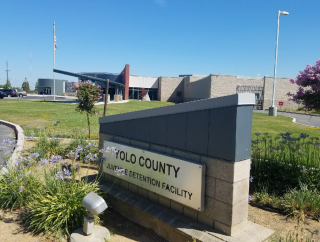
This teen boy that had presumably traveled thousands of miles to be locked away in Yolo County was in a cell in what the warden referred to as a “pod,” which is really a somewhat nice cell block. We were shown two of three “pods”, on the tour of the Yolo County Juvenile Detention Facility, which is under contract with the controversial Federal Office of Refugee Resettlement (ORR). Each “pod” had a seating area, some colorful chairs that looked like a plush sofa except that it was made of plastic and had no cushions. They had a huge mural on the wall.
The first pod we toured contained a mural of a timeline which we were told previously incarcerated teens had helped design. On the left was a jack-in-the-beanstalk feeling drawing of disfigured humans dancing around large vines. That gave way to a middle section, a giant field, and someone at the bottom. We were told that the first section depicted life on drugs and out of control, the middle section was the incarcerated kids coming to their senses and thinking more about their futures. The third of four sections, off towards the right, was a picture of a visitation area. We had seen this visitation area earlier on the tour – a grim place, with panels of glass and phones, much like what you see in the movies – and were told to expect to see something better at the end of the tour. This section of the panel was apparently added by the mural designers as depiction of their least favorite part of incarcerated life. The fourth section showed a series of open doors and represented the freedom they hoped to find.
We were told that this was the probation officer’s least favorite mural due to some of the more bleak themes in it, and he was eager to show us another, more hope-inspiring mural. That’s how we came to be ushered into the other ‘pod’, where I saw the boy. It’s true that the other mural was more inspiring. It depicted a phoenix rising.
—
Just 48 hours earlier, Josh Jones and I sat in on the Yolo County Board of Supervisors hearing for this center. It was a controversial event – with the entire world looking at the atrocities taking place on the US Border, photographs of traumatized young children behind cages shocking us all, our sleepy little community suddenly seemed to realize that right in our backyard is one of only a few juvenile detention centers used by the Office of Refugee Resettlement (ORR) to house refugee children who had been deemed a threat to themselves and/or to others. In the middle of this, the ORR’s contract with the Yolo Juvenile Detention Center was up for renewal at a vote with our county supervisors.
At the hearing, the Yolo Interfaith Immigration Network, frequent volunteers at the center, spoke strongly in favor of maintaining the center. Their reasoning was that the teenagers being kept at it would be moved to the Shenandoah facility in Northern Virginia, a facility dogged with allegations of abuse and harassment. Many other community members stood up and argued that these children should not be detained at all, that the detention will ultimately harm them much more than it could possibly hope to help them.
The motion to renew the ORR program at the center passed 3-1, with one supervisor having recused himself.
Josh then chased down the Chief of Probation and Juvenile Detention Center to ask that we be allowed to tour the center and get the information out. As a result, a few days later, we were escorted through one of the flash points of national politics, right here in our backyards.
—
 Our tour started when we were greeted at the door of the Juvenile Detention Center, asked to leave everything behind except our car keys and a couple small notebooks, and given a stack of paperwork to sign. A non-disclosure agreement – no names, no crimes were ever to be given. Another form insisted that we limit any contact with the kids to handshakes or fist-bumps, that hugs were not permitted. As a matter of course that never happened. Though our party of four had a person fluent in Spanish, we were never allowed to see or speak with the incarcerated youth.
The children at the Yolo Juvenile Detention Center are 15-17 years old. They are all boys. Just over 20 of them are sent from the ORR, the Office of Refugee Resettlement, and the other fifteen or so are local Yolo kids who’ve been charged with crimes. They are kept in three “pods” – one of pod of only ORR kids, one of only Yolo kids, and one mixed group that contained some yolo kids and some ORR kids , (currently with three of one and two of the other). The officer claimed that care is taken to ensure the more dangerous kids are separated from the less dangerous ones, but it is somewhat unclear how that is done within just 3 pods that are more organized by origin. As the social worker was keen to point out, when lower risk teens are mixed with higher risk teens, the negative influence is stronger than the positive one, and the result is damaging to the lower risk teens.
We were led through the corridor and shown a visitation area that looked more like a sparse version of an IKEA Playroom than a prison visitation area. I was pleasantly surprised. It was designed for juvenile detainees who were also parents to meet their children, “because children sometimes have children,” as the probation officer pointed out.
Moments later we were shown the bleak visitation area previously mentioned, as well as some initial holding cells where teens wait while they are processed. They were dismal little rooms with seating built into the walls and small silver toilets in full view.
From there we were guided to a library, which was a surprisingly lovely little space with maybe 10-15 bookshelves including one smaller bookshelf of Spanish books and another smaller one of non-fiction. (One way to help is to donate Spanish books to the center – they say they have had too few donations of these books to have a selection as large as they’d like). The teens have access to this room a few times a week, and the room is also used for individual meetings with their attorneys.
We were shown a medical area, which looked not unlike most medical areas – sanitized, with clean walls and gloves and hand sanitizer sprinkling the area. It smelled strongly of disinfectant and possibly blood.
It was after this point we were led to see two separate pods. Again, a pod is a 30 room high security prison space. Other than the murals, each one was a two-story space with a high-ceilinged common area, bedrooms/cells on the one side, classrooms on the other. There were several showers, each an individual space with a small, half-height door similar to those often found in public restrooms. When we visited Pod C we we told the kids were in one of the pod classrooms. Part of each pod are many showers and two classrooms. In the other pod, the kids had been ushered into private rooms (locked in their cells? Quite different connotation, but same meaning!) to allow us to see the other mural.
I took great interest in looking at their schedules, which were pinned to a notice board. Wake-up time was 6:15 AM Monday-Friday, and on Saturdays and Sundays they had the option of sleeping in until 7:30 AM. Their days were packed with classes and activities. Movie night once a week, PE several times a week. Their weekly menu was listed, too, and a cursory glance showed ham sandwiches several times a week, a reasonable amount of variety, but no options. I noticed YIIN marked in for a few hours, once a week – that’s the visit from the Yolo Interfaith Immigration Network, mentioned above. I don’t know whether YIIN visit the local detainees too, or just the ORR kids. I was also quite pleased to note that their movie that week was Black Panther.
On an aside, we were also told that several times a day the staff have a shift-change, at which point all the kids are locked in their rooms while the staff debrief on ongoing situations to monitor, progress, etc. I recall that this process takes about half an hour each time.
After seeing the pods, we were brought outside and down an outdoor corridor, flanked by story-tall, multi-layer fences with translucent screens blocking much more than shadows to be seen through them, and a large layer of ringed barbed-wire along the top. This led to a recreational area with a basketball court and a small astro-turfed field.
From there we circled back to another corridor, through another locked door leading out to a less fenced, covered pathway; here you could see a sign facing outwards stating any contact with the children is forbidden. This pathway led us to a large gymnasium; by far the nicest place on the whole tour. It had plenty of space to run around, was nicely air-conditioned, had plenty of water fountains and restrooms. It also boasted a TV projector on one wall and a screen on the other. We were told this was where the kids had their movie nights. To my pleasant surprise, we also found out that this space was designed to facilitate visitation, and that sometimes families were allowed in to spend time with the detainees in the gymnasium area.
ORR children were allowed to have family visitors, though the fact that there are so few centers where they can stay means the families often have to travel a long distance to visit the detained children. We were told of one woman in Los Angeles who came up every weekend, and another family who made the trip from far across the country, stayed for a week and were allowed to visit several times that week. That being said, it's unclear how many of the ORR detained children have family who are allowed to travel the US freely, and there is no sign of any way for them to connect to family who are blocked from physically coming to Woodland, as one might expect of families without legal immigration status, or without papers.
It is highly obvious that the people running the Yolo Juvenile Detention Center care enormously about the wellbeing of the children in their facility as well as the quality of their center. They beamed when showing us the gymnasium, having just opened in the fall of 2017. The old visitation areas and more bleak elements made them flinch. The social worker was able to recite from memory where she was hoping to place the current group of children at the end of their stay – each stay averages 45 days. The center is designed to be a temporary place for them while it is identified how best to situate them going forward. Some are released to family in the USA, others are sent to family overseas. The implication is that the young detainees get a say in where they are released to.
That being said, the reality of the site is that it is essentially a prison, and information about why the young people are being held there is unavailable except for the ambiguous assertion that “everyone who is here, is here because it has been determined that they are a risk to themselves or others”. I can’t help but wonder whether that means that a suicide attempt is grounds for internment there. It’s also unclear whether any allegations against them have to have been committed in the United States, or whether actions taken in a war zone in attempt to survive, before fleeing and seeking asylum, can also count as grounds for detention.
I was left at the end of the tour with more questions than answers.
Where are the girls kept? What happens to them?
What is the nature of the charges against these boys?
How does being a non-citizen impact their treatment? How many of them would have been incarcerated even if they were citizens? The only thing we know for sure is that non-citizen juvenile detainees are transported much further from their families than other juvenile detainees.
Sadie Fulton is Chair of the Yolo County Green Party and a former volunteer with refugees in Calais France. Photos by Josh Jones.

 Davisite
Leave a comment