

 by Colin Walsh
The City of Davis Social Services Commission will be considering a new "Proposed Mobile Home Park Closure, Cessation, or Conversion Ordinance" at 7pm this evening in the Community Chambers.
Preserving mobile home parks is a strategy to continue to provide cost effective housing that is not currently covered by local, state or federal Affordable Housing programs. It is difficult if not impossible to offer the mobile home park residents anything comparable if a park closes.
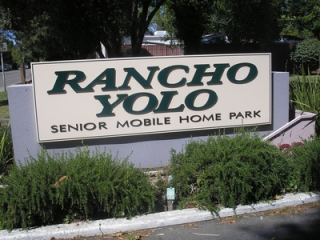
The 4 Mobile home Parks in Davis, Rancho Yolo, Slater's Court, Davis Mobile Estates and 1502 Olive Drive all provide low cost housing. Together they represent over 400 homes.
All 4 of these parks are located very close to large new developments. Rancho Yolo is across the street from the massive new Sterling Apartments that are currently under Construction, while the 3 other parks are on Olive Drive near the recently approved Lincoln 40 and the Embassy Suites Hotel project. These 3 projects all represent the types of development that could replace the mobile home parks and provide the land owner considerably larger profits from hotels, for-sale homes, apartments or commercial use.
The new ordinance states 3 purposes:
(a) Establish procedures and standards to govern the closure, cessation, or conversion of an existing mobile home park to another land use;
(b) Mitigate the impact of such closures, cessations, or conversions on displaced residents
who may be required to relocate; and
(c) Encourage the preservation of affordable housing.
The ordinance itself clearly defines how it will achieve (a) and (b) but the words “preserve” or “preservation” never appear in the ordinance again.
My assessment of the ordinance is it may actually do more to assist in the closure of the four mobile home parks in Davis than to aid in their preservation.
The new ordinance sets out a straight forward procedure for closing mobile home parks.
First, when the owner or their representative applies to redevelop the park, they first must pay for the city to hire an outside consultant to assess the relocation impact and write a report.
Second, the developer is required to have 2 meetings with the residents of the mobile home park slated for closure. It is notable that there is no requirement to meet with the residents until after the developer has decided to close the park and likely submitted a new development plan for the property. In the Davis mobile home parks, some of the tenants have lived there for more than 20 years. They are unique communities in Davis and deserve to be treated respectfully.
Third, the City will convene a Resident’s Advisory Commission of not more than 5 members. There is no language as to how these members are selected, so presumably they will be chosen by the developer or the city rather than elected by the mobile home park. This advisory commission's purpose is to "work closely with the City, applicant, and consultant during the closure and/or conversion process to ensure park residents are adequately represented, involved and informed." These advisory commissions should be set up well in advance of a decision to close a mobile home park so they could participate in the process and have the possibility of avoiding closure. The ordinance could even set up these advisory groups up right away.
The relocation report then goes to the commission system for consideration and approval based on 10 factors. The 10 factors look to the ability to relocate the residents to another location within 50 miles. In the case of Davis, this would mean that, residents could be expected to move to Zamora, Capay, Esparto, anywhere in Sacramento, or Vacaville. Given there is so little comparable available housing in Davis it is likely Davis mobile home residents would likely be moved to these far-flung places.
This seems a significant hardship on mobile home residents forcing them to move many miles from their jobs and social networks. Many Olive Drive Mobile home residents do not own cars making such a relocation particularly impractical.
The relocation factors also include making sure the mitigation plan is consistent with the general plan and zoning and if "Based upon the mitigation measures imposed, if any, whether the proposed conversion will be detrimental to public health, safety, and general welfare"
The relocation plan includes language about assessing residence relocation costs and what appropriate lump sum payments might be made to residents forced to move, but it is unclear how these payments will be calculated or if they will actually legally be required of and agreed to by the developer.
No part of this process outlined in the City ordinance details how the parks will be "preserved" to maintain affordable housing only how the parks can be closed and the residents moved most likely out of Davis. At it's worst, this appears to be a playbook for gentrification of existing neighborhoods.
There are other better ways to preserve Mobile home parks. The Western Planner, Journal of Planning recommends 4 strategies:
"Creating a specific zoning district"
Davis already has a mobile home zoning designation, but only Rancho Yolo has that zoning designation. The 3 parks on Olive Drive are zoned in the Gateway/Olive Drive Specific Plan as other residential designations.
“Offering financial incentives”
Agreement with financial incentives can be offered to mobile home park owners in exchange for guarantees that they not be redeveloped for set periods of time. There is no money budgeted for this currently, but it could have been required of the Lincoln 40, Sterling, Nishi or other new developments as part of the project development agreements. Future developments near existing mobile home parks could have this requirement.
“Providing an opportunity to purchase”
In some instances, mobile homes have been purchased by their tenants. Western Planner states that “Ownership of the park itself grants a very high level of security to the residents that they will not be dislocated in the future without their consent.” They could even be cooperatively owned and managed.
“Encouraging the sale to a third party”
Non-profit housing providers or a land trust can be brought in to manage the property as affordable housing. Since these properties have been held for extended time periods, a sale of the property could trigger much higher taxes, but acquisition of the property by a nonprofit could eliminate this increased tax burden and help to keep the properties low cost.
“Facilitating the creation of new parks”
Given the limited available real estate in Davis without a Measure J/R vote this would likely mean creating a new mobile home park outside of Davis, possibly at considerable distance, or including it in a new peripheral development with a Measure J/R vote.
In Conclusion: None of these recommendations by Western Planner are considered in the proposed ordinance. Indeed by waiting for the Mobile home park owner or new developer to come to the City after they have already decided to close a park it would make it much more difficult for the City or Mobile Home residents to act on any of these solutions.


 Davisite
Leave a comment