


By Nancy Price
On this Earth Day, let’s honor Rachel Carson. Let’s remember her great masterpiece, Silent Spring, published in September, 1962. After decades of drenching the environment with DDT and other chemicals and the atomic bomb and later nuclear bomb testing, she documented and raised concerns about the massive harms to the environment and the “balance of nature” by the indiscriminate use of pesticides and to public health, emphasizing the potential for accumulating body burden and disease at any time from prenatal development throughout an individual’s life.
She questioned whether humans could obtain mastery over harmful pests by chemicals. And she accused the chemical industry of spreading disinformation and public officials of accepting industry funding. The public relations campaign launched then against her and Silent Spring by the chemical industry has never let up, only now more massively funded than ever.
Carson died on April 14, 1964. Five years later, the public was galvanized into action after two iconic disasters: the fire on the Cuyahoga River in downtown Cleveland, Ohio and the huge Santa Barbara Channel oil spill, then the largest oil “blowout” in U.S. waters, that devastated 30 miles of sandy beaches and marine life.
On this Earth Day, let’s honor Gaylord Nelson. Environmentalists and anti-war activists had had enough of disasters, four political assassinations, violence at the Chicago 1968 Democratic Convention, and Vietnam War crimes with the My Lai massacre, carpet-bombing, and Agent Orange. When Wisconsin Senator Gaylord Nelson proposed April 22, 1970 as Earth Day, 20 million people across the United States peacefully demonstrated.
On that first Earth Day, Nelson, inspired by both Rachel Carson and Martin Luther King, described his “dream” to “build bridges between man and nature’s systems, instead of more highways and dams and new weapon systems that escalate the arms race.” Nelson knew the “change” he a King envisioned called for “new standards for progress, emphasizing human dignity and well-being rather than an endless parade of technology that produces more gadgets, more waste and more pollution.”
While during the 1960s, states had passed laws to protect the environment, within three years after Earth Day, Congress created the Environmental Protection Agency, Occupational Safety and Health Administration. It also passed the Clean Air Act, Clean Water, and Endangered Species Acts, and more laws to curtain illegal toxic waste dumping, air, land and water pollution, and protect public health, ecosystems and national parks. Alarmingly, these laws to protect people and the planet are being undone by an administration that sees regulation as a threat to the free enterprise system.
On this Earth Day, let’s honor Martin Luther King. Let’s remember his most revolutionary “Beyond Vietnam: A Time to Break Silence” speech given at Riverside Church in New York City, a year to the day before he was assassinated in Memphis in 1968.
Breaking his silence, King moved from civil rights to a critique of capitalism. His envisioned “a worldwide fellowship that lifts neighborly concern beyond one’s tribe, race, class and nation.” He called for a “revolution of values” – a shift from a “thing-oriented society to a “person-oriented” society, saying, “when machines and computers, profit motives and property rights are considered more important than people, the giant triplets of racism, extreme materialism, and militarism are incapable of being conquered.” King warned, “a nation that continues year after year to spend more money on military defense than on programs of social uplift is approaching spiritual death.”
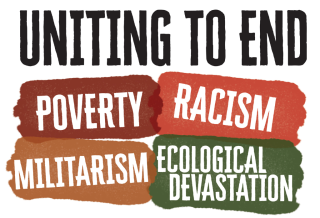
On this Earth Day, let’s join the new Poor People’s Campaign. Now, 50 years after King’s assassination, Rev. Dr. William J. Barber, Il and Rev. Dr. Liz Theoharis are taking up King’s beginning efforts, cut short by his assassination, to organize a Poor People’s Campaign, a campaign for economic rights that the civil rights campaigns of the early 60s had not been able to accomplish.
Co-Chairs Revs. Barber and Theoharis seek to unite people across the country to challenge the evils that King called out – racism, militarism and materialism – that they highlight as – systemic racism, poverty, the war economy, and ecological devastation. Adding ecological destruction brings us full circle to Rachel Carson, Gaylord Nelson, and moves us beyond King’s “spiritual death” to “change the national conversation” so as to confront the nation’s “distorted morality” with a call for a moral revival.
The aim of this new Poor People’s Campaign is to build a fusion movement. Acknowledging the validity of the many issues and “silos” we are each committed to, they are calling people to act together to build a people-centered, transformative movement for systemic change and to full realize economic, environmental and social justice based on civil and human rights, and on recognizing the rights of nature. The Poor People’s Campaign: A National Call for Moral Revival is uniting tens of thousands of people
The four interconnected themes of the Poor People’s Campaign – systemic racism, poverty, the war economy, and ecological destruction – will be highlighted each week during the 40 days of action beginning May 14 Mother’s Day and continuing through June 21st Solstice. On June 23rd, a mass rally will be held in Washington, D.C. California, among more than 30 states, has three campaign coordinators.
On this Earth Day, let us honor Rachel Carson, Gaylord Nelson, and Martin Luther King, Jr.
Learn more about, sign the pledge and join the Poor People’s Campaign at https://poorpeoplescampaign.org

 Davisite
Leave a comment